Security, privacy and compliance built into how we deliver healthcare software.
We follow recognized healthcare and privacy standards in how we design, build and run software that handles patient data. This page explains what we design to, what we do on every project and who is responsible for what, in plain terms and without certificates we do not hold.
Standards we design to. They are not certifications, and we do not claim any. ISO 27001 certification is in progress.
Compliance Standards and Regulatory Frameworks We Design To
For each standard: what it is, how it shapes our work and the safeguards that usually apply. The exact safeguards depend on your product, data flows and contracts.
HIPAA
Health data privacy and security
The US law that sets rules for protecting patient health information (PHI). It applies to covered entities and the business associates who handle PHI for them.
For projects that handle PHI, we design to the HIPAA Security Rule safeguards based on your architecture, data flows and contract. Compliance is shared: your organization, your cloud provider and our team each own a part.
Safeguards that usually apply:
Role-based access to PHI
Authentication and automatic logoff
Encryption in transit and at rest
Audit logging of record access
Business Associate Agreement before PHI access
HITECH
Breach notification and enforcement
The act that strengthened HIPAA enforcement and added breach notification duties for covered entities and business associates.
We build the logging, alerting and incident steps your team needs to detect, assess and report a breach on time.
Safeguards that usually apply:
Access and change logs you can search
Alerts on unusual access patterns
Documented incident response steps
Support during your breach assessment
GDPR and UK GDPR
Personal data protection
European and UK rules for processing personal data, including health data, which is a special category with extra protection.
For products with UK or EU users, we consider privacy from solution design onwards and keep data processing to what the product needs.
Safeguards that usually apply:
Data protection by design
Data minimization
Consent and access request flows
Data residency choices per region
HL7 FHIR and USCDI
Interoperability standards
The standards certified EHRs use to share data, including the US Core Data for Interoperability set and SMART on FHIR app authorization.
Integrations we build follow the published FHIR profiles and SMART authorization flows, so apps get only the data and scopes they need.
Safeguards that usually apply:
SMART on FHIR scoped access
US Core profiles
OAuth 2.0 and OpenID Connect
Tested in vendor sandboxes
PCI DSS
Payment card data
The card industry standard for systems that store, process or transmit payment card data.
For patient payments, we integrate PCI DSS validated payment providers so card numbers never touch your servers, which keeps most of your system out of PCI scope.
Safeguards that usually apply:
Hosted or tokenized payment fields
No card data stored in your app
Provider-side fraud and 3-D Secure
Separation of billing and clinical data
FDA software guidance
Software as a medical device
Some health software, such as features that diagnose or recommend treatment, can be regulated by the FDA as a medical device.
We do not make regulatory decisions for you. In discovery we flag features that may raise FDA questions, so your regulatory advisor can review them early.
Safeguards that usually apply:
Feature-level regulatory flags
Traceable requirements
Change history for every release
Documentation your advisor can review
How Our Practices Support Your Software Project
Standards only help when they turn into everyday engineering habits. These run on every healthcare project we deliver.
Information Security
Encryption, secrets management and dependency scanning are part of every build, not added before launch.
Quality Management
Peer code review on every change, automated tests for integrations and a release checklist your team can see.
Risk Management
Threat modeling for features that touch PHI, with risks written down, owned and tracked to closure.
Controlled Access
Least-privilege roles, multi-factor authentication and approved, time-limited access to production.
Incident Response
Named owners, a written response plan and support for your breach notification duties.
Continuous Improvement
After each release and each incident we review what happened and update the controls.
What We Walk You Through in a Security Review
Healthcare buyers and their security teams usually need to see:
Five steps that repeat for every release, not a one-time checklist.
1
Assess
Which rules apply, which data is involved and where it flows.
2
Plan
Safeguards, hosting, access model and responsibilities written down.
3
Implement
Controls built in from the first sprint, tested like any feature.
4
Monitor
Logs, alerts and access reviews running after go-live.
5
Improve
Controls updated as your product, vendors and rules change.
Who Is Responsible for What
Compliance is shared. This is how responsibilities usually split on a project hosted in your cloud account; we confirm it in writing for every engagement.
AreaYour organizationGroovy WebCloud provider
HIPAA compliance program and policiesOwnsSupports with documentation-
Business Associate AgreementsSigns with us and with the cloud providerSigns with youSigns with you
Application access controls and audit logsApproves rolesBuilds and maintains-
Encryption, network and hosting setupApprovesConfigures in your accountProvides HIPAA-eligible services
Physical data center security--Owns
Breach assessment and notificationOwns the decision and noticesDetects, reports and supportsReports incidents in its services
Compliance for Data-Sensitive Healthcare Sectors
Each part of healthcare raises its own questions. These are the ones we plan for first.
Hospitals and Health Systems
Role-based access across departments, audit trails and HL7 v2 interfaces to existing systems.
Telehealth
PHI in video, chat and prescribing flows, plus state-by-state and e-prescribing considerations.
Clinical Research
E-consent, audit trails and record-change history that research sponsors expect to review.
Labs and Diagnostics
Results integrity, instrument interfaces and controlled release of results to patients.
Medical Billing and RCM
X12 eligibility and claims data, payment card scope and separation from clinical records.
Medical Devices
Device data pipelines, release traceability and early flags for FDA software questions.
Why Healthcare Teams Trust Us With Patient Data
We would rather show you how we work than show you a badge. Our approach gives you:
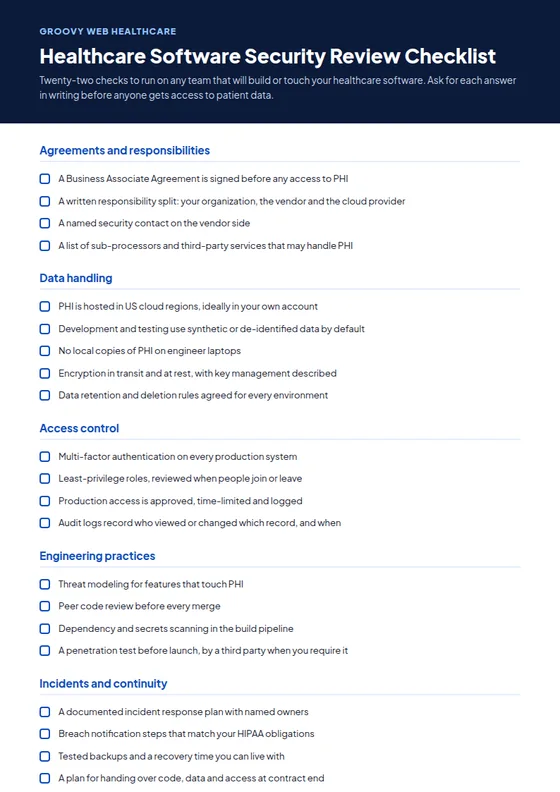
Twenty-one checks to run on any team that will build or touch your healthcare software, before anyone gets access to patient data.
Agreements, BAAs and responsibilities
Data handling, hosting and access control
Engineering practices and incident response
FAQ
Security and Compliance FAQs
No company can be. There is no official HIPAA certification from the US government. We design software to the HIPAA Security Rule safeguards, and compliance is shared between your organization, your cloud provider and our team.
No, we do not hold these certifications today. Instead, we answer your security questionnaire in full, walk you through our practices and put the safeguards for your project in writing before work starts.
Yes. When our team will create, receive, maintain or transmit protected health information for you, we sign a BAA before any access to PHI.
In US cloud regions, in your own cloud account by default, using services your provider offers under its own BAA. We build and test with synthetic data.
Only when a task requires it, through controlled and logged environments with multi-factor authentication and least-privilege roles, and never by copying PHI to local machines. Most development needs no PHI at all.
We follow a written incident response plan with named owners. We contain the issue, investigate it and report to you promptly with the facts you need for your HIPAA breach assessment and any notices, which remain your decision.
Yes. We answer vendor security questionnaires and HECVAT-style reviews before you sign, and walk your security team through our answers on a call.
No vendor can make you compliant on its own. We build the technical safeguards and documentation, and your organization keeps its compliance program, policies and decisions.
Build Healthcare Software With a Team That Takes Patient Data Seriously
From the first data flow diagram to go-live monitoring, a senior engineer walks you through how your patients' data will be protected.
Talk to our healthcare engineers and get a tailored proposal.
After a 30-minute call you receive a detailed proposal covering scope, timeline and investment, with no obligation.
Detailed proposal before you commit
1-week risk-free trial
You own all code from day one
Safeguards designed to support HIPAA. BAA available.Senior engineers on your US hours. You own 100% of the code. Not ready yet? Try the cost calculator.