
AI Power Demand Forecasting
How we built an assistant for grid operators that reads grid load and weather, forecasts demand 48 hours ahead with a likely range, checks each forecast against what actually happened, and explains the numbers in plain words.
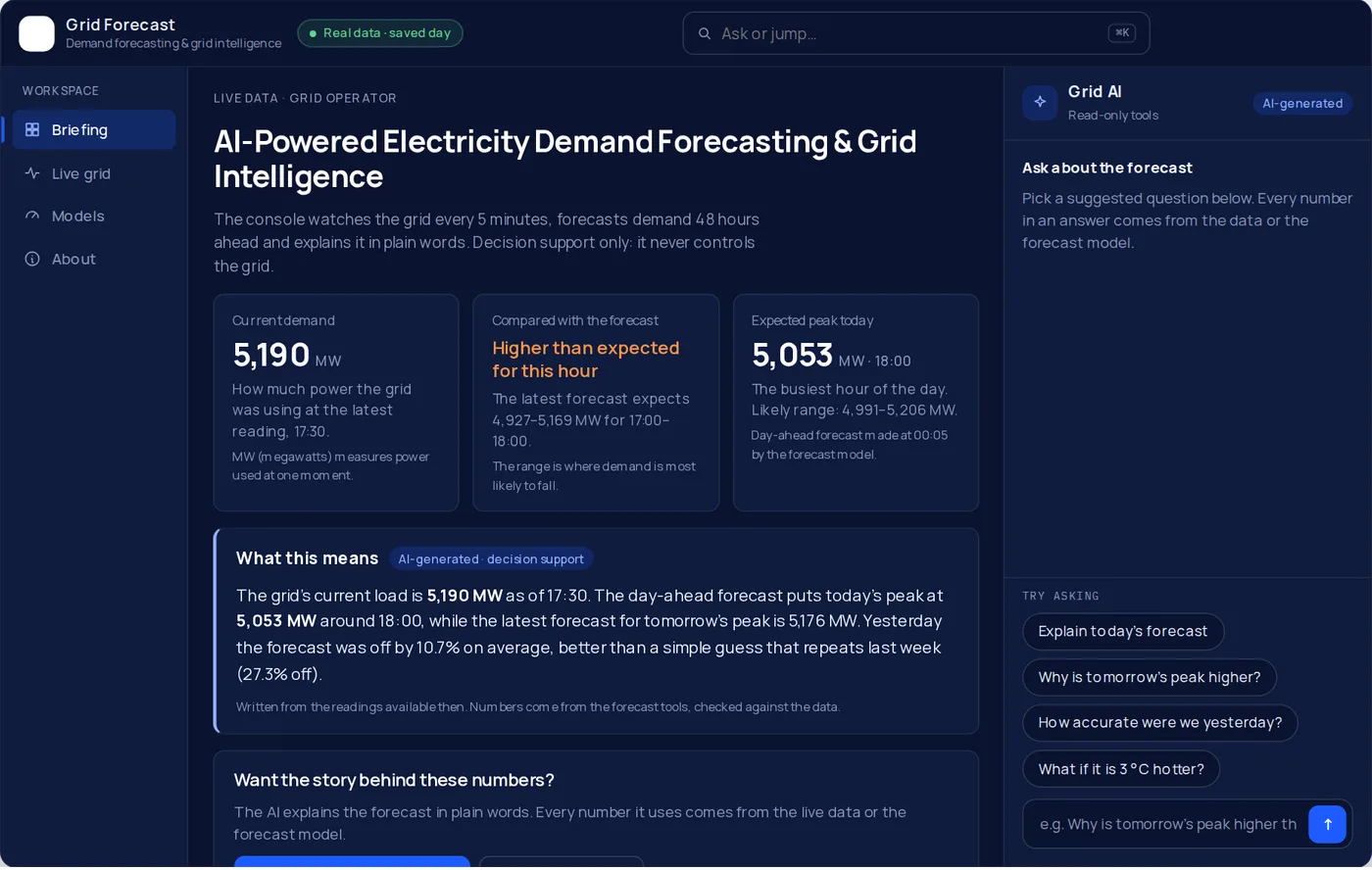
Tomorrow's Demand, Split Across Two Websites
Grid teams must know tomorrow's demand to buy enough power and keep spare capacity for the peak. Load data sits on one site and weather on another, and turning them into a forecast someone can explain takes time a control room does not have.
The brief was to bring that scattered picture into one place, and to do it without taking the decision away from the people responsible for it.
- Grid operators
- Power planners
Manual Work vs Generic AI vs Our Build
We designed the AI to support the people doing the work, not to replace their judgment. It reads the data, explains what it found and drafts the next step. A person makes the call.
| Aspect | Manual Process | Generic AI Chatbot | Our Build |
|---|---|---|---|
| Data | Spread across separate systems | Only what someone pastes in | Sources brought into one view |
| Decisions | A person, with part of the picture | The model answers, nobody signs off | A named person approves every action |
| Explanation | Varies by who you ask | Hard to trace | Every suggestion shows its reason |
| Fit | Familiar, but slow | Not built around the workflow | Built around 4 real workflows |
A Forecast the Planner Can Check and Explain
From two websites to one saved record. We built each workflow to end with a named person's decision. This is one of them, step by step.
Data pipeline
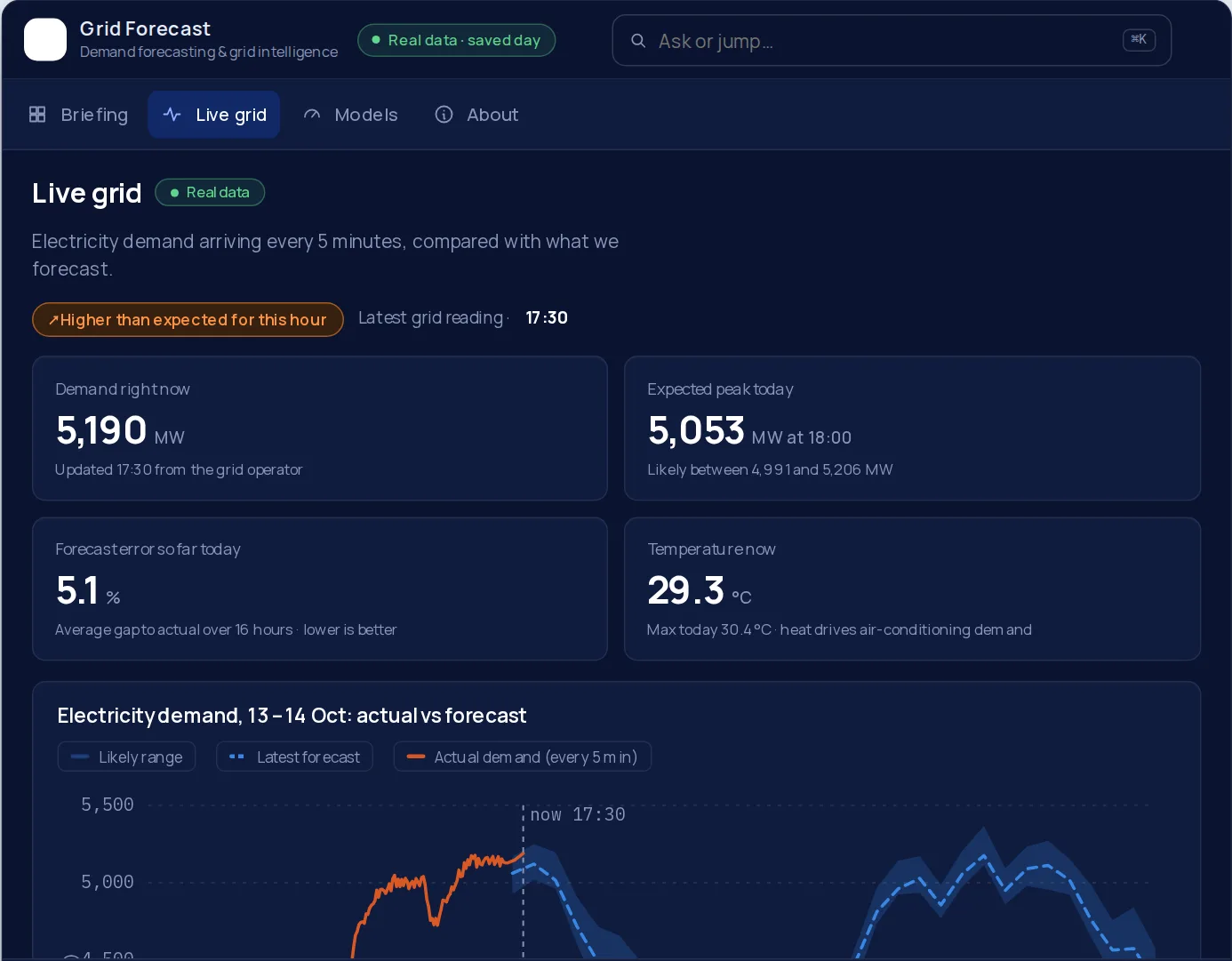
Reads the grid load every 5 minutes.
Data pipeline
Reads temperature and humidity every hour.
Checks
Marks missing readings and outliers.
Grid operator
Sees the latest reading next to the forecast and its likely range.
Outcome
Every reading is saved with its time, so any forecast can be scored later.
Live grid data
Grid load is read every 5 minutes and weather every hour. Gaps and odd values are flagged before anyone relies on them.
Demand forecast
Demand is forecast 48 hours ahead, with a likely range around the number.
Accuracy checks
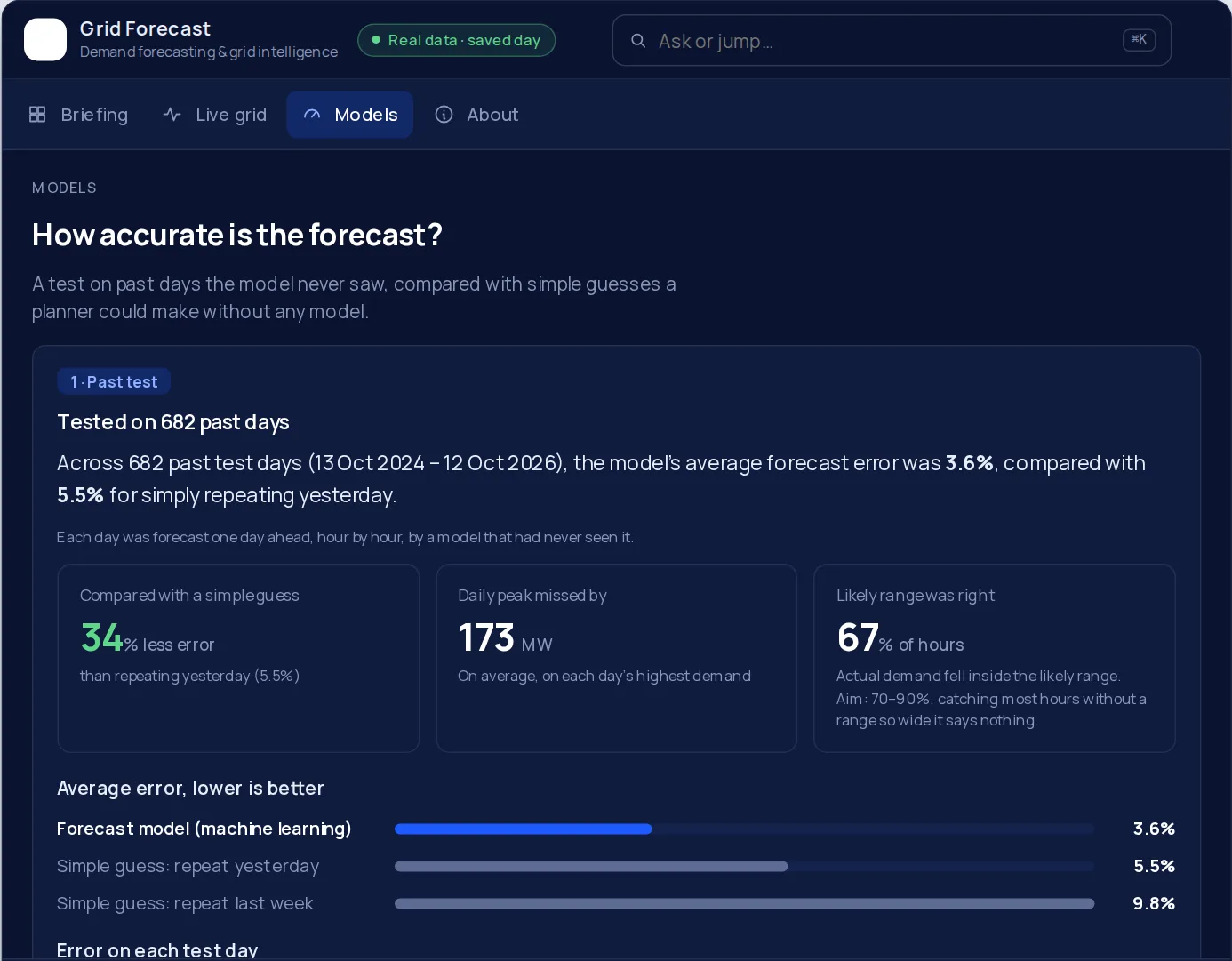
Every forecast is scored later against the actual load, so the team can see how good it really was.
Plain-language answers
An AI agent explains what moved the forecast in words a planner can use.
Pipelines and a forecasting model produce every number. The AI agent only explains them. The system supports decisions and never controls the grid.
The Finished Build
What We Delivered
Where It Stands
Data shown in the screens: A saved day of real grid load data.
Facing a Similar Challenge?
Tell us what you want to solve. We will walk you through this build on a call and scope the same approach on your own data.
Built by Groovy Web • A person approves every action