 Claude
Should a Manufacturer Build Custom Software or Buy an ERP?
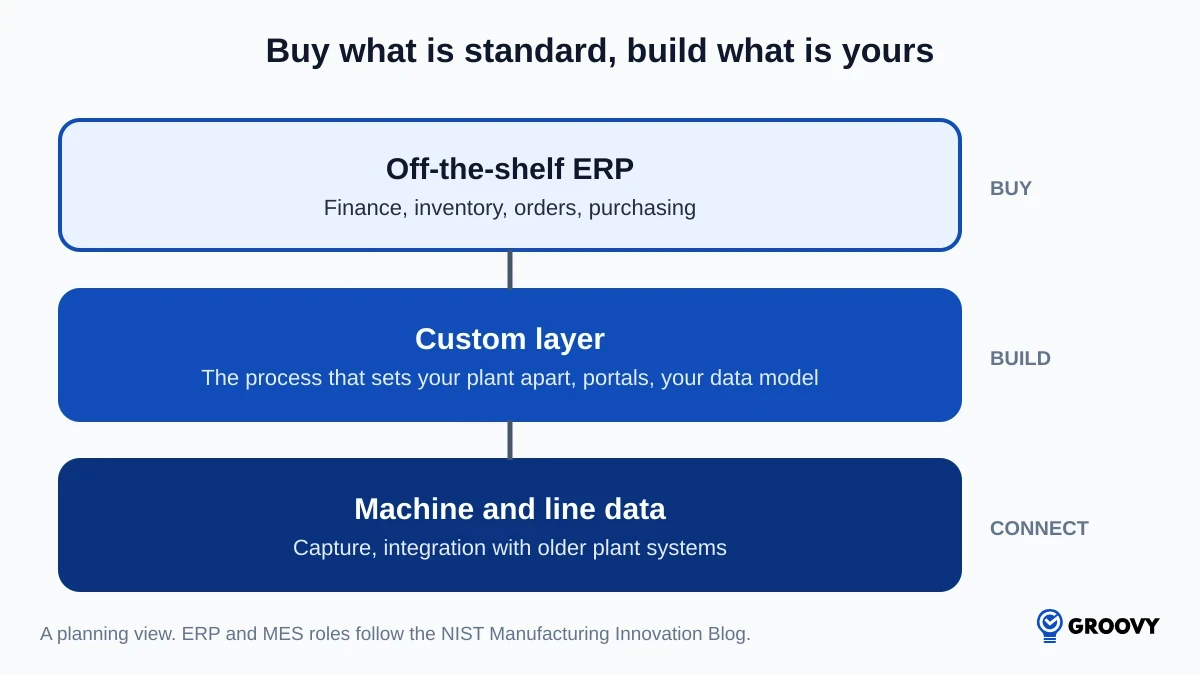
Buy an ERP for the standard back office, and build custom software only for the parts of your plant that no package fits. Most manufacturers end up with both: an ERP for finance, inventory and orders, and a custom layer for the process that gives them an edge.
Groovy Web builds custom ERP solutions for manufacturing units. Want the AI angle first? Read ERP and AI in manufacturing.
Ahead: where each option fits, why ERP projects struggle, which cost lines to compare, and four questions that settle build vs buy.
What Does an Off-the-Shelf ERP Do Well, and Where Does It Stop?
An ERP holds the shared records of the business: inventory, orders, purchasing and finance. It works best on processes that most manufacturers run in a similar way, because a package is built for the common case.
Shop floor data is a different layer. The NIST Manufacturing Innovation Blog explains in its post on why small manufacturers should consider a manufacturing execution system that many manufacturers have struggled to leverage their ERP investment, because software is only as useful as the data it receives.
The same post says a manufacturing execution system collects production data from many components and can feed it into the ERP. Choosing between custom software and an ERP often comes down to who owns that data layer.
When Is Custom Manufacturing Software Better Than an ERP?
Custom software wins when your process is the result of years of tuning that no package matches. Staff running key work in spreadsheets beside the ERP is the usual tell. It suggests a custom layer may pay off.
| Need | Off-the-shelf ERP | Custom software |
|---|---|---|
| Finance, payroll, standard purchasing | Strong fit. Built for the common case | Rarely worth building |
| Inventory and order records | Strong fit | Build only if records are unusual |
| A scheduling or quoting rule unique to your plant | Needs heavy customization or a workaround | Strong fit. Built around your rule |
| Machine and line data capture | Often limited without an add-on | Strong fit if you need your own data model |
| Customer or supplier portals | Package portals follow a fixed pattern | Strong fit when the experience is part of your offer |
| Integration with older plant systems | Depends on available connectors | Built to the systems you actually run |
Why Do ERP Projects Struggle in Manufacturing?
Panorama Consulting Group lists seven root causes in its January 2025 article on IT failures in the manufacturing industry. Several of them bear on the build or buy choice.
| Root cause named by Panorama | What it means for your choice |
|---|---|
| Technology not tied to business goals | Write the goal first, then pick build, buy or both |
| Weak change management | Plan training and adoption for either path |
| Underestimating ERP complexity, including over-customization and poor data migration | Heavy customization adds cost and risk, so compare it with building that part |
| Over-reliance on legacy systems | Plan the integration to older systems early |
| Insufficient testing | Budget testing time, whichever path you take |
| Neglected cybersecurity and data governance | Assign ownership of plant and cloud data security |
| Lack of scalability and future-proofing | Check that the system can adapt as demand and rules change |
The article does not give failure rates, so we do not quote one. Treat any single statistic about ERP failure with care unless its source and sample are stated.
Custom ERP vs Off-the-Shelf ERP vs Hybrid: How Do They Compare?
| Buy an ERP | Build custom | ERP plus custom layer | |
|---|---|---|---|
| Time to start | Fastest for standard processes | Slowest, since you define everything | Medium, the ERP starts first |
| Fit to your process | Good for common processes | Exact | Exact where it matters |
| Ownership and control | Vendor roadmap and licence terms | You own the code | Split by layer |
| Upkeep | Vendor updates, your configuration | Your team or a partner maintains it | Both, with a clear interface between them |
| Main risk | Over-customization | Scope growth | Weak integration between layers |
Which Cost Lines Should You Compare?
No single price fits every plant, because cost follows scope, the number of sites and users, and how much old data must move. Compare the same lines on each path instead of comparing headline prices.
- Licences or subscriptions, now and as users grow
- Configuration or customization work
- Data migration and cleanup
- Integration with machines, scanners and older systems
- Training and change management
- Testing before each go-live
- Upkeep, upgrades and support after launch
Ask any vendor to price these as separate lines. A custom build trades licence cost for build cost, and an ERP trades build cost for configuration and licence cost.
What Can AI Add on Top of Either Choice?
AI features such as demand forecasting or quality checks need clean, connected data. Back to the NIST point: software is only as useful as the data it receives.
So fix the data layer first, whichever path you pick. Then add AI to a clear, narrow task. Our guide to ERP with AI in manufacturing shows where those features fit.
Build vs Buy: Which Four Questions Decide It?
| Question | If yes | If no |
|---|---|---|
| 1. Does a package already cover most of your processes? | Lean toward buying an ERP | Go to question 2 |
| 2. Is one process unique and central to how you win? | Plan a custom layer for it | Go to question 3 |
| 3. Do staff run key work in spreadsheets outside the system? | Map that work before you choose | A package may be enough |
| 4. Will you need to connect machines or older plant systems? | Budget integration, and consider custom connectors | Standard connectors may do |
Which Fits Your Plant: ERP, Custom or Both?
Choose an off-the-shelf ERP if:
- Your processes are close to what most manufacturers in your sector run
- You want a proven system for finance, inventory and orders quickly
- You can accept the vendor's roadmap and licence terms
Choose custom software if:
- One or more processes are unique and central to how you compete
- Staff already work around the package with spreadsheets
- You want to own the code and the data model
Choose an ERP plus a custom layer if:
- The standard back office fits, but one part of the plant does not
- You need machine or line data that the package does not capture
- You can define a clean interface between the two systems
Bottom line: Buy what is standard and build what is yours. Write down the processes that set you apart, price both paths on the same cost lines, and budget integration and data cleanup before you commit.
FREE · 30 MINUTES · NO OBLIGATION
Tell us which processes your package misses. A senior engineer will help you decide what to build, what to buy and how to connect them.
Frequently Asked Questions
Is custom manufacturing software cheaper than an ERP?
Not by default. Custom software removes licence fees but adds build and upkeep cost, while an ERP adds licences and configuration. Compare both on the same cost lines for your plant, since no single price fits every manufacturer.
When should a manufacturer build custom ERP software?
When a process central to how you win is not supported by any package, staff already run it in spreadsheets, and you want to own the data model. If your processes are standard, buy an ERP and build only the missing layer.
Can custom software replace an ERP?
It can, but it is rarely the best starting point. Standard functions such as finance and inventory are well served by packages. Many manufacturers keep an ERP and build custom software only for the processes that set them apart.
What is the difference between ERP and MES?
An ERP holds business records such as inventory and orders. A manufacturing execution system tracks production as it happens and can feed data into the ERP. NIST describes pairing the two as a way to respond faster to demand changes.
Why do ERP implementations fail in manufacturing?
Panorama Consulting names weak links to business goals, poor change management, underestimated complexity and over-customization, rushed testing, weak data governance and rigid systems. Planning for each of these lowers the risk on any path.
Can I start with an ERP and add custom software later?
Yes. Keep the interface between the two systems clear from the start, so the custom layer can grow without changing the ERP core, and plan data cleanup before either one goes live.
Can an India-based team build manufacturing software for a US plant?
Yes, if the team works to your quality and security rules and you agree on hours, handover and documentation. Ask for a named lead, sample documentation and a plan for integration testing on your systems.
Want to Map Which Processes Need Custom Software?
Groovy Web builds custom ERP and plant software for manufacturers. Tell us which processes the package misses and we will help you decide what to build, what to buy and how to connect them.
Related Services
Further Reading
Ship Production-Grade AI with Senior Engineers
Our AI-First engineering approach delivers production-ready applications in weeks, not months.
Hire an AI-First Engineering Team