
 Claude
Who Owns the Code in an AI Development Contract?
You own what the contract says you own, and nothing more. In US law, copyright in code written by an outside developer does not move to you automatically. It moves through a signed written transfer, so the assignment clause is the first thing to read.
This guide covers the AI development contract itself, also called an AI software development agreement. It is general information, not legal advice, so have your counsel confirm every clause. Still choosing a vendor? Start with AI development company selection and the questions to ask an AI development company.
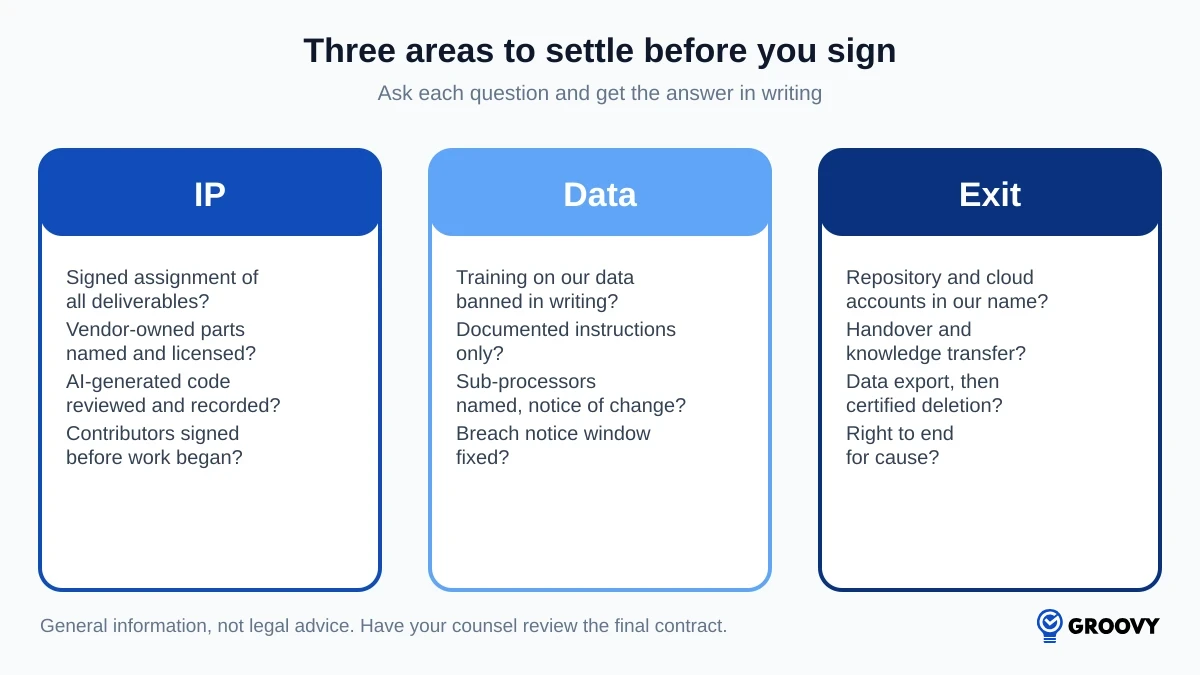
For each of IP, data and exit, you get the question to ask, what a good answer looks like, and which terms point to a weak vendor.
Is a Work Made for Hire Clause Enough for Software IP Ownership?
Many contracts say the work is "made for hire" and stop there. The US Copyright Office explains in its guide to works made for hire that a commissioned work qualifies only if it falls into one of nine listed categories and both parties sign a written agreement saying so.
Custom software is not named among those nine categories. That is why a work made for hire clause alone can fail to give you ownership of contractor-written code. A separate assignment of rights is the safer route, and your counsel should confirm it.
The assignment itself needs a signature. Under 17 U.S.C. 204, a transfer of copyright ownership is not valid unless it is in writing and signed by the owner of the rights conveyed.
| Clause to find | Question to ask | A good answer looks like |
|---|---|---|
| IP assignment | Do we receive a signed assignment of all deliverables? | A written assignment, effective on payment, covering code, designs, prompts and documentation |
| Work made for hire | Is that clause backed by an assignment? | Yes, the assignment applies even if the work made for hire label fails |
| Vendor tools and libraries | Which parts does the vendor keep? | A named list of pre-existing components, with a license to you that does not expire |
| Contractors and staff | Do their agreements pass rights to the vendor first? | Yes, every contributor signed an assignment before work began |
Who Owns AI-Generated Code?
AI tools can write part of your code, and that creates a gap. The Copyright Office's January 2025 report on copyrightability of AI outputs concludes that, given current technology, prompts alone do not provide sufficient human control to make a user the author of the output.
So a contract can assign you every right the vendor holds and still leave parts of the codebase with weaker protection. Ask how much of your product is AI-generated, how humans review and change it, and how the vendor records that work.
The same report says AI can be used as a tool without blocking protection, and that human selection, arrangement and substantial modification can qualify. Good vendors keep review records that show those human steps.
Can an AI Vendor Train Models on Your Data? What the Contract Should Say
Start with one direct question: will anything of ours be used to train or tune a model that anyone else can use? The answer should be no, in writing, and it should cover your data, your prompts and the outputs.
If personal data is involved, EU law gives you a checklist. Article 28 of the GDPR says a processor contract must require processing only on documented instructions, confidentiality, security measures, conditions for sub-processors, help with data subject requests, deletion or return of data at the end of the services, and audit access.
| Data term | Question to ask | A good answer looks like |
|---|---|---|
| Training use | Is our data ever used to train or tune shared models? | No. The contract bans it for data, prompts and outputs |
| Instructions | Does the vendor process data only as we direct? | Yes, documented instructions are part of the contract |
| Sub-processors | Who else sees our data? | A named list, with notice before any change and a right to object |
| Location and access | Where is data stored and who can reach it? | Stated regions, role-based access and logged access |
| Security incidents | How fast do we hear about a breach? | A fixed notice window in the contract, with a named contact |
What Exit Terms Belong in an AI Development Contract?
Exit terms decide whether you can leave without losing the product. Raise them before you sign. Once you depend on the system, the vendor has little reason to discuss them.
Under the GDPR rule above, the controller chooses whether personal data is deleted or returned after the services end. Extend that idea to everything else: code, configuration, model files, evaluation sets and credentials.
| Exit item | Question to ask | A good answer looks like |
|---|---|---|
| Source code | Do we hold the repository from day one? | Yes, the repository sits in your account and the vendor works inside it |
| Environments and keys | Who owns cloud accounts and credentials? | You do, and the vendor holds access only for the work |
| Knowledge transfer | What handover do we get at the end? | Documentation, a recorded walkthrough and a fixed number of support hours |
| Data return | How do we get our data back, and in what format? | A standard export within a set number of days, then certified deletion |
| Termination | What can we do if the vendor misses milestones? | A right to end for cause, with clear payment for work accepted to date |
Which Warranty, Liability and Indemnity Terms Matter for AI Work?
Ask what the vendor warrants about the work it hands over. At a minimum, it should promise that it has the right to assign the deliverables and that they do not knowingly copy third-party code or content.
Then read the liability cap. A cap set at a small share of the fees may not cover a data incident or an IP claim. Ask whether IP infringement and data breach sit outside the cap, and which insurance the vendor carries. Your counsel should set the numbers.
What Should a Vendor Disclose About Subcontractors and Third-Party Models?
Modern AI products often call outside model providers and open-source packages. Each one brings its own license and its own data terms, and they reach your product through the vendor.
Ask for a written list of third-party models, services and open-source components, with their license types. Ask who pays when a provider changes its terms, and whether you can swap a provider without a rewrite.
Which AI Contract Terms Are Red Flags?
Some terms deserve a pause before you sign. None proves bad intent, but each one needs a clear explanation.
- IP transfers only at the end of the project, or only after a final milestone you cannot control
- The vendor keeps the right to reuse your code, prompts or data in other work
- No list of sub-processors or third-party models
- The repository and cloud accounts sit in the vendor's name
- No handover, export or deletion terms
- A liability cap that excludes nothing
Which IP Structure Fits: Assignment, License or Escrow?
Choose full IP assignment if:
- You plan to raise money, sell the company or be audited on what you own
- The product is core to your business, not a short experiment
- You can accept that the vendor keeps only a short, named list of its own tools
Choose a license to vendor components if:
- The vendor has a reusable framework that speeds delivery and lowers cost
- You receive a perpetual license that survives the end of the contract
- The list of vendor-owned parts is named and kept small
Choose escrow or step-in rights if:
- The vendor hosts or runs part of the product after launch
- A vendor failure would stop a business-critical process
- You need a path to run the system yourself if the vendor cannot continue
Bottom line: Get a signed assignment, a written ban on training with your data, a named list of third parties, and exit terms for code, data and access before any work starts. Then have your counsel review the final text.
FREE · 30 MINUTES · NO OBLIGATION
Tell us what you plan to build. A senior engineer will walk you through ownership, data and exit terms before you sign anything.
Frequently Asked Questions
What should an AI software development agreement include?
At minimum: a signed IP assignment, a named list of vendor-owned components, a ban on training models with your data, a list of sub-processors and third-party models, warranties and liability terms, and exit terms for code, data and access.
Who owns the code if an AI vendor builds my software?
Ownership depends on the contract. Under US law a transfer of copyright needs a signed written instrument, and a work made for hire label may not cover custom software. Ask for an explicit assignment and have your counsel confirm it.
Can an AI vendor train models on my data?
Only if the contract allows it. Ask for a written ban on training or tuning any shared model with your data, prompts and outputs. For personal data, a GDPR processor contract must also limit processing to your documented instructions.
Is AI-generated code protected by copyright?
Not always. The US Copyright Office says prompts alone do not give enough human control to make a user the author. Human selection, arrangement and substantial changes can qualify, so ask the vendor how it reviews and records human work.
What should an exit clause include?
It should cover source code in your repository, cloud accounts and credentials in your name, documentation, a handover period, a data export in a standard format and certified deletion. It should also say when you can end the contract for cause.
Do I need a lawyer to review an AI development contract?
Yes. This guide gives questions to ask, not legal advice. IP, liability and data terms depend on your country, your industry and your data, so a qualified lawyer should review the final text before you sign.
What does Groovy Web agree on IP and data?
We talk through ownership, data use and exit terms during scoping. Ask for the written terms at that stage and compare them with the questions above before you decide.
Want Contract Terms You Can Trust Before You Start?
Groovy Web builds AI products for US teams, and we cover ownership, data and exit terms during scoping. Tell us what you plan to build and we will walk you through each one before work starts.
Related Services
Further Reading
Ship Production-Grade AI with Senior Engineers
Our AI-First engineering approach delivers production-ready applications in weeks, not months.
Hire an AI-First Engineering Team