
 Claude
POC vs Prototype vs MVP: Which Should a Non-Technical Founder Pay For First?
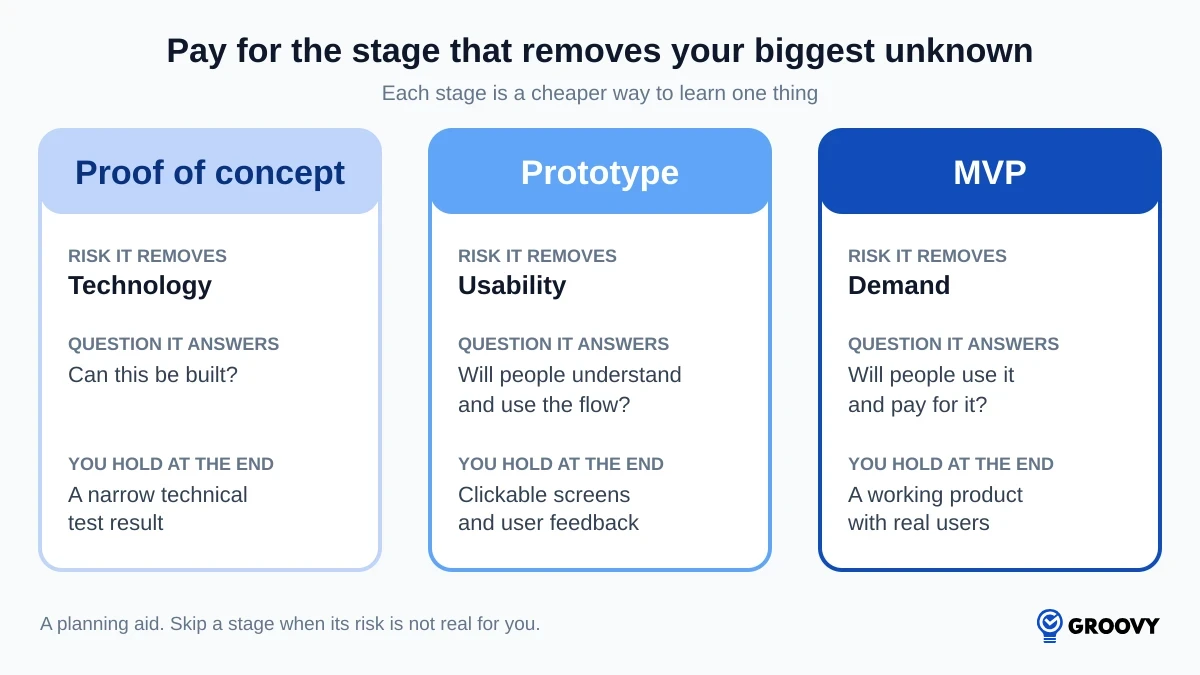
Pay first for the stage that removes your biggest unknown. A POC (proof of concept) is for the doubt that the technology will work. A prototype is for the doubt that people will understand the product. An MVP (minimum viable product) is for the doubt that anyone will use it or pay.
Most non-technical founders carry demand and usability risk, not technology risk. For them a prototype or a thin MVP is usually the better first purchase.
Below: what each term means, how the three differ, and how to choose without technical knowledge. If you already know you want a build, see our MVP development service, or read what an AI MVP build includes before you ask for quotes.
What Is a POC (Proof of Concept) in Software?
Wikipedia describes a proof of concept as a realization of an idea or method that demonstrates its feasibility. It is a small effort that shows a concept has practical potential before it is fully developed.
In software, that means building just enough to answer one question: can this be done? A proof of concept might test whether an AI model reaches the accuracy you need on your data. It is built for you and your team, not for customers.
What Is a Prototype in Software Development?
Nielsen Norman Group defines the fidelity of a UX prototype as how closely it matches the look and feel of the final system. Low-fidelity versions capture only some or none of the final visuals, while high-fidelity ones are clickable and look like a live system.
A prototype answers a different question: do people understand this and can they complete the task? It lets you test the workflow with real users before engineers build the real thing.
What Is an MVP?
Wikipedia's entry on the minimum viable product describes an early version with just enough features to be usable by early customers, who then give feedback that guides later development. Eric Ries popularised the idea as the version that collects the maximum validated learning about customers with the least effort.
An MVP answers the commercial question: will people use it and pay for it? Unlike the other two, it is a real product that real users touch.
What Is the Difference Between a POC, a Prototype and an MVP?
| Proof of concept | Prototype | MVP | |
|---|---|---|---|
| Question it answers | Can this be built? | Will people understand and use the flow? | Will people use it and pay for it? |
| Who sees it | You and your team | Test users and stakeholders | Real early customers |
| What exists | A narrow technical test | Screens and flows, often not working code | A working product with core features |
| Main risk removed | Technology | Usability and fit | Demand |
| Typical first buyer | Founders using new technology such as AI | Founders with an unproven workflow | Founders with a validated problem |
Vendors use these words loosely. One agency's "MVP" is another's prototype with a login screen. So ask two things before you agree to anything: what question will this answer, and what will I hold at the end?

Which Risk Should You Remove First?
CB Insights analysed more than 400 startup post-mortems and found that poor product-market fit (43%) was one of the top reasons for failure. Running out of capital was cited in 70% of cases, which the report calls almost always the final cause rather than the root problem.
The lesson is to spend early money on learning, not on features. Each stage is a cheaper way to learn one thing before you commit to the next.
What Should You Ask a Vendor Before You Pay?
- Which single question will this stage answer for me?
- What will I receive at the end, and who owns it?
- Can the work be reused in the next stage, or will it be rebuilt?
- What result would tell us to stop, change direction or continue?
- Who will test it with real users, and when?
A good partner can state the question, the output and the stop rule in plain words. If you get only a feature list and a price, you are buying build hours, not learning.
Do You Need All Three: POC, Prototype and MVP?
No. The usual order is POC, then prototype, then MVP, but each step is optional. Many founders skip the POC because the technology is well understood. Some go from a prototype straight to an MVP. Use a stage only when its risk is real for you.
Building on AI? A short POC on your own data is often worth it, since model accuracy is hard to judge from a demo.
Worried about demand? Put a working core in front of customers as early as you safely can. Our guide to how an AI MVP goes from idea to launch covers what comes after.
Which Stage Should You Pay For First?
Choose a proof of concept if:
- Your product depends on a technology you have not seen work, such as AI accuracy on your data
- A failed technical test would change or end the plan
- You want an answer for you and your investors, not a customer-facing product
Choose a prototype if:
- The technology is well understood, but the workflow and screens are unproven
- You want user feedback before engineers write production code
- You need something to show customers or investors quickly
Choose an MVP if:
- You have a validated problem and know who feels it
- You want real users, real usage and real payment signals
- You are ready to run, support and improve a live product
Bottom line: Name your biggest unknown first, then pay for the cheapest stage that answers it. Technology doubt means a proof of concept, usability doubt means a prototype, and demand doubt means an MVP. Ask every vendor what question the work answers and what you keep at the end.
FREE · 30 MINUTES · NO OBLIGATION
Tell us your idea and your biggest unknown. A senior engineer will help you pick a proof of concept, a prototype or an MVP first.
Frequently Asked Questions
What is the difference between POC, prototype and MVP?
A proof of concept tests whether something can be built. A prototype tests whether people can use the flow. An MVP is a working product with core features that real early customers use, so you learn if they will pay.
What should I build first: a POC, a prototype or an MVP?
Build the one that answers your biggest unknown. Doubt the technology: POC. Doubt that users will understand the flow: prototype. Doubt demand and willingness to pay: MVP. Most non-technical founders start with a prototype or a thin MVP.
Is a POC the same as a prototype?
No. A POC proves something can be built and is seen only by you and your team. A prototype shows how the product looks and flows, and is tested with users. A POC may have no interface, and a prototype may have no working code.
Should I build a prototype before an MVP?
Often yes, when your workflow is unproven. A prototype lets users react before engineers write production code. If you already know the problem and the flow, you can go straight to a thin MVP.
Do I need a proof of concept for an AI product?
Usually a short one is worth it, because AI accuracy on your own data is hard to judge from demos. Define the accuracy you need up front, so the result clearly says continue, change or stop.
Can a prototype become the MVP?
Sometimes, but plan for it. A clickable prototype often has no working code behind it, so the engineering is still to do. Ask whether designs, tests and decisions can be reused, and treat the code as new.
How much does each stage cost?
It depends on scope, so no honest single number fits every project. Our guide to what an AI MVP build includes shows how we scope budgets, and we price each stage after we understand the question it must answer.
Can an India-based team build my MVP for a US startup?
Yes, if the team works in your repository, shares named engineers and agrees on overlap hours. Ask for the stage output, the stop rule and the code ownership terms in writing before you start.
Not Sure Which Stage Fits Your Idea?
Groovy Web helps non-technical founders pick the right first stage and build it. Tell us your idea and your biggest unknown, and we will tell you whether to start with a proof of concept, a prototype or an MVP.
Related Services
Further Reading
Ship Production-Grade AI with Senior Engineers
Our AI-First engineering approach delivers production-ready applications in weeks, not months.
Hire an AI-First Engineering Team