
 Claude
Should You Fix or Rebuild a Vibe Coded App?
Fix a vibe coded app (we call it hardening) if the idea is proven and the code is mostly sound. Rebuild it if real users are arriving and the foundation cannot be made safe or maintainable. A short code audit is the only reliable way to tell, so do that before you spend on either path.
Groovy Web takes AI-built prototypes to production through our vibe coding development service. Still sizing the project? Read what an AI MVP build includes first.
Below: what to audit, which signs point each way, and how to decide on evidence instead of gut feeling.
What Does Fixing a Vibe Coded App Involve?
Vibe coding means describing what you want to an AI tool and accepting the code it writes with little manual review. It gets you to a working demo fast. Plenty of founders have tested an idea that way in days.
Hardening keeps that code and fixes what makes it unsafe for real customers: a security review, access rules, error handling, tests, monitoring and a clean deployment process. Users see the same product. The foundation underneath gets stronger.
Is a Vibe Coded App Safe to Launch?
Working screens hide missing safeguards, and that is the trap. Veracode tested more than 100 language models and reported that 45% of code samples failed security tests and introduced OWASP Top 10 vulnerabilities. The same report found failure rates of 72% for Java, 45% for C#, 43% for JavaScript and 38% for Python.
Veracode adds that newer and larger models wrote more correct code but were no better at writing secure code. This is a benchmark result, not a measure of every AI-written app, but it shows why review matters.
Researchers at Stanford found the same pattern with people. In Do Users Write More Insecure Code with AI Assistants?, participants with an AI assistant wrote significantly less secure code and were more likely to believe it was secure.
A real incident shows the risk. The record for CVE-2025-48757, published on May 30, 2025, describes an insufficient database row-level security policy in an AI app builder that let remote attackers read or write tables of generated sites. The supplier disputes the issue and says each customer is responsible for protecting its own data.
How Do You Know Whether to Fix or Rebuild?
| Signal | Points to hardening | Points to a rebuild |
|---|---|---|
| Data model | Tables and relations match how the business works | Data is duplicated or stored in ways that block reporting |
| Access control | Gaps can be closed with rules at the database and API layer | Anyone can read or change anything and the structure resists fixes |
| Code structure | Clear modules, so one change touches one place | Repeated code everywhere, so each fix breaks something else |
| Tests | A few can be added around core flows quickly | Nothing is testable without restructuring first |
| Scale needs | Current design fits your next stage of users | Design cannot handle the load, integrations or compliance you now need |
Most prototypes land in the middle. Core screens and logic can stay, while the data layer or the access rules need real rework. That is why the decision is rarely all or nothing.
What Does a Vibe Coded App Need to Be Production Ready?
Ask for a written code audit covering the points below. Ask who read the code line by line, not who ran a scanner. You want a plain list of what is safe, what is fixable and what must be replaced.
- Who can read or change each table, and how that is enforced
- Where secrets, keys and credentials are stored
- How user input is validated before it reaches the database
- Whether the app has tests, logging and error tracking
- How the app is deployed, backed up and restored
- Which parts depend on one tool or platform you cannot leave
Fixing vs Rebuilding a Vibe Coded App: How Do They Compare?
| Harden | Rebuild | |
|---|---|---|
| What you keep | Screens, logic and data you already have | The product idea, design decisions and what users taught you |
| Speed to a safe release | Usually faster, since most work is already there | Slower, since you build the foundation again |
| Main risk | Hidden flaws you did not find in the audit | Losing momentum and rebuilding mistakes into the new code |
| Long-term upkeep | Depends on how much structure the audit lets you fix | Cleaner, because the structure is planned |
| Best when | You have users and a sound base | The base blocks security, scale or the next feature |
Timing and price depend on the audit result, so we scope them after reading the code. Our guide to how AI-first engineering changes the development process explains how review and testing are built into delivery.
Can You Keep Building in Cursor or Lovable?
Often yes, for design and quick experiments. What matters is who owns and reviews the code that ships. Treat generated code like a new hire's first pull request: quick, useful, and not merged until someone has read it.
Export the code to a repository you control, and keep any platform-specific services behind clear interfaces. That keeps your options open if you later move the product to a stricter build process.
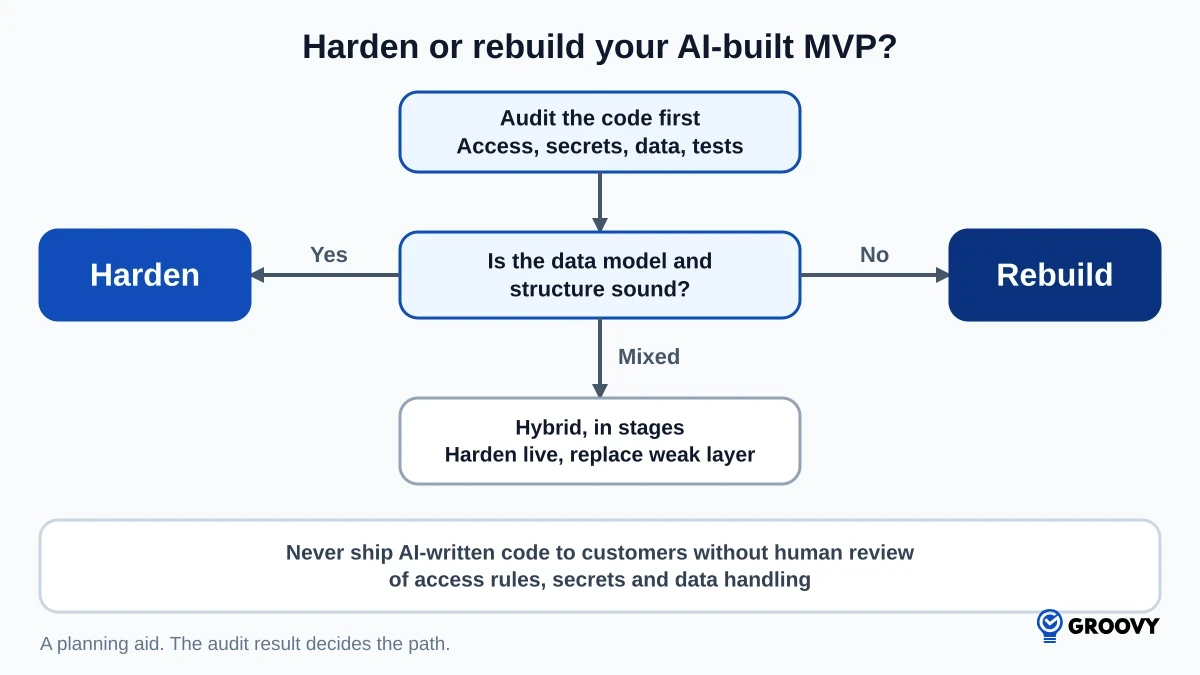
Fix, Rebuild or Both: Which Fits Your App?
Choose to harden if:
- Users are already paying or testing, and the idea is proven
- An audit finds a sound data model and fixable access gaps
- You need a safe release soon and cannot pause the product
Choose to rebuild if:
- The data model or structure blocks security, scale or the next feature
- Each fix breaks something else, so changes keep slowing down
- You need compliance, integrations or load the prototype was never designed for
Choose a hybrid, in stages, if:
- Some parts are sound and others are not
- You want to harden the live product while you rebuild the weakest layer
- You would rather replace one module at a time than pause the product
Bottom line: Audit first, decide second. Harden when the idea is proven and the base is sound, rebuild when the base blocks you, and mix the two when the codebase is uneven. Never ship AI-written code to customers without a human review of access, secrets and data handling.
FREE · 30 MINUTES · NO OBLIGATION
Tell us how the prototype was built and who uses it. A senior engineer will help you decide whether to harden, rebuild or mix the two.
Frequently Asked Questions
Is AI-generated code safe to put in production?
Not without review. Veracode found that 45% of code samples in its test failed security checks, and Stanford researchers found that people using AI assistants wrote less secure code. Review, testing and access controls make AI-written code fit for production.
Should I fix or rebuild my vibe coded app?
Fix it when the idea is proven and the structure is sound. Many prototypes can be hardened. A code audit shows whether the data model and structure are sound. Rebuild only when they block security, scale or the next feature.
How do I make a vibe coded app production ready?
Start with a written audit of access rules, secrets, input handling and deployment, done by an engineer who reads the code. Then fix the critical gaps, add tests, logging and backups, and set up a clean release process. A scanner alone is not enough.
How do I know if my vibe coded app is secure?
You cannot tell from a working demo. Check who can read or change each table, where secrets are stored and how input is validated. Have an engineer review these by hand, and test with two separate user accounts.
Can I hand an AI-built prototype to a development team?
Yes. Export it to a repository you control and share the original prompts and decisions. A good team will audit it first and tell you what to keep, fix or replace before it scopes the work.
How much does it cost to harden an AI-built MVP?
It depends on what the audit finds, so no honest single number fits every project. Our guide to what an AI MVP build includes shows how we scope budgets, and we price hardening after reading the code.
Can an India-based team harden a prototype for a US startup?
Yes, if the team works in your repository, shares named engineers and agrees on overlap hours and data location. Ask for a sample audit report before you commit.
Want an Honest Read on Your AI-Built Prototype?
Groovy Web audits AI-built MVPs and tells founders whether to harden, rebuild or mix the two. Send us the repository and your goals, and we will tell you what to keep, fix or replace.
Related Services
Further Reading
Ship Production-Grade AI with Senior Engineers
Our AI-First engineering approach delivers production-ready applications in weeks, not months.
Hire an AI-First Engineering Team