
 Claude
Should You Build or Buy AI Prior Authorization Software?
For AI prior authorization software, the first question is which side of the CMS rule you sit on.
The rule puts its biggest software deadline on payers: a Prior Authorization API starting January 1, 2027. That date belongs to health plans, not to Groovy Web. Providers feel it as faster decisions, specific denial reasons and new ways to submit requests.
If you are new to the topic, read what AI prior authorization is first. Groovy Web builds AI software for healthcare teams, see our healthcare software development work.
Read on for who the rule covers, what the software must do, and how to choose between building, buying and hiring a team.
Who Does the Rule Cover, and When?
The CMS fact sheet for the Interoperability and Prior Authorization Final Rule, CMS-0057-F, applies the rule to Medicare Advantage plans, state Medicaid and CHIP fee-for-service programs, Medicaid and CHIP managed care plans, and qualified health plan issuers on the federal exchanges.
| Requirement | What CMS says | Date |
|---|---|---|
| Decision timeframes | 72 hours for expedited requests and seven calendar days for standard requests | Compliance from January 1, 2026 |
| Denial reasons | Payers must give a specific reason for a denied request | From 2026 |
| Public reporting | Payers publicly report certain prior authorization metrics each year | Annual |
| Prior Authorization API | Payers implement and maintain the API | From January 1, 2027 |
The fact sheet also says the rule does not apply to prior authorization decisions for drugs. The decision timeframe requirement excludes qualified health plan issuers on the federal exchanges.
Does a Provider Need the Prior Authorization API?
The rule requires the API from impacted payers, as the CMS fact sheet states. A provider organization does not have to build it. What a provider needs is software that gathers the right documents, submits the request and tracks the answer.
A payer's job is different. It must expose the API, list the items and services that need approval, state the documentation required and return an approval, a denial with a specific reason, or a request for more information.
Decide which side you are on before you read any proposal. The two builds have different scopes.
What Should AI Prior Authorization Software Do?
| Function | Provider side | Payer side |
|---|---|---|
| Intake | Spot which orders need approval | Receive requests through the API |
| Documentation | Pull the right clinical notes and attach them | Publish documentation requirements for each service |
| Decision | Track status and deadlines | Return approval, denial or request for more information |
| Denials | Read the reason and plan an appeal | State a specific reason |
| Records | Audit trail of what was sent | Data for the public metrics report |
CMS ties the API to Fast Healthcare Interoperability Resources, so connection to health plan and EHR systems through FHIR is part of any serious scope. See our guide to how EMR integration works.
Where Can AI Help, and Where Must a Person Decide?
AI helps with reading and matching: finding the right passage in a clinical note, comparing it with a plan's documentation requirements and drafting the request. Staff can then review a complete packet instead of building one by hand.
A person should still own the decisions that affect care. Keep a human review step, log every AI action and record which documents were sent. Our guide to build vs buy for AI agents in healthcare operations covers the same principle.
What Does Each Route Cost?
No single number fits every team, and any figure quoted without your scope is a guess. The cost lines differ by route, so compare those instead of a headline price.
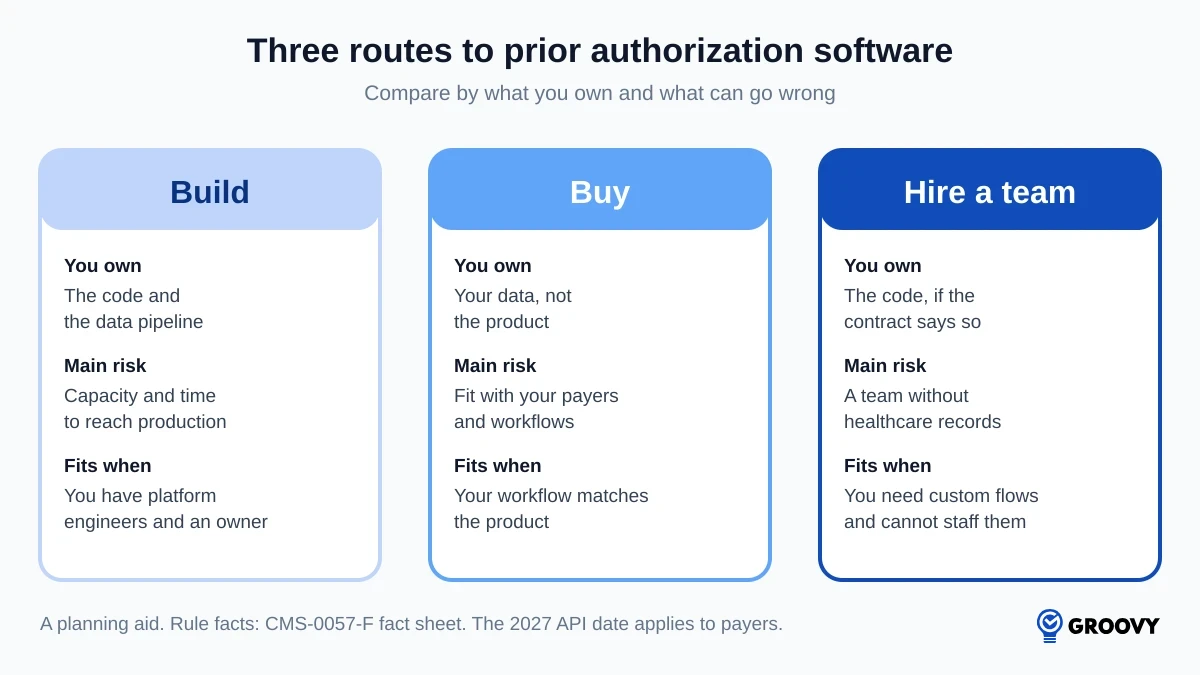
| Build | Buy | Hire a team | |
|---|---|---|---|
| You pay for | Design, build, testing and upkeep of your own system | A licence or usage fee, plus setup | A team to build and support it for you |
| You own | The code and the data pipeline | Your data, not the product | The code, if the contract says so |
| Main risk | Capacity and time to reach production | Fit with your payers and workflows | Choosing a team without healthcare records |
| Best signal | You have platform engineers and a product owner | Your workflow matches the product | You need custom workflows without a hiring plan |
Ask any vendor or team to price integration, security review, testing and support as separate lines, and to say what changes when a payer changes its rules.

What Should You Vet Before You Buy Prior Authorization Software?
- A signed business associate agreement, since the software handles protected health information
- Whether any AI model provider sees patient data, and what contract covers it
- A human review step and a full audit trail for every submission
- FHIR connection experience with the systems you use
- Who owns the code, prompts and data, and how you exit
The text of 45 CFR 164.504 requires a business associate contract to bind subcontractors to the same restrictions. That covers any cloud or model provider that touches the data.
Which Route Fits Your Team?
Choose to build in house if:
- You have platform engineers, a product owner and a compliance lead
- Your workflows are specific to your payers and specialties
- You can wait for a staged release and maintain it long term
Choose to buy a product if:
- Your workflow matches what the product already handles
- You can accept the vendor's data terms and release schedule
- You need to be live before you could hire and build
Choose to hire a specialist team if:
- You need custom workflows and FHIR connections but cannot staff them
- You want to own the code and the audit trail
- You need a partner who will sign the business associate agreement
Bottom line: Decide whether you are a payer or a provider, then decide who owns the code and the audit trail. Compare routes by cost line, not by headline price, and keep a person in charge of decisions. The January 1, 2027 date applies to payers.
FREE · 30 MINUTES · NO OBLIGATION
Tell us whether you are a payer or a provider and which systems you use. A senior engineer will help you scope the build.
Frequently Asked Questions
What should I look for in prior authorization software?
Look for a signed business associate agreement, clarity on whether any AI model provider sees patient data, a human review step with a full audit trail, FHIR connection experience with your systems, and written terms on who owns the code, prompts and data.
What does CMS-0057-F require?
It requires impacted payers to meet decision timeframes, give specific denial reasons, report prior authorization metrics publicly and implement a Prior Authorization API. The decision timeframes and denial reasons apply from 2026, and the API requirement starts January 1, 2027.
Does the rule apply to prior authorization for drugs?
No. The CMS fact sheet says the provision does not apply to prior authorization decisions for drugs, and the API requirements also exclude them. Check your own pharmacy workflow separately.
Does a provider have to build a Prior Authorization API?
No. The rule requires the API from impacted payers. Providers need software that gathers documents, submits requests and tracks decisions, and they can connect to payer systems as those APIs come online.
Should we build, buy or hire a team?
Build if you have platform engineers and a product owner. Buy if a product matches your workflow. Hire a team if you need custom workflows and cannot staff them, and make sure the contract covers code, data and exit.
Can AI make prior authorization decisions?
AI can read documents and prepare requests, but we recommend a person owns decisions that affect care. Keep a human review step and log what the AI did and what was sent.
Can an India-based team build prior authorization software?
Yes, if it signs the business associate agreement, controls access to patient data and keeps audit records. Ask for named engineers, sample documentation and data location terms before you sign.
Want Prior Authorization Software Scoped Properly?
Groovy Web builds AI software for healthcare teams and can scope a prior authorization build with you. Tell us whether you are a payer or a provider and which systems you use, and we will tell you what to confirm first.
Related Services
Further Reading
Ship Production-Grade AI with Senior Engineers
Our AI-First engineering approach delivers production-ready applications in weeks, not months.
Hire an AI-First Engineering Team