The best healthcare analytics platform for a multi-site provider group is the one that reliably unifies EHR, scheduling, claims and quality data across every location, matches each patient to one identity, enforces role-based HIPAA access, and answers your specific operational and quality questions. That can mean buying a platform, building one, or pairing a warehouse with BI.
Vendor lists rank products. They rarely tell a CTO which approach fits a group with five clinics on two EHRs, an outside billing company and a quality team chasing MIPS deadlines. This guide covers that decision, the data to unify, HIPAA safeguards, architecture, quality reporting, registries, metrics and cost.
Buy, Build or Warehouse Plus BI: Which Fits a Multi-Site Group?
Buy when your needs match a vendor's standard content and your EHRs are on its supported list. Build when your workflows, specialties or data sources are unusual. Most mid-size groups land in the middle: a cloud data warehouse, a modeled semantic layer and an off-the-shelf BI tool.
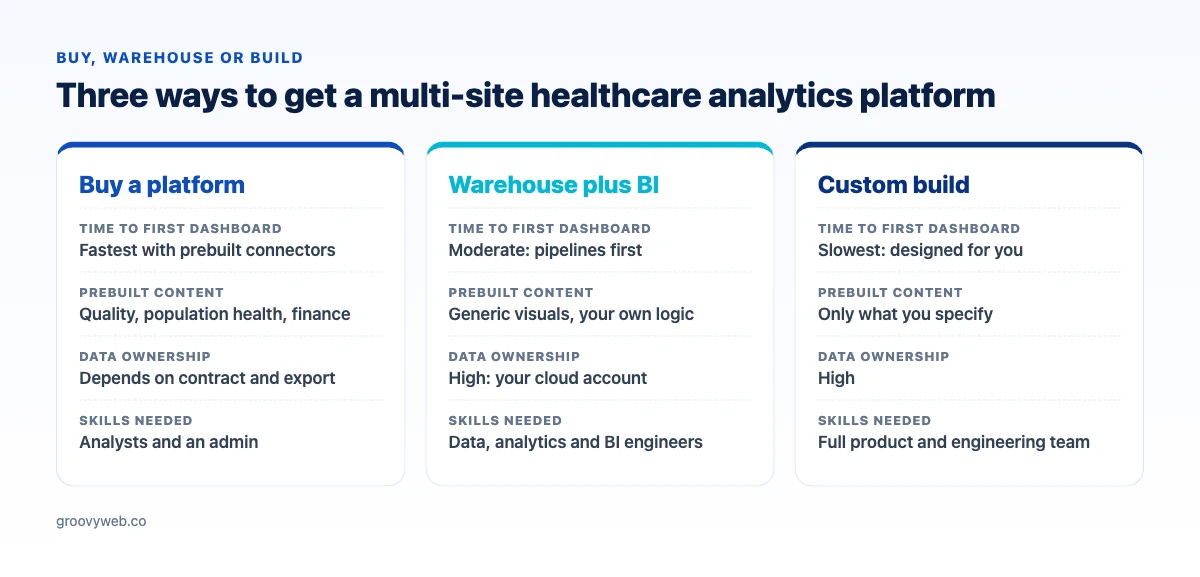
The options differ less in dashboards and more in who owns the data model and how fast you can add a site or source.
| Factor | Buy a healthcare analytics platform | Warehouse plus BI | Custom build |
|---|---|---|---|
| Time to first dashboard | Fastest if your EHRs have prebuilt connectors | Moderate. Pipelines and models come first | Slowest. Everything is designed for you |
| Prebuilt content | Quality measures, population health, financial dashboards | Generic BI visuals; healthcare logic you model yourself | Only what you specify |
| Data ownership and portability | Depends on contract terms and export options | High. Data sits in your cloud account | High |
| Adding a new site or source | Vendor roadmap and services queue | Your team adds a pipeline | Your team adds a pipeline |
| Internal skills needed | Analysts and an admin | Data engineer, analytics engineer, BI developer | Full product and engineering team |
| Main risk | Paying for modules you do not use; lock-in | Healthcare logic (attribution, measures) done wrong | Scope creep and long time to value |
Choose a packaged platform if:
- Your EHRs and payers are on the vendor's supported connector list
- Your main goal is value-based care, population health or standard quality reporting
- You lack data engineers and want the vendor to run pipelines
Choose warehouse plus BI if:
- You run two or more EHRs or practice management systems across sites
- You want to own the data model and keep data in your own cloud account
- You have, or can hire, one or two data engineers
Choose a custom build if:
- You need a clinical registry or surveillance workflow no product covers
- Analytics is part of a product you sell to other providers
- You need embedded dashboards inside your own patient or clinician apps
A hybrid is common: a vendor quality module for submission, plus your own warehouse for operational and financial dashboards. For vendor due diligence, our guide on how to choose a healthcare software development company covers BAAs, references and code ownership.
What Data Should a Multi-Site Analytics Platform Unify?
Start with four domains: clinical data from each EHR, scheduling and visit data, claims and remittance data, and quality measure data. Together they answer most questions a multi-site group asks about access, revenue, quality and provider performance.
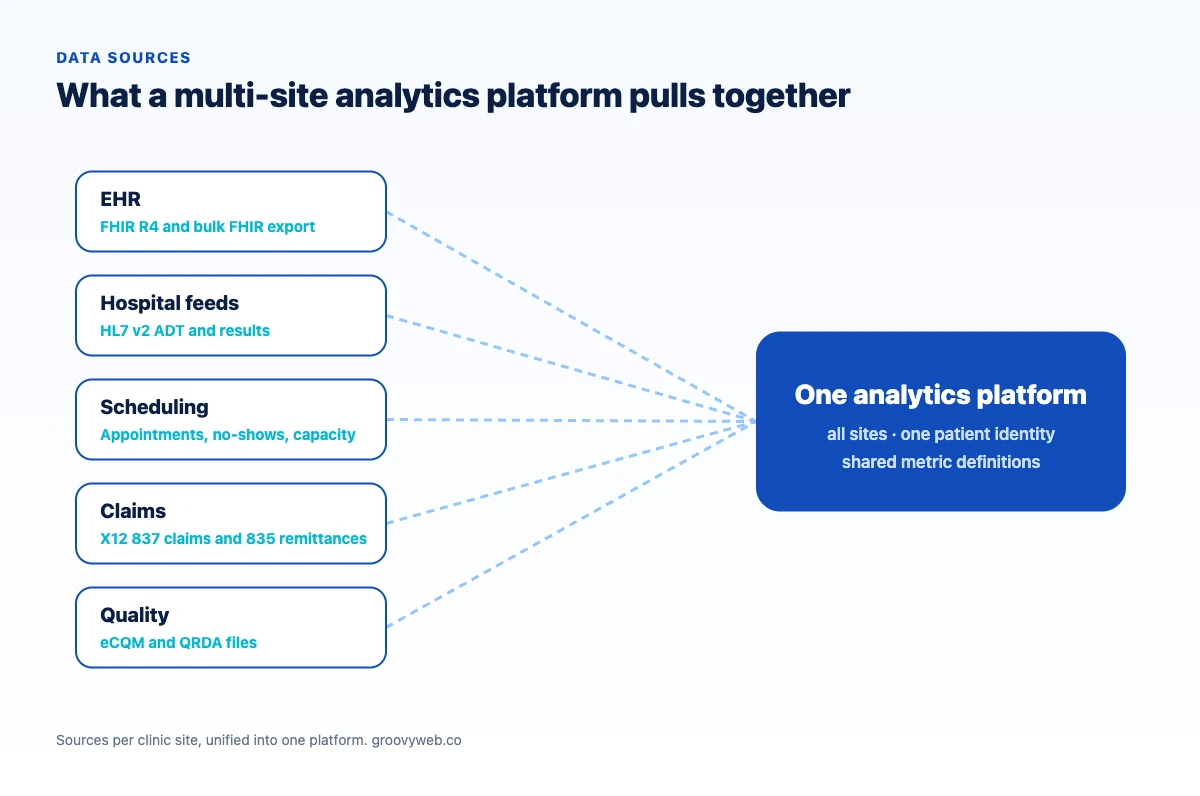
EHR data through FHIR, bulk FHIR and HL7 v2
Certified EHRs must expose population-level data. ONC's standardized API criterion, 45 CFR 170.315(g)(10), requires certified health IT to respond to requests for multiple patients' data as a group, using the FHIR Bulk Data Access specification with US Core 6.1.0 and USCDI v3 as the baseline. The current published HL7 Bulk Data Access IG (v3.0.0, STU 3) defines export endpoints for all patients and for a Group of patients, returns files as newline-delimited JSON (NDJSON), supports a _since parameter for incremental pulls, and recommends SMART Backend Services authorization.
Bulk FHIR handles nightly or weekly loads well. HL7 v2 messages fill near-real-time gaps: ADT (admit, discharge, transfer) events, scheduling (SIU) and lab results (ORU). Most groups need both. Our FHIR and HL7 integration team builds these connectors, and the Epic, Oracle Health and athenahealth integration page covers vendor-specific access programs.
Scheduling and practice management data
Slots, cancellations, no-shows and check-in times often live in a practice management system, not the EHR. Pull them at slot level, not only completed visits, because access and capacity metrics depend on it.
Claims and remittance data (X12 837 and 835)
HIPAA standard transactions are your most consistent financial source across payers. CMS lists ASC X12N 837 Version 5010 for claims and 835 Version 5010 for payment and remittance advice, both with a January 1, 2012 compliance date. Matching 837 claims to 835 remittances gives you denials by reason code, payer and site, and the gap between expected and paid amounts.
Quality measure data
Pull measure results from your EHR's quality module or registry, plus the raw data elements behind them, so you can see which patients and providers move a score.
How Do You Keep Healthcare Analytics HIPAA-Ready?
Apply the minimum necessary standard through role-based access, use de-identified or limited data sets where identity is not needed, log every access, and sign a BAA with every vendor that stores or processes PHI (protected health information) for you.
Minimum necessary and access by role
The Privacy Rule requires reasonable efforts to limit PHI to the minimum necessary for the purpose (45 CFR 164.502(b)), with exceptions such as disclosures to a provider for treatment. Under 45 CFR 164.514(d), you must identify which workforce roles need PHI, which categories they need, and limit their access to match. In an analytics platform that maps to concrete controls:
- Site managers see their own location; executives see aggregates across sites.
- Revenue cycle staff see claims detail but not clinical notes.
- Quality staff see patient-level gaps for their attributed population.
- Row-level security in the warehouse and BI tool, not only hidden dashboard tabs.
The Security Rule adds unique user IDs, audit controls and transmission security (45 CFR 164.312). Audit controls matter in analytics because one exported spreadsheet can hold every patient in the group.
De-identification and limited data sets for analytics
HIPAA offers two de-identification routes in 45 CFR 164.514(b). Expert Determination uses a person with appropriate statistical expertise who documents that re-identification risk is very small. Safe Harbor removes 18 listed identifiers, including names, most geography below state level (the first three ZIP digits may stay only if that area holds more than 20,000 people), all date elements except year, and ages over 89. A limited data set (164.514(e)) keeps dates, city, state and ZIP, but requires a data use agreement with the recipient.
Safe Harbor strips the dates that trend analysis needs, so a limited data set or expert determination is often more useful. Your privacy officer makes that call.
BAAs with cloud and BI vendors
Your warehouse, BI tool, ETL service and any AI assistant that touches PHI need a BAA. Microsoft states that a cloud provider serving a covered entity is a business associate and lists Power BI among the services covered by its HIPAA BAA. AWS offers its BAA through AWS Artifact and says PHI should be processed only in HIPAA-eligible services. A BAA does not make your setup compliant on its own. Configuration, access and logging are still your job. Our healthcare security and compliance team runs these reviews, and HIPPASHIELD, our HIPAA access-control platform, shows the kind of access logic we build.
What Does a Healthcare Analytics Platform Architecture Look Like?
Five layers: ingestion, a warehouse or lakehouse with raw and modeled zones, identity matching across sites, a semantic layer that defines every metric once, and dashboards. Governance and audit logging run across all five.
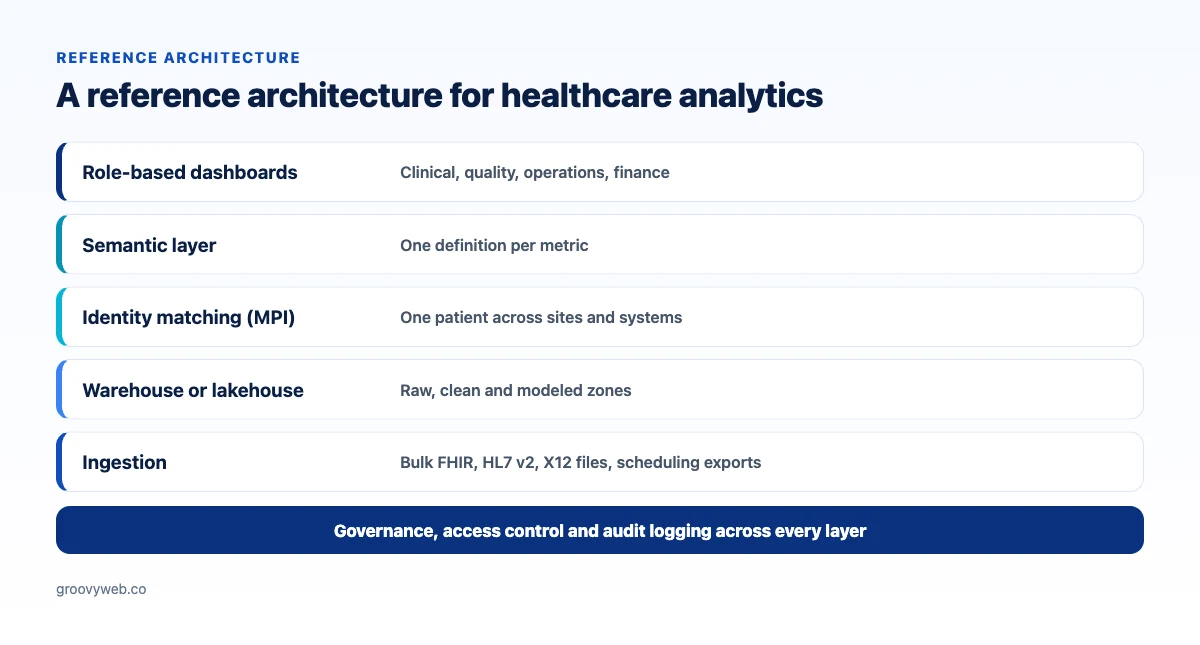
- Ingestion. Scheduled bulk FHIR exports, an interface engine for HL7 v2, file pickup for 837 and 835, and API or file pulls from scheduling systems. Keep raw payloads so you can reprocess when mappings change.
- Warehouse or lakehouse. A raw zone for source data, a clean zone with standard codes (ICD-10, CPT, LOINC, SNOMED CT), and a modeled zone of patients, encounters, providers, sites, claims and measures.
- Identity matching and MPI. The same patient often has different MRNs at different sites. ONC describes patient matching as identifying and linking one patient's data within and across health systems, typically using name, date of birth, phone and address. A master patient index (MPI) assigns one enterprise ID, with a review queue for uncertain matches. Provider and location matching needs the same care, usually keyed on NPI.
- Semantic layer. One definition of no-show rate, denial rate or attributed patient, used by every dashboard. Without it, two sites report different numbers for the same metric.
- Dashboards and delivery. Role-based dashboards, scheduled reports, and extracts for quality submission or registries.
Identity matching is where multi-site analytics fails most often. Duplicate patients inflate panel sizes, split care gaps across records and distort per-site metrics. Budget time for match rules, a steward who reviews uncertain matches, and a way to merge and unmerge records.
Plan retention from day one too. See our guide to healthcare data archiving compliance.
How Do Quality Reporting, Clinical Registries and Surveillance Dashboards Fit In?
These are three uses of the same unified data: quality reporting turns it into CMS submissions, registries track defined patient cohorts over time, and surveillance dashboards watch for trends in conditions or syndromes. Build the shared data model once and serve all three.
CMS quality reporting: MIPS and eCQMs
For most physician groups, CMS quality reporting means the Merit-based Incentive Payment System (MIPS) under the Quality Payment Program. The eCQI Resource Center lists 49 eligible clinician eCQMs (electronic clinical quality measures) for the 2026 performance period, including Controlling High Blood Pressure (CMS165v14) and Diabetes: Glycemic Status Assessment Greater Than 9% (CMS122v14). CMS kept the MIPS performance threshold at 75 points through the 2028 performance year and finalized six new MIPS Value Pathways (MVPs) for 2026. eCQM results go to CMS in QRDA Category III format, specified in the 2026 CMS QRDA III Implementation Guide for Eligible Clinicians.
Your certified EHR or a registry usually produces the submission file. The analytics platform shows measure performance by site and provider every month, lists patients with open gaps, and catches data capture problems before the year closes. Measure versions change yearly, so check the eCQI Resource Center.
Clinical registries
A registry is a defined cohort, such as patients with diabetes or heart failure, with consistent data elements tracked over time. It drives outreach lists and care management. For a multi-site group, the hard parts are cohort definitions that work across EHRs and the identity matching above. MyDiabetes Connect (see the project) is an example of the condition-specific data work we do.
Disease surveillance dashboards
Public health surveillance shows what timely data looks like at scale. CDC reports that 85% of US emergency departments send data to the National Syndromic Surveillance Program, often within 24 hours, and more than 7,500 facilities contribute daily (page updated September 1, 2026). Inside a provider group, a surveillance dashboard tracks syndromes, diagnoses or lab positivity by site and week. That needs near-real-time feeds (HL7 v2 or frequent incremental bulk FHIR pulls), not monthly batch loads. For required public health reporting, CMS's Promoting Interoperability program includes an Electronic Case Reporting measure, which CMS suppressed for the CY 2025 performance period.
Which Metrics Should a Multi-Site Provider Group Track?
Track a small set of access, financial, quality and provider metrics, defined once and comparable across sites. Compare sites with each other and with their own history before using outside benchmarks, which are rarely defined the way yours are.
| Domain | Metric | How it is usually defined | Main data source |
|---|---|---|---|
| Access | No-show rate | No-shows divided by scheduled appointments, by site, provider and visit type | Scheduling |
| Access | Third next available appointment | Days until the third open slot for a new or return visit | Scheduling |
| Capacity | Slot utilization | Booked slots divided by available slots | Scheduling |
| Revenue | Denial rate | Denied claims divided by submitted claims, by payer, reason code and site | 837 and 835 |
| Revenue | Days in accounts receivable | Outstanding receivables divided by average daily charges | Practice management, 837 and 835 |
| Revenue | Net collection rate | Payments divided by allowed amounts | 835 |
| Quality | eCQM performance rate | Per CMS measure specification, by site and provider | EHR quality data |
| Quality | Open care gaps | Patients in a measure denominator not yet meeting the numerator | EHR, registry |
| Provider | Visits and RVUs per clinical session | Completed visits or work RVUs divided by scheduled sessions | Scheduling, 837 |
Publish the definition next to every number. Most arguments between site leaders are definition differences.
How Much Does a Healthcare Analytics Platform Cost?
It depends on the number of sources, sites and dashboards, and on whether you buy, build or combine. We do not publish a fixed price for analytics platforms. The one piece with a standard range is the EHR connection: a single-EHR integration (FHIR or HL7) typically runs $15K to $40K for a first release. Everything else is scoped after discovery.
What drives the rest of the cost:
- Number of distinct source systems. Three sites on one EHR cost far less than three sites on three EHRs.
- Freshness. Daily batch loads are simpler than near-real-time HL7 v2 feeds for surveillance.
- Identity matching. Clean shared MRNs versus probabilistic matching with a steward queue.
- Claims depth. Parsing 835 adjustment codes and matching them to 837 lines takes real effort.
- Quality logic. Reusing EHR measure output versus recomputing measures from raw data.
Our engineers start at $22/hr and work at least four hours overlapping US Eastern time. For a scoped estimate, see our healthcare data analytics services or hire a healthcare engineer to extend your team.
Healthcare Analytics Platform Selection Checklist
Scope and data
- [ ] Top 10 questions leadership wants answered, written down
- [ ] Inventory of EHRs, practice management, billing and quality systems per site
- [ ] Confirmed bulk FHIR access and HL7 v2 feeds for each EHR
- [ ] 837 and 835 file access from clearinghouse or billing vendor
- [ ] Agreed metric definitions for access, revenue and quality
Security and governance
- [ ] Role matrix mapping each job to the PHI categories it needs
- [ ] Row-level security by site in warehouse and BI tool
- [ ] Decision on de-identified, limited data set or full PHI per use case
- [ ] BAAs signed with cloud, ETL, BI and AI vendors
- [ ] Audit logging for queries, exports and dashboard access
Architecture and delivery
- [ ] MPI approach and steward review process chosen
- [ ] Raw, clean and modeled zones defined in the warehouse
- [ ] Semantic layer owns every published metric
- [ ] First release limited to one domain across all sites
- [ ] Retention and archiving plan for raw data
Key Takeaways
- There is no single best platform. Fit depends on your EHR mix, team skills and how much of the data model you want to own.
- Warehouse plus BI suits most multi-site groups with two or more source systems; packaged platforms suit standard value-based care needs.
- Unify EHR (bulk FHIR plus HL7 v2), scheduling, 837 and 835 claims, and quality data first.
- Identity matching across sites is the most underestimated piece.
- Build HIPAA controls in: minimum necessary by role, de-identification where possible, audit logs and BAAs.
Frequently Asked Questions
What is the best healthcare analytics platform for multi-site provider groups?
No single product wins for every group. The best fit unifies EHR, scheduling, claims and quality data across all your sites, matches patients to one identity, and enforces role-based HIPAA access. Packaged platforms fit groups on supported EHRs with standard value-based care needs. A warehouse plus BI fits groups running several EHRs that want to own their data model.
Should we buy or build a healthcare data analytics platform?
Buy if your EHRs are on the vendor's connector list and prebuilt quality and population health content covers your needs. Build, or use a warehouse plus BI, if you run multiple EHRs, need custom registries or surveillance views, or want data in your own cloud account. Many groups combine a vendor quality module with their own warehouse.
How does bulk FHIR help healthcare analytics?
Bulk FHIR lets you export data for all patients or a defined group in one asynchronous request, delivered as NDJSON files. ONC certification criterion 170.315(g)(10) requires certified EHRs to support multi-patient export. The _since parameter enables incremental loads. HL7 v2 feeds still fill near-real-time needs such as admissions and lab results.
Can we use de-identified data for internal analytics?
Yes. HIPAA allows de-identification by Safe Harbor, which removes 18 identifiers, or by Expert Determination. De-identified data is no longer PHI. Safe Harbor removes most dates, which limits trend analysis, so many groups use a limited data set under a data use agreement or keep PHI with strict role-based access. Your privacy officer should decide per use case.
Do BI and cloud vendors need to sign a BAA?
Yes, if they create, receive, maintain or transmit PHI for you. That includes the data warehouse, BI tool, ETL service and any AI assistant with access to patient data. Microsoft and AWS both offer BAAs for in-scope services. A BAA alone does not make you compliant; access controls, configuration and audit logging remain your responsibility.
How long does it take to build a healthcare analytics platform?
It depends on source systems, sites and scope. A focused first release, such as one domain like access or denials across all sites from one EHR, moves much faster than a full platform. Identity matching, claims parsing and measure logic add time. We scope timelines after a discovery call that reviews your systems and priorities.
Planning a Multi-Site Analytics Platform?
We help provider groups and health-tech teams decide between buy, build and warehouse plus BI, then build the EHR, HL7 and claims pipelines, identity matching and HIPAA-ready access controls. Groovy Web signs BAAs and works your US hours.
Next Steps
Need Help With Healthcare Analytics?
We map your sources, design the warehouse and identity layer, and deliver dashboards your site leaders trust, with HIPAA-ready access controls from day one.
Schedule a free consultation →
Related Services
- Healthcare Data Analytics — warehouses, dashboards and quality reporting for provider groups
- FHIR and HL7 Integration — bulk FHIR, HL7 v2 and EHR connectors
- Healthcare Security and Compliance — access controls, audit logging and HIPAA risk reviews
Published: November 2026 | Author: Groovy Web Team | Category: Healthcare
Ship Production-Grade AI with Senior Engineers
Our AI-First engineering approach delivers production-ready applications in weeks, not months.
Hire an AI-First Engineering Team