The medical device software development process is the documented life cycle defined by IEC 62304: planning, requirements, architecture, detailed design, unit implementation and verification, integration and system testing, and release. Maintenance, ISO 14971 risk management, configuration management and problem resolution run alongside it, inside the manufacturer's quality system, scaled to software safety class A, B or C.
Most guides list the IEC 62304 clauses and stop. This one also covers which activities apply to your safety class, what FDA wants in a premarket submission, what the 2026 Quality Management System Regulation changed, and what to ask a development company before it writes regulated code. If you need budget numbers by safety class, read our medical device software development cost guide. If you are still deciding whether your product is SaMD or embedded software, start with SaMD vs embedded medical device software.
What Is the Medical Device Software Development Process?
It is a controlled software life cycle that produces working software and the objective evidence that it is safe and does what it claims. In the US, four layers define it:
- FDA's Quality Management System Regulation (QMSR). 21 CFR Part 820 is now titled the Quality Management System Regulation, and it incorporates ISO 13485:2016 by reference (21 CFR 820.7, eCFR). The final rule was published on February 2, 2024 and took effect on February 2, 2026 (Federal Register, 89 FR 7496).
- IEC 62304. The software life cycle standard. FDA lists IEC 62304 Edition 1.1 (2015-06), adopted in the US as ANSI/AAMI IEC 62304:2006/A1:2016, as a recognized consensus standard under recognition number 13-79 (FDA Recognized Consensus Standards database).
- ISO 14971. The risk management standard. IEC 62304 assumes an ISO 14971 process and adds software-specific risk tasks.
- FDA guidance. Nonbinding, but it tells you what reviewers expect.
FDA defines Software as a Medical Device (SaMD), using the IMDRF definition, as software intended for medical purposes that performs them without being part of a hardware medical device. Software in a Medical Device (SiMD) is integral to a hardware device (FDA, Software as a Medical Device). The IEC 62304 life cycle applies to both. SiMD adds hardware interfaces and firmware; SaMD adds cloud hosting and frequent updates.
What Are IEC 62304 Software Safety Classes A, B and C?
The safety class sets how much of the life cycle you must perform and document. You classify by the worst harm a software failure could contribute to, after considering risk controls outside the software, such as a hardware interlock or a clinician review step.
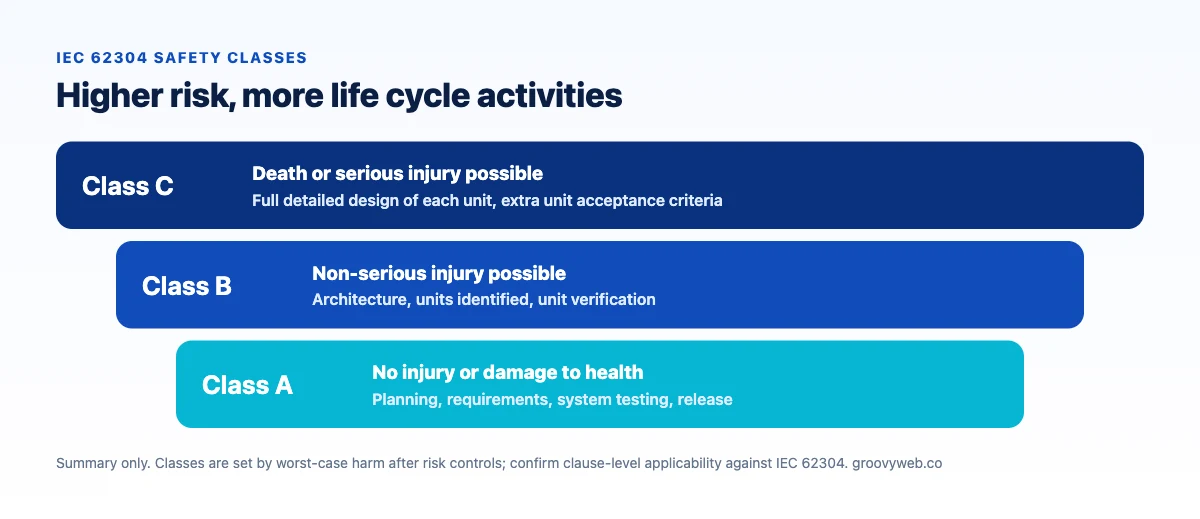
- Class A: the software cannot contribute to a hazardous situation, or any hazardous situation does not result in unacceptable risk once external risk controls are considered.
- Class B: the software can contribute to a hazardous situation with unacceptable risk, and the possible harm is non-serious injury.
- Class C: the same, but the possible harm is death or serious injury.
Three practical rules follow. Unclassified software is treated as Class C. Software items can carry different classes only if you can show they are truly separated. And the class is a design input: an external risk control added early, such as an independent hardware alarm, can lower the class and shrink the documentation load for years.
| Life cycle activity (IEC 62304 clause) | Class A | Class B | Class C |
|---|---|---|---|
| Development planning (5.1) | Yes | Yes | Yes |
| Software requirements analysis (5.2) | Yes | Yes | Yes |
| Architectural design (5.3) | No | Yes | Yes |
| Detailed design (5.4) | No | Units identified | Full detailed design of each unit |
| Unit implementation (5.5) | Implementation only | Plus unit verification | Plus extra unit acceptance criteria |
| Integration and integration testing (5.6) | No | Yes | Yes |
| Software system testing (5.7) | Yes (since Amendment 1) | Yes | Yes |
| Software release (5.8) | Yes | Yes | Yes |
| Maintenance, risk, configuration, problem resolution (6-9) | Yes | Yes | Yes |
This table is a summary; confirm subclause applicability against your copy of IEC 62304. The safety class is also not FDA's Documentation Level, covered below.
Vendor Questions Checklist: What to Ask a Development Company Before Hiring Them Under FDA and IEC 62304
Ask questions that force evidence, not adjectives: whose quality system governs the work, and what their life cycle records look like. For general healthcare vendor vetting (security, BAAs, certifications), see how to choose a healthcare software development company.
One fact shapes every answer. Under the QMSR, the manufacturer is responsible for the quality system and for controlling its suppliers. FDA has also said it will not require ISO 13485 certification and will not accept a certificate as a substitute for an inspection (QMSR final rule, response to comment 79). So a vendor's certificate does not move your obligations. What matters is whether the vendor can work inside your procedures and hand you complete records.
Quality system and roles
- [ ] Whose quality system governs the work: yours, the vendor's, or a defined mix written into a quality agreement?
- [ ] Does the vendor hold ISO 13485 certification? If yes, ask for the certificate number and scope. If no, ask how it works inside a client QMS.
- [ ] Will they sign a quality agreement and accept supplier audits?
IEC 62304 process evidence
- [ ] Can they show a redacted development plan, requirements specification and architecture document from past regulated work?
- [ ] How do they trace user needs to requirements, design, tests and risk controls? Which tool holds the trace matrix?
- [ ] How do they classify software items and justify segregation between classes?
- [ ] How do they qualify and document SOUP (software of unknown provenance), including open-source libraries?
- [ ] What is their unit test and code review practice for Class B and C items?
Risk, security and FDA submissions
- [ ] How do engineers feed software failure modes into your ISO 14971 risk file?
- [ ] Can they produce a software bill of materials (SBOM) and a threat model for a cyber device?
- [ ] Have they supported a premarket submission for device software functions, and which documents did they write?
- [ ] How do they record anomalies, and how do unresolved anomalies get a documented safety evaluation?
Handover and maintenance
- [ ] Does the code live in your repository from day one, with signed commits and tagged releases?
- [ ] Who maintains the software after release, and how are changes risk-assessed and regression-tested?
A red flag is any vendor that calls itself "IEC 62304 certified." IEC 62304 is a process standard you follow and document; conformity is shown through records and the manufacturer's Declaration of Conformity.
The IEC 62304 Lifecycle Step by Step
Clause 5 defines eight activities, from planning to release. They overlap and repeat across iterations, and agile delivery is fine as long as each increment produces the required records.
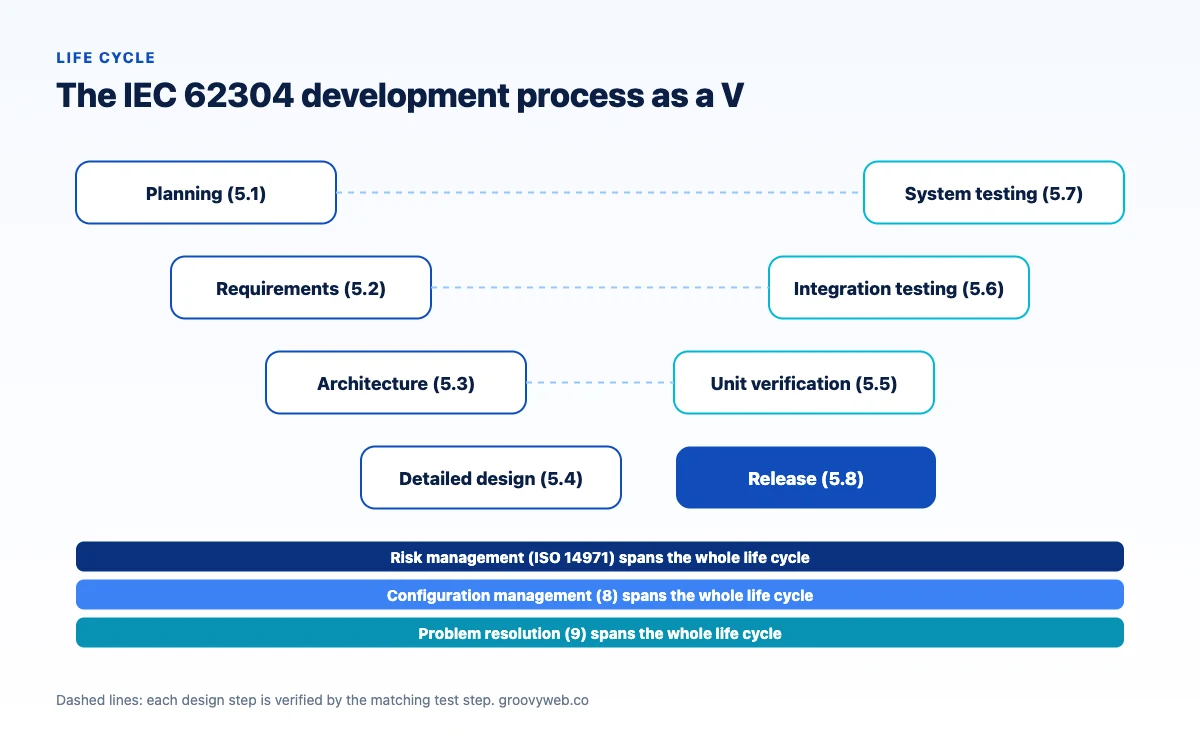
- Software development planning (5.1). Write the plan: life cycle model, deliverables, tools, verification, risk, documentation and configuration management. Keep it current.
- Software requirements analysis (5.2). Turn user needs and system requirements into software requirements, including interfaces, alarms, security and risk control measures implemented in software. Verify them for consistency and testability.
- Software architectural design (5.3). Break the system into software items, define interfaces, identify SOUP and document any segregation between safety classes. Verify the architecture against the requirements.
- Software detailed design (5.4). Refine items into units. For Class C, document and verify a detailed design for each unit and its interfaces.
- Software unit implementation and verification (5.5). Write code to your coding standard. For Class B and C, verify each unit against acceptance criteria through review, static analysis and unit tests.
- Software integration and integration testing (5.6). Integrate units and items by plan, test that risk controls work as designed and run regression tests as changes land.
- Software system testing (5.7). Test every software requirement with recorded expected and actual results, pass or fail, tester, date and version. Log failures as problem reports.
- Software release (5.8). Confirm verification is complete, evaluate residual anomalies, document how the version was built and archive it.
Write the records as you go; documentation written at the end usually exposes traceability gaps that force retesting. Automate where you can: requirement IDs in commits, CI test results feeding the trace matrix, and an SBOM on every build.
Which Processes Run Across the Whole Lifecycle?
Four supporting processes run from the first plan until the product is retired: maintenance, risk management, configuration management and problem resolution. Auditors examine them as closely as the development steps.
Software maintenance (clause 6)
Plan how you receive feedback, evaluate problem reports, assess each change for safety impact and release updates. Every post-release change goes back through the relevant development steps.
Software risk management per ISO 14971 (clause 7)
Identify how software, including SOUP, could contribute to a hazardous situation, define risk controls, verify each one is implemented and effective, and re-assess risk on every change. The output feeds the device risk management file that FDA expects in every submission.
Software configuration management (clause 8)
Identify every configuration item (code, SOUP versions, build scripts, tools, documents), control changes through approved requests and record each release's configuration so any shipped version can be rebuilt exactly.
Software problem resolution (clause 9)
Log every problem, investigate it, assess safety relevance, verify the fix and watch for trends. Problem reports link back into risk management.
What Does FDA Expect for Device Software in a Premarket Submission?
FDA expects software documentation scaled to one of two Documentation Levels, Basic or Enhanced, plus cybersecurity documentation for devices that connect to the internet. The key guidance is "Content of Premarket Submissions for Device Software Functions," announced on June 14, 2023, which replaced FDA's software submission guidance from May 11, 2005 (Federal Register notice; FDA guidance page).
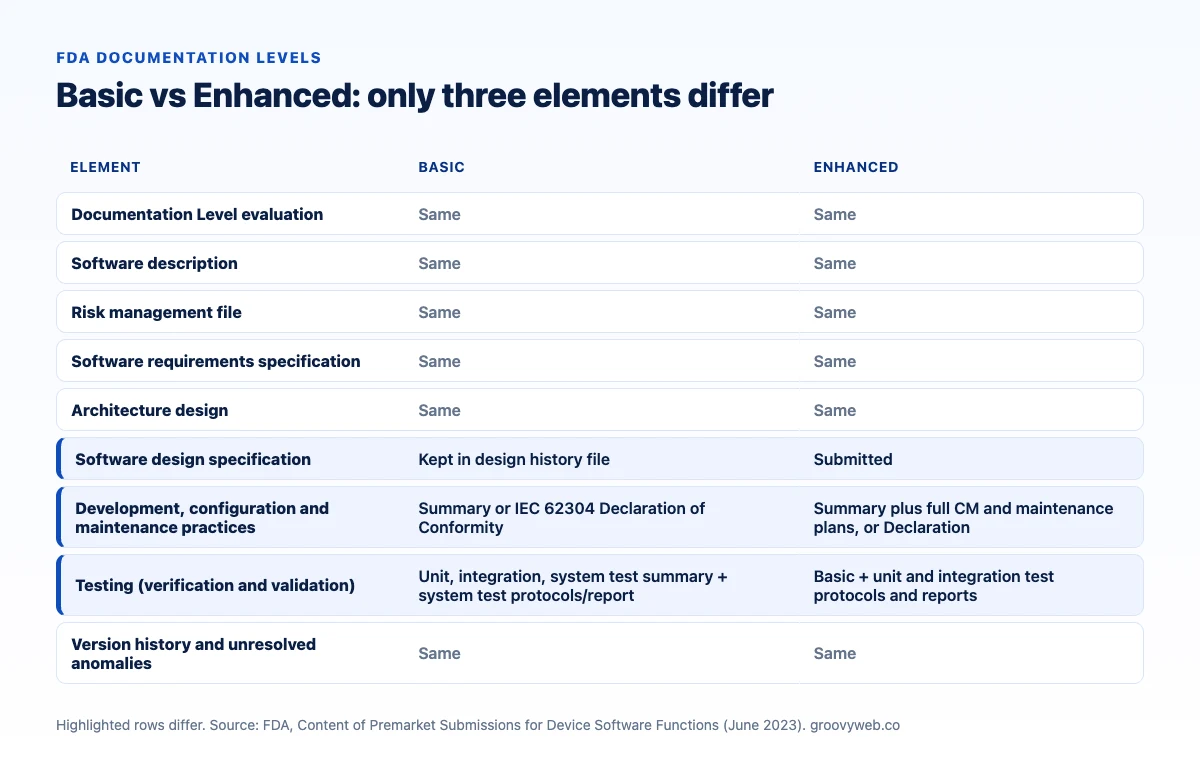
Enhanced applies when a software failure or flaw could present a hazardous situation with a probable risk of death or serious injury, assessed before risk controls. Basic applies otherwise. FDA generally recommends Enhanced for Class III devices and for device constituents of combination products, and you can ask FDA about your level in a Pre-Submission.
| Documentation element | Basic | Enhanced |
|---|---|---|
| Documentation Level evaluation | Level and rationale | Same |
| Software description | Required | Same |
| Risk management file | Plan, assessment, report | Same |
| Software requirements specification | Required | Same |
| System and software architecture design | Detailed diagrams of modules, layers, interfaces and data flow | Same |
| Software design specification | Kept in the design history file, not submitted | Submitted |
| Development, configuration management and maintenance practices | Summary, or Declaration of Conformity to listed IEC 62304 clauses | Summary plus full configuration management and maintenance plans, or Declaration of Conformity |
| Software testing as part of verification and validation | Summary of unit, integration and system testing plus system test protocols and report | Basic plus unit and integration test protocols and reports |
| Software version history | Required | Same |
| Unresolved software anomalies | List with safety and effectiveness impact | Same |
Source: Table 1 of the FDA premarket software guidance. FDA notes a Declaration of Conformity to the complete IEC 62304 standard is not needed, because the guidance and the standard categorize software differently. That is why safety class and Documentation Level are separate decisions.
What does section 524B require for cyber devices?
Section 3305 of the Food and Drug Omnibus Reform Act, enacted on December 29, 2022, added section 524B to the FD&C Act (21 U.S.C. 360n-2). A cyber device is one that includes sponsor-validated software, can connect to the internet and could be vulnerable to cybersecurity threats. Sponsors of 510(k), PMA, De Novo, PDP and HDE submissions for cyber devices must:
- Submit a plan to monitor, identify and address postmarket vulnerabilities, including coordinated vulnerability disclosure.
- Maintain processes that reasonably assure cybersecurity, with regular patches and out-of-cycle fixes for critical vulnerabilities.
- Provide a software bill of materials covering commercial, open-source and off-the-shelf components.
FDA's guidance "Cybersecurity in Medical Devices: Quality System Considerations and Content of Premarket Submissions" was updated on June 27, 2025 to cover section 524B, replacing the September 27, 2023 version (Federal Register notice). For the engineering side, see our healthcare security and compliance services.
What changed with the QMSR on February 2, 2026?
The old Quality System Regulation was replaced by the QMSR, built on ISO 13485:2016. FDA also stopped using the Quality System Inspection Technique (QSIT) and now inspects under Compliance Program 7382.850 (FDA QMSR page). If you already follow IEC 62304, daily software work barely changes. Procedures and vendor quality agreements that cite old Part 820 sections need remapping to ISO 13485 clauses.
Who Should Build Your Device Software?
Pick the model by who owns the quality system and how much engineering capacity you have. The manufacturer always owns the regulatory outcome.
Choose an in-house team if:
- Your software is your core product and will change for years
- You already run an ISO 13485 quality system with software procedures
- You can hire and keep engineers who know IEC 62304
Choose a development partner working inside your QMS if:
- You hold the quality system and regulatory lead but need engineering capacity
- You want code, records and the trace matrix in your own tools from day one
- Your product is SaMD or device-connected software (apps, cloud, integrations)
Choose a full-service design firm with its own ISO 13485 certification if:
- You have no quality system yet and need the supplier's procedures to carry early design work
- The project includes hardware, firmware and electrical safety testing
- You accept higher cost and tighter dependency
Groovy Web fits the middle model. We build SaMD and device-connected software (patient apps, clinician dashboards, cloud back ends and FHIR and HL7 integrations) inside the client's quality system, with IEC 62304-aligned plans, requirements, traceability, test records and SOUP lists. We do not hold ISO 13485 certification, and we are not the manufacturer of record: your regulatory team owns the submission. Our engineers overlap at least four hours with US Eastern time. Details are on our medical device software development page, and if you need senior engineers embedded in your team, see hire healthcare AI engineers.
Key Takeaways
- The process is the IEC 62304 life cycle: eight development activities plus four supporting processes, run inside the manufacturer's quality system.
- Safety class A, B or C sets how much of it you perform. Unclassified software is Class C.
- FDA's Documentation Level (Basic or Enhanced) separately sets what you submit.
- Cyber devices need a postmarket vulnerability plan, patching processes and an SBOM under section 524B.
- Since February 2, 2026, 21 CFR 820 is the QMSR, built on ISO 13485:2016.
- Ask vendors for evidence: sample IEC 62304 records, traceability, SOUP handling and whose quality system governs the work.
Frequently Asked Questions
What are the steps of the IEC 62304 software development process?
Clause 5 of IEC 62304 defines eight activities: software development planning, requirements analysis, architectural design, detailed design, unit implementation and verification, integration and integration testing, system testing, and release. Four supporting processes run throughout: maintenance, risk management, configuration management and problem resolution. How many tasks you must perform within each activity depends on the software safety class.
Is IEC 62304 mandatory for FDA submissions?
No. IEC 62304 is a voluntary consensus standard that FDA recognizes. FDA's premarket software guidance lets you either describe your development, configuration management and maintenance practices or provide a Declaration of Conformity to specific IEC 62304 clauses. Most manufacturers follow the standard because it gives reviewers a familiar structure and is also expected by regulators outside the US.
What is the difference between IEC 62304 safety class and FDA Documentation Level?
The safety class (A, B or C) comes from IEC 62304 and sets which life cycle activities you perform, based on harm after external risk controls. FDA's Documentation Level (Basic or Enhanced) sets what you submit, based on whether a software failure could present a probable risk of death or serious injury before risk controls. They are assessed separately and do not map one to one.
Does a medical device software vendor need ISO 13485 certification?
Not necessarily. FDA does not require ISO 13485 certification and will not accept a certificate in place of an inspection. The manufacturer must run a compliant quality system and control its suppliers. A vendor without certification can work inside the manufacturer's quality system under a quality agreement, as long as it follows those procedures and hands over complete records.
Does IEC 62304 apply to SaMD as well as embedded software?
Yes. IEC 62304 covers software that is itself a medical device and software that is part of a hardware device. The life cycle is the same. The differences are in the system around the software: embedded software adds hardware interfaces and firmware constraints, while SaMD adds cloud hosting, off-the-shelf platforms, cybersecurity exposure and faster release cycles.
What is SOUP in IEC 62304?
SOUP stands for software of unknown provenance: any software item you did not develop under your own IEC 62304 process, such as open-source libraries, operating systems or commercial components. You must identify each SOUP item and version, define the requirements it must meet, assess known anomalies for safety impact and keep it under configuration management. Your SOUP list also feeds the SBOM.
Building Device Software Inside Your Quality System?
We build SaMD and device-connected software with IEC 62304-aligned records, inside your QMS and alongside your regulatory team. Share your device, safety class and timeline, and we will say plainly what we can own.
Next Steps
Need Help With Medical Device Software Development?
Groovy Web builds SaMD and device-connected software with IEC 62304-aligned documentation, inside your quality system. You remain the manufacturer of record.
Schedule a free consultation →
Related Services
- Medical Device Software Development — SaMD and device-connected software with IEC 62304-aligned documentation
- Healthcare Security and Compliance — threat modeling, SBOMs and security controls for connected health software
- FHIR and HL7 Integration — connecting device data to EHRs and clinical systems
Published: November 2026 | Author: Groovy Web Team | Category: Healthcare
Ship Production-Grade AI with Senior Engineers
Our AI-First engineering approach delivers production-ready applications in weeks, not months.
Hire an AI-First Engineering Team