To choose a healthcare software development company, score each vendor on ten things you can verify: BAA willingness, where PHI is hosted and who can reach it, proven FHIR/HL7/X12 work, certifications actually held, pricing transparency, engagement model, US-hours overlap, code and IP ownership, exit terms, and named proof you can check.
Most vendor websites use the same words: HIPAA, FHIR, secure. This guide gives US health-tech founders, CTOs and provider IT leaders a framework that works for any healthcare product, from patient apps and telehealth to EHR integrations and AI tools. It covers what to evaluate, how to verify each claim, what published prices look like across named firms, and the red flags that should end a conversation. If you are choosing a vendor specifically to build or replace an EHR, read our EHR development company scoring guide after this one for EHR-specific depth.
What Should You Evaluate in a Healthcare Software Development Company?
Evaluate the ten criteria below, and for each one ask for evidence, not a yes. A vendor that answers every row with a document, a name or a demo is easier to trust than one that answers with adjectives.
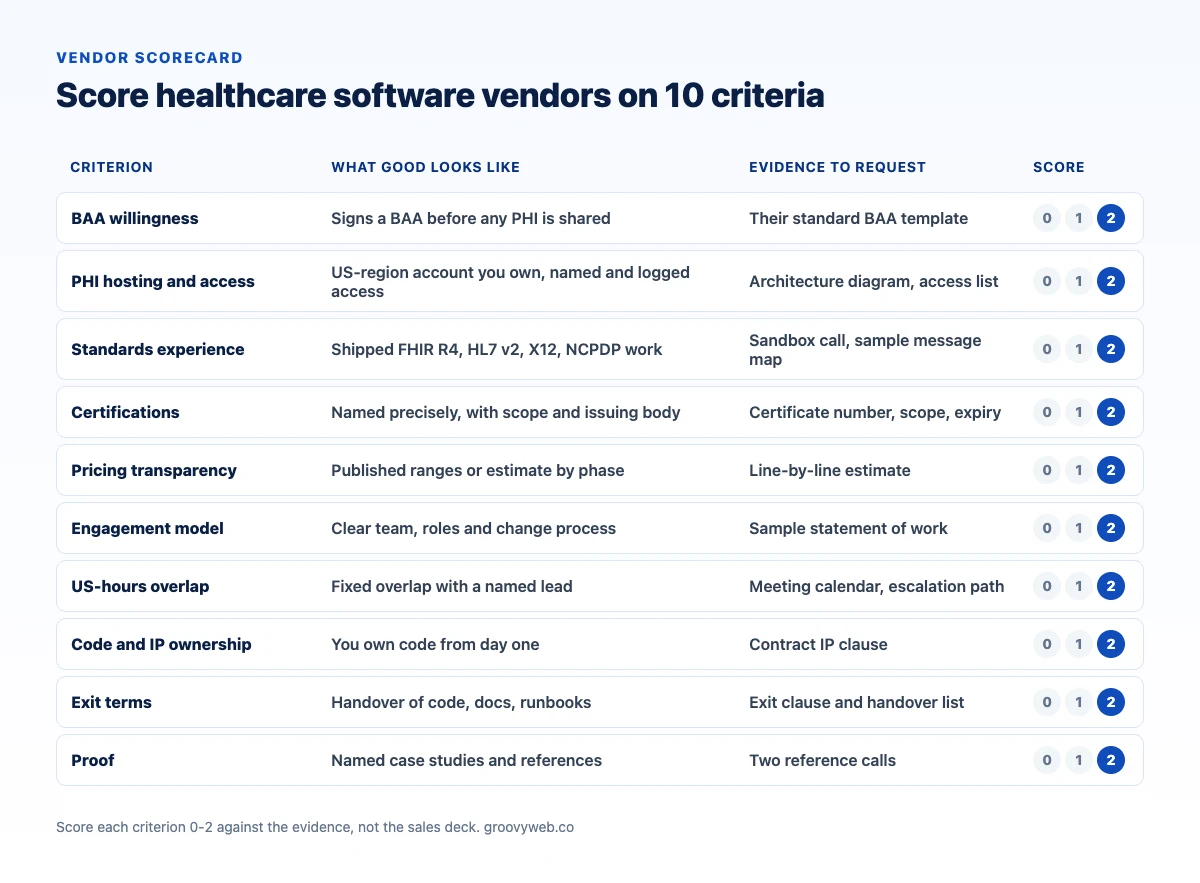
Score each row 0 (no evidence), 1 (claimed, not shown) or 2 (shown with documents). A zero on BAA or IP ownership ends the evaluation on its own.
| Criterion | What good looks like | How to verify |
|---|---|---|
| BAA willingness | Signs a business associate agreement before any PHI is shared, and flows the same terms down to subcontractors | Ask for their standard BAA template up front. Compare it with the HHS sample BAA provisions (published January 25, 2013) |
| Where PHI is hosted and who can access it | PHI stays in a US-region cloud account you own; vendor staff get named, logged, revocable access; development uses synthetic data | Ask for an architecture diagram, the cloud account owner, and the access list with roles |
| Standards experience | Shipped work on the standards your product needs: FHIR R4, HL7 v2, X12 5010 for claims and eligibility, NCPDP for pharmacy | Ask to see a sandbox call, a sample message map, or an integration they can name. Ask which FHIR version and which EHR sandboxes they have used |
| Certifications claimed vs held | Certificates named precisely, with scope and issuing body; compliance language kept separate from certification language | Ask for certificate number, scope statement, certification body and expiry date |
| Pricing transparency | Published ranges or a written estimate split by phase, with assumptions listed | Compare the estimate line by line against their public price page, if they have one |
| Engagement model | Clear choice of fixed scope, time and materials, or dedicated team, matched to how settled your requirements are | Ask for a sample statement of work and change-request process |
| US-hours overlap | Several daily hours of live overlap with your team, with named people in standups | Ask for the team calendar and who attends which meetings |
| Code and IP ownership | You own the code, designs and documentation on payment; code lives in your repository from day one | Read the IP clause in the master services agreement, not the sales deck |
| Exit terms | Short notice period, handover plan, credential transfer, and PHI returned or destroyed at termination | Ask for the termination and transition clauses in writing |
| Proof | Named healthcare projects and references you can call | Ask for two references from healthcare clients and a walkthrough of one live product |
Why do the standards rows matter so much?
Because the standards are fixed by regulation, and a vendor that has not shipped them will learn on your budget. CMS lists ASC X12 Version 5010 as the adopted HIPAA transaction standard, with NCPDP Version D.0 for retail pharmacy transactions. Clinical data exchange runs mostly on HL7 FHIR R4 (v4.0.1) and older HL7 v2 feeds. If you sell to payers, the CMS Interoperability and Prior Authorization final rule (CMS-0057-F) gives impacted payers until primarily January 1, 2027 to meet its API requirements, so FHIR API experience is a near-term need, not a nice-to-have. For the build side of this, see our FHIR and HL7 integration services.
What does the BAA have to cover?
A BAA is the contract that makes a vendor accountable for PHI it touches. The HHS sample provisions require, among other things, that the business associate report uses or disclosures not allowed by the agreement, make sure any subcontractor with PHI access agrees to the same restrictions, and at termination return or destroy PHI if feasible. A vendor that hesitates to sign one, or wants to start work before it is signed, is telling you how it treats PHI.
ISO 27001, ISO 13485, SOC 2, HITRUST: What Does Each Certification Actually Prove?
Each one certifies something different, and none of them is "HIPAA certification," because that does not exist. Check the exact scope of every claim.
- ISO/IEC 27001:2022 sets requirements for an information security management system (ISMS). In ISO's own description, conformity means an organization "has put in place a system to manage risks related to the security of data owned or handled by the company." It certifies a management system, not a product.
- ISO 13485:2016 is quality management systems for medical devices, "requirements for regulatory purposes". ISO lists it as last reviewed and confirmed in 2025. It matters if you are building software as a medical device (SaMD). It says little about a vendor's security.
- SOC 2 is a CPA firm's examination of controls at a service organization relevant to security, availability, processing integrity, confidentiality or privacy, under AICPA standards. It is a report, not a certificate. Ask which criteria are in scope and what period it covers.
- HITRUST offers assessments built on the HITRUST Framework: e1 (43 core controls, valid 1 year), i1 (182 control requirements, valid 1 year) and r2 (tailored, valid 2 years). Ask which one, and when it expires.
"HIPAA certified" does not exist. HHS states that no standard or implementation specification requires a covered entity to "certify" compliance, and that HHS "does not endorse or otherwise recognize private organizations' 'certifications'" regarding the Security Rule. ISO also does not perform certification or issue certificates; external certification bodies do. A vendor that says "ISO certified" should be able to name the body that certified it.
Where does Groovy Web stand?
Groovy Web's ISO 27001 certification is in progress, not complete. We do not hold SOC 2 or HITRUST. What we do instead: we sign BAAs, we build and test with synthetic data so engineers do not handle real PHI during development, we deploy to US-region hosting in the client's own cloud account, and the client owns the code. Our approach to HIPAA safeguards is set out on our healthcare security and compliance page. If your procurement requires a SOC 2 report or HITRUST certificate from the vendor itself, we are not the right fit today, and we would rather tell you that now.
How Do You Verify Each Vendor Claim?
Ask for the document behind each claim, then check it with a third party where you can.
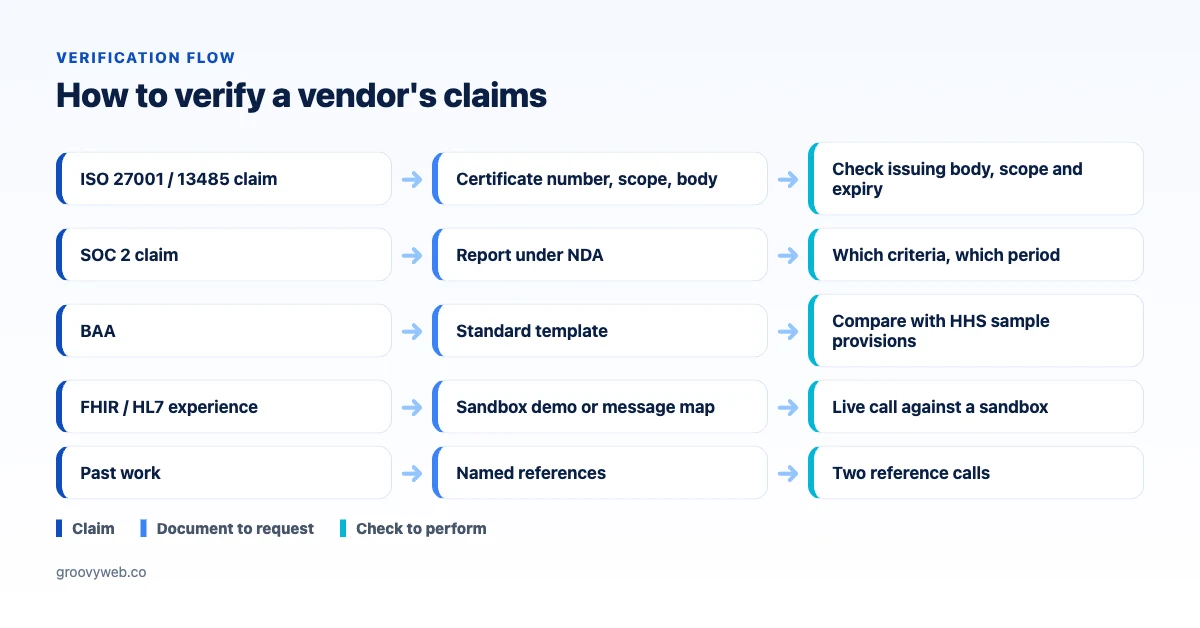
- Certificates. Ask for the certificate number, the scope statement, the certification body and the expiry date. Check that the scope covers the delivery team that will work on your project, not only a head office or one product line.
- SOC 2 report. Ask for the full report under NDA, not a badge or summary letter. Read the scope, the period covered, and the exceptions section.
- Sample BAA. Ask for it before the first technical call. Check breach notification timing, subcontractor flow-down, and return or destruction of PHI at termination.
- Sandbox demo. Ask them to show a working FHIR call against an EHR sandbox, or a parsed HL7 v2 message, live on screen.
- References. Ask for two healthcare clients you can call. Ask the reference who owned the code, how change requests were priced, and whether the team that sold the project was the team that built it.
- Named work. Ask for a walkthrough of a live product. At Groovy Web, for example, the healthcare projects we can name are HIPPASHIELD, a HIPAA access-control and eligibility platform, MyDiabetes Connect, Rehabilitation Management Software and Start Psychotherapy.
What are the red flags when choosing a healthcare software vendor?
One should slow you down. Two should end the evaluation.
- Claims to be "HIPAA certified," or shows a HIPAA badge with no explanation.
- Will not share a BAA template until after contract signature.
- Wants real PHI copied to its own servers or laptops for development.
- Names ISO or SOC 2 but cannot give a certificate number, scope or report.
- Cannot name the FHIR version or EHR sandboxes it has worked with.
- Keeps the code in its own repository and transfers it "at the end."
- Long notice periods or termination fees with no handover plan.
- A fixed price quoted before anyone asked about your integrations.
How Do Published Healthcare Software Development Prices Compare?
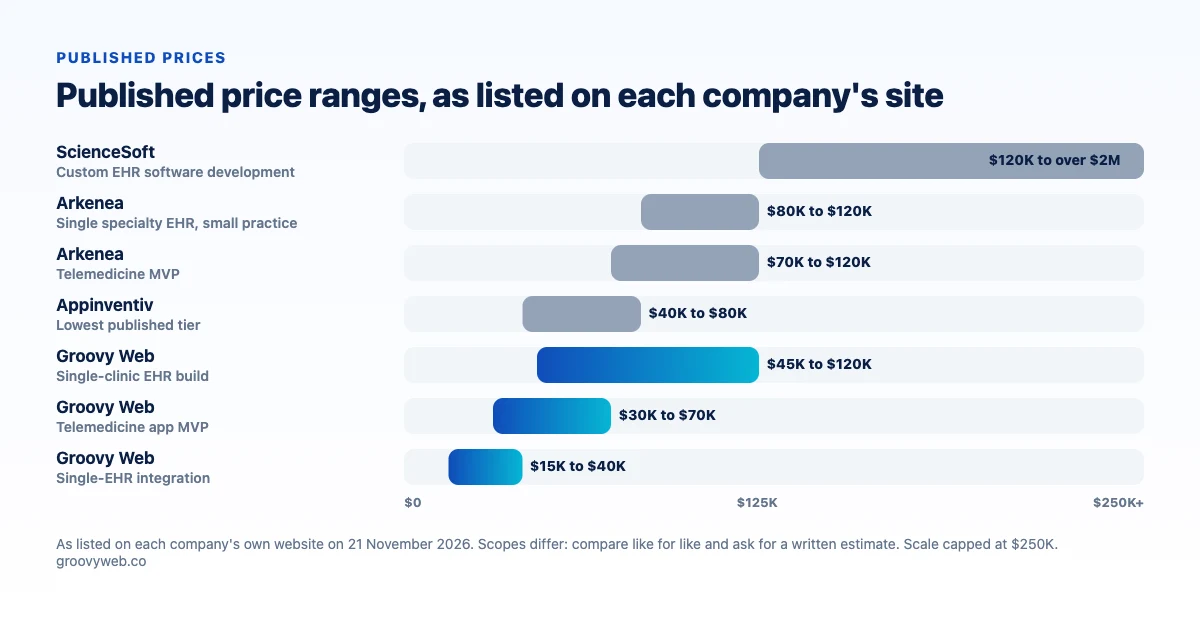
Published starting prices vary widely because each firm prices a different scope. Use them to set a range, then compare like for like on your own written scope.
The table lists only figures each company publishes about itself, as listed on its own page on November 21, 2026. It is not a ranking. Scopes, inclusions and timelines differ between firms and rows, so a lower or higher number does not mean better or worse value. Prices change, so re-check each page.
| Company | What the price covers (their wording) | Published range | Source (as listed on Nov 21, 2026) |
|---|---|---|---|
| Arkenea | Healthcare app first release | $50,000 to $200,000 | arkenea.com/pricing |
| Arkenea | Telemedicine MVP with video visits, scheduling and secure chat | $70,000 to $120,000 | arkenea.com/pricing |
| Arkenea | Single specialty EHR for a small practice | $80,000 to $120,000 | arkenea.com/pricing |
| Appinventiv | Lowest published tier, listed with appointment booking and records, basic teleconsultation, single EMR/EHR integration (3-5 months) | $40K to $80K | appinventiv.com/healthcare-software-development |
| ScienceSoft | Custom EHR software development | $120,000 to over $2,000,000 | scnsoft.com/healthcare/ehr/development |
| Groovy Web | Single-EHR integration (FHIR/HL7), typical first release | $15K to $40K | groovyweb.co cost guide |
| Groovy Web | AI patient chatbot or voice agent | $20K to $60K | groovyweb.co cost guide |
| Groovy Web | AI prior authorization automation | $25K to $80K | groovyweb.co cost guide |
| Groovy Web | Telemedicine app MVP | $30K to $70K | groovyweb.co cost guide |
| Groovy Web | AI medical scribe pilot | $40K to $90K | groovyweb.co cost guide |
| Groovy Web | Single-clinic EHR build | $45K to $120K | groovyweb.co cost guide |
Compare like for like. A "single specialty EHR" from one firm and a "single-clinic EHR build" from another may include different modules, integrations, compliance work and support. Groovy Web's ranges are typical first releases, and the final price follows a 30-minute scoping call; hourly work starts at $22/hr. Send every shortlisted vendor the same written scope and compare the estimates, not the headline numbers. For how EHR costs break down, see our EHR software development cost guide.
Which Type of Healthcare Software Partner Fits You?
Match the vendor type to your stage, your compliance requirements and how settled your scope is. Large firms, healthcare specialists and dedicated senior teams each fit different buyers.
Choose a large multi-vertical firm if:
- Your procurement requires vendor-held ISO, SOC 2 or HITRUST evidence
- You need a large team across many workstreams at once
- You have budget for a longer discovery and governance process
Choose a healthcare-focused specialist if:
- You are building software as a medical device and need ISO 13485 processes
- Clinical workflow depth matters more than team size
- You want a vendor whose whole portfolio is healthcare
Choose a dedicated senior team if:
- You need a first release or integration shipped in weeks, not months
- You want senior engineers working your US hours, not a large bench
- You want PHI in your own cloud account and code in your own repository
- You value published prices and a BAA over vendor-held certifications
Groovy Web fits the third profile: senior engineers in India working US hours with at least 4 hours of overlap with US Eastern, a US office in Wilmington, Delaware, and 200+ clients since 2015. If that fits your project, our healthcare AI engineers page explains how the engagement works.
Healthcare Software Vendor Checklist: Questions to Ask Before You Sign
Send these questions to every shortlisted vendor and ask for written answers with documents attached. Tick each item only when you have the evidence, not the promise.
Compliance and PHI
- [ ] Will you sign our BAA, or send yours for review, before any PHI is shared?
- [ ] Where will PHI be hosted, in which cloud region, and in whose account?
- [ ] Which of your staff can access PHI, how is access logged, and how is it revoked?
- [ ] Do you develop and test with synthetic data?
- [ ] Which subcontractors will touch PHI, and do they sign the same terms?
Certifications and audits
- [ ] Which certifications do you hold today? Certificate number, scope, issuing body, expiry?
- [ ] Can we read your SOC 2 report under NDA? Which criteria and period does it cover?
Standards and integration
- [ ] Which FHIR version, HL7 v2 message types, X12 transactions or NCPDP standards have you shipped?
- [ ] Which EHR sandboxes have you worked in? Can you demo a live call?
Commercials, IP and exit
- [ ] Is the estimate itemized by phase, with exclusions and change-request rates?
- [ ] Does the code live in our repository from day one? When does IP transfer?
- [ ] What is the notice period, and what does handover include?
- [ ] How is PHI returned or destroyed at termination?
Team and proof
- [ ] Who exactly is on the team, and how many hours overlap with our time zone?
- [ ] Can we speak to two healthcare references?
- [ ] Can you walk us through a live healthcare product you built?
Key Takeaways
- Score vendors on evidence across ten criteria. A zero on BAA, PHI hosting or IP ownership is disqualifying.
- "HIPAA certified" does not exist. HHS does not recognize private HIPAA certifications.
- ISO 27001 covers an information security management system, ISO 13485 covers medical device quality management, SOC 2 is a CPA report on controls, and HITRUST is a framework-based assessment. Check scope and dates for each.
- Published prices differ because scopes differ. Send every vendor the same written scope.
- Code in your repository, PHI in your cloud account, and clear exit terms protect you more than any badge.
Frequently Asked Questions
How do I choose a healthcare software development company?
Shortlist three to five vendors and score each on evidence: a signed BAA, US-region PHI hosting with logged access, shipped FHIR, HL7 or X12 work, certificates with scope and numbers, an itemized estimate, code ownership from day one, clear exit terms, and references you can call. Send all of them the same written scope so the quotes are comparable.
Is there such a thing as a HIPAA certified software development company?
No. HHS says no HIPAA standard requires a covered entity to certify compliance, and it does not endorse or recognize private organizations' HIPAA certifications. A vendor can sign a BAA, follow the Security Rule's safeguards, and hold separate certifications such as ISO 27001 or a HITRUST assessment, but "HIPAA certified" is a marketing phrase, not a credential.
What should I ask a healthcare software development company before hiring?
Ask whether they will sign a BAA before PHI is shared, where PHI will be hosted and who can access it, which standards and EHR sandboxes they have shipped against, which certifications they hold with numbers and scope, how the estimate breaks down, who owns the code and when, what the exit terms are, and which healthcare clients you can call as references.
What is the difference between ISO 27001 and SOC 2 for a healthcare vendor?
ISO/IEC 27001 is a certification of an information security management system, issued by an external certification body. SOC 2 is a report from a CPA firm on a service organization's controls relevant to security, availability, processing integrity, confidentiality or privacy. Both are useful. Neither is HIPAA compliance by itself. Check the scope of each against the team that will build your product.
How much does healthcare software development cost?
Published ranges vary by scope and firm. As listed on November 21, 2026, single specialty or single-clinic EHR builds are listed at $45K to $120K at Groovy Web and $80,000 to $120,000 at Arkenea, while ScienceSoft lists custom EHR development from $120,000 to over $2,000,000. Compare quotes against the same written scope, not headline figures.
Should I hire a healthcare-only firm or a general software company?
It depends on what you are building. If you need ISO 13485 processes for software as a medical device, a healthcare specialist with that certificate makes sense. If you need an app, integration or AI feature shipped quickly, a senior team that has shipped FHIR and HL7 work, signs a BAA and keeps PHI in your cloud account can be a better fit.
Want a Second Opinion on Your Vendor Shortlist?
Send us your scope and the questions above. We will answer them in writing, including where we are not the right fit, and give you a published-range estimate after a 30-minute call.
Next Steps
Need Help Choosing a Healthcare Software Development Partner?
Groovy Web's senior engineers build HIPAA-ready healthcare apps, EHR integrations and AI tools on your US hours. We sign BAAs, work with synthetic data, deploy to your own US-region cloud account, and you own the code. Starting at $22/hr.
Schedule a free consultation →
Related Services
- EHR Integration (Epic, Oracle Health, athenahealth) — connect your product to the EHRs your customers use
- Healthcare Security and Compliance — HIPAA-ready architecture, BAAs and audit logging
- Healthcare App Development Cost — published price ranges by product type
Published: November 2026 | Author: Groovy Web Team | Category: Healthcare
Ship Production-Grade AI with Senior Engineers
Our AI-First engineering approach delivers production-ready applications in weeks, not months.
Hire an AI-First Engineering Team