
 Claude
Healthcare Analytics Platform: Should You Build or Buy?
Buy when your questions are standard and your data sits in one or two systems. Build custom when your data, models or workflows are the advantage, or when off-the-shelf tools cannot reach your sources. Many teams do both, in stages.
HIPAA duties apply to every route, so the contract matters as much as the code.
Groovy Web builds healthcare data analytics software for provider and healthtech teams. If you are still working out how your records connect, read our guide to how EMR integration works first.
Below: the routes side by side, where HIPAA changes the decision, and what to ask a vendor before you sign.
What Does a Healthcare Analytics Platform Actually Include?
Four layers do most of the work. Ingestion pulls data from records, claims and devices. Standardization maps it to a common shape. A secure store holds it, and dashboards or models turn it into answers for clinicians and operators.
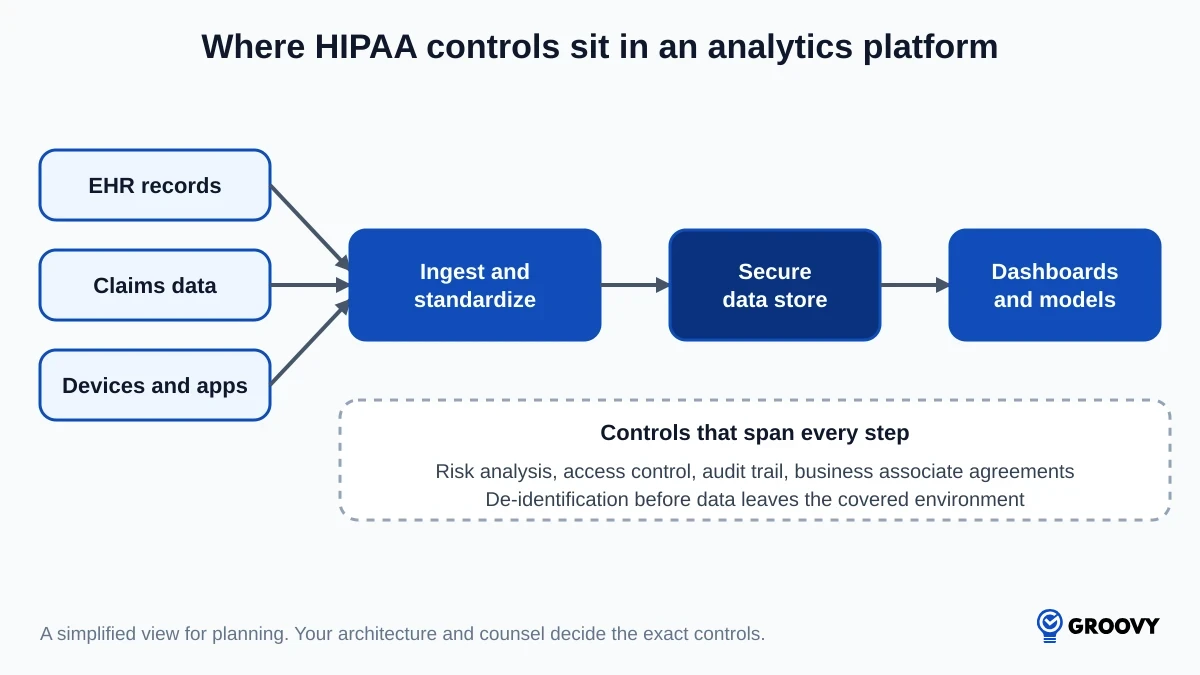
Buying usually covers some layers well and others thinly. Ask which layers hold your advantage. Those are worth owning.
Build vs Buy: How Do the Healthcare Analytics Options Compare?
| Buy | Hybrid | Build | |
|---|---|---|---|
| Time to first dashboard | Fastest | Fast for the bought part | Slowest at the start |
| Fit to your questions | Standard reports | Standard plus custom layers | Built for your questions |
| Source and EHR coverage | What the vendor connects | Vendor plus custom connectors | Scoped to your systems |
| Models and logic | Vendor's, with limited changes | Yours where it matters | Yours |
| Cost shape | Recurring fees | Fees plus a smaller build | Build, then maintenance |
| Data and pipeline control | Vendor holds most | Split by layer | You decide, by contract |
Treat the table as a map of trade-offs. A hybrid route often wins because it buys the commodity layers and builds only the part that differentiates you.
How Does HIPAA Shape the Decision?
Whichever route you pick, the security rule asks for a risk analysis. Under 45 CFR 164.308, you must conduct an accurate and thorough assessment of potential risks and vulnerabilities to electronic protected health information, and implement measures that reduce those risks to a reasonable level.

A vendor that creates, receives, maintains or transmits protected health information for you is a business associate. Your contract must follow 45 CFR 164.504, which sets what a business associate contract has to include.
| Contract term | Why it matters for analytics |
|---|---|
| Permitted uses and disclosures | Limits what the vendor may do with your data, including any use for its own products |
| Safeguards for electronic PHI | Sets the security duty for the store, pipelines and dashboards |
| Reporting of unauthorized uses and breaches | Decides how quickly you learn of a problem |
| Subcontractors bound to the same limits | Covers hosting and data tools behind the vendor |
| Return or destruction of PHI at the end | Decides how you leave |
Our guide to HIPAA-compliant AI development in healthcare covers how these duties extend to models that learn from patient data.
Can De-Identified Data Lower the Risk?
Sometimes. Health information that does not identify an individual is not individually identifiable health information under 45 CFR 164.514. The rule gives two ways to get there: an expert determination, or removing 18 listed identifiers under the de-identification standard.
The list is broad. It includes names, geographic units smaller than a state, all elements of dates except year, and any other unique identifying number, characteristic or code. Many analytics questions need dates and places, so check whether de-identified data can answer yours before you plan around it.
How Does EHR Integration Change the Choice?
Integration is where many analytics projects slow down. A bought tool only helps if it can reach your records. List your source systems first, then compare vendors.
Health IT certified to the ONC criterion in 45 CFR 170.315(g)(10) must support a standardized API for patient and population services, which includes requests for a single patient and for groups of patients. That gives both vendors and custom builds a common way in, though coverage and data quality still vary by system.
What Does Each Route Cost Over Time?
No single number fits every analytics platform, so be wary of a quote that gives one without asking about your sources. The shape of the cost differs by route.
- Buy: recurring fees that grow with users, data volume or modules, plus paid work for new sources
- Hybrid: fees for the bought layers plus a build cost for the custom ones
- Build: a build cost, then hosting, security reviews, data quality work and a team to change it
Compare the total over the period you plan to run it. Include the cost of connecting each source and the cost of leaving.

Who Owns the Models, Pipelines and Data?
Ownership decides how hard it is to leave. Ask who owns the data models, the pipeline code, the trained models and any derived datasets, and what you receive at the end of the contract.
With a build, write these rights into the agreement. With a purchase, ask for export formats and for a written plan that matches the return or destruction terms of the business associate contract.
What Should You Ask a Vendor Before You Sign?
- Will you sign a business associate agreement, and who are your subcontractors?
- Which of my source systems do you connect to today, and which are on a roadmap only?
- Where is data stored, and can I export raw and derived data in usable formats?
- Can you use my data to train or improve your own products?
- Who owns the models, pipelines and derived datasets?
- How do you support my risk analysis, audit logs and access controls?
Written answers beat a demo. A vendor that is vague about data use or subcontractors is showing you how the relationship will go.
Which Analytics Route Fits Your Team?
Choose to buy if:
- Your questions are standard and your data sits in one or two systems
- You need dashboards quickly and have little data engineering capacity
- The vendor signs a business associate agreement and agrees export terms
Choose a hybrid route if:
- Commodity reporting is fine, but one model or metric is your advantage
- You want to buy the standard layers and build the differentiating one
- You can define the interface between the two before either side starts
Choose to build custom if:
- Your data, models or workflows are part of what you sell
- You need sources or analyses that vendors do not support
- You have security, clinical and data owners ready to run it after launch
Bottom line: Buy the commodity layers, build the part that makes you different, and settle the business associate agreement, the data use terms and the exit plan before you pick a vendor. Your risk analysis applies on every route.
FREE · 30 MINUTES · NO OBLIGATION
Tell us your data sources and the questions you need answered. A senior engineer will help you decide what to buy, what to build and how to plan it.
Frequently Asked Questions
Is a hybrid approach better than building or buying healthcare analytics?
Often, yes. A hybrid route buys the commodity layers, such as ingestion and standard dashboards, and builds only the model or metric that sets you apart. Define the interface between the bought and built parts before either side starts, so ownership stays clear.
Is it cheaper to buy a healthcare analytics platform than to build one?
Buying often costs less at the start, because the product already exists. Over several years, recurring fees, paid connectors and migration costs can narrow the gap. Compare the total for the period you plan to run it.
Does a healthcare analytics vendor need a business associate agreement?
Yes, if it creates, receives, maintains or transmits protected health information for you. The contract must follow 45 CFR 164.504, including safeguards, breach reporting, subcontractor limits and the return or destruction of PHI at the end.
Can we run analytics on de-identified data to avoid HIPAA duties?
If data meets the 45 CFR 164.514 standard, through expert determination or removal of 18 identifiers, it is no longer individually identifiable health information. Many analyses need dates or places, so check that the de-identified data can still answer your question.
Is healthcare analytics software regulated by the FDA?
Not automatically. Operational dashboards usually have no medical purpose. Software that analyses patient data to diagnose or treat can be Software as a Medical Device, so confirm the intended use with a regulatory expert.
How long does it take to build a healthcare analytics platform?
It depends on how many sources you connect and how clean the data is. Start with one source and one question, put it in daily use, and add sources in stages. Ask any vendor to scope the first stage before quoting the whole.
Can an India-based team build healthcare analytics software for a US provider?
Yes, if the team works under a business associate agreement, keeps access to patient data tightly controlled and agrees US-hours support. Ask for named engineers, data location terms and sample documentation before you sign.
Not Sure Whether to Build or Buy?
Groovy Web builds healthcare data analytics software and can help you decide which layers to buy and which to build. Tell us your sources and the questions you need answered, and we will tell you what to confirm before you choose.
Related Services
Further Reading
Ship Production-Grade AI with Senior Engineers
Our AI-First engineering approach delivers production-ready applications in weeks, not months.
Hire an AI-First Engineering Team