Healthcare data archiving compliance means keeping patient records and legacy system data for the longest period any applicable law requires (state law, Medicare rules, payer contracts, legal holds), protecting the archive with HIPAA Security Rule safeguards, keeping it searchable so patients can still get their records, and destroying data properly when retention ends.
Most teams face this when they replace an EHR (electronic health record) system. The old one still holds years of charts, results, billing data and audit logs. Keeping it running costs license fees and carries security risk. Turning it off without a plan can break retention laws and patient access rights. This guide covers the rules, what to migrate versus archive, how a compliant archive is built, and a checklist for your compliance lead.
What Is Healthcare Data Archiving, and How Is It Different From a Backup?
An archive is a separate, read-only system that stores inactive patient records and legacy data for the full retention period, with search, a viewer, access controls and audit logs. A backup is a copy kept to restore a live system after failure. You need both.
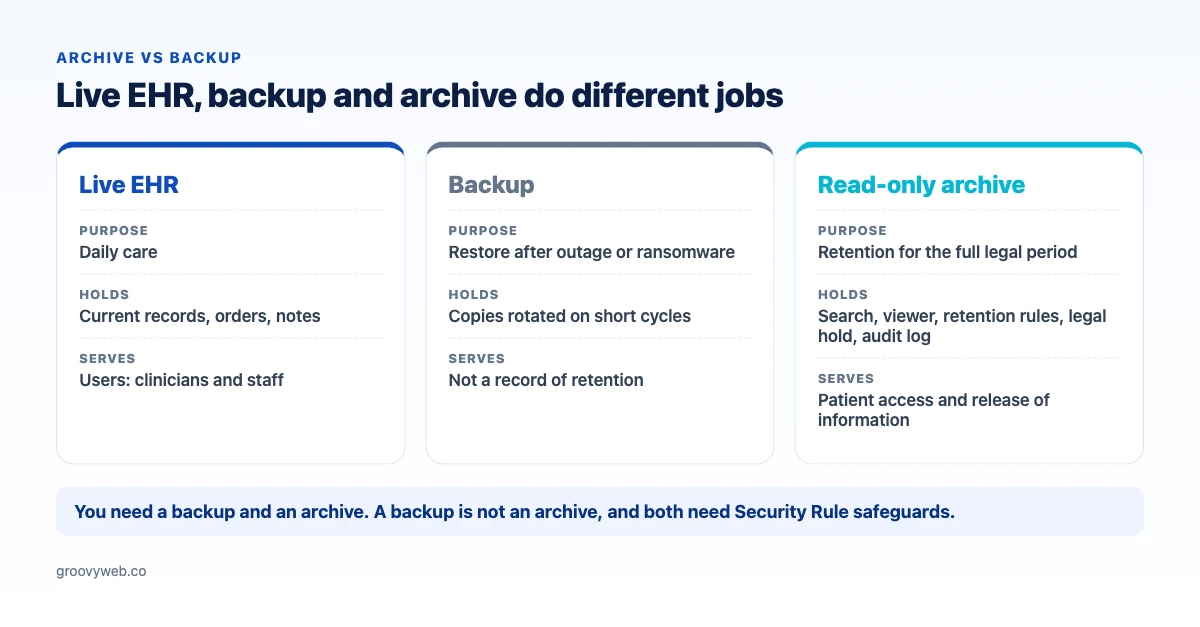
The Security Rule's contingency plan standard requires a data backup plan that can "create and maintain retrievable exact copies" of ePHI (electronic protected health information) and a disaster recovery plan (45 CFR 164.308(a)(7)). It does not make backups searchable by patient or keep them for state-mandated years. That is the archive's job.
Keeping the legacy EHR running read-only works as a short bridge, rarely as a long-term answer.
| Option | Main purpose | Retention fit | Patient access | Main risk |
|---|---|---|---|---|
| Backup | Restore a live system after outage or ransomware | Poor. Usually rotated on short cycles | Not practical. Data must be restored first | Assumed to be an archive when it is not |
| Keep legacy EHR running | Avoid migration work in the short term | Works while the vendor supports it | Works, but staff must know the old system | Unpatched software, ongoing license cost, vendor end-of-life |
| Read-only archive | Hold inactive records for the full retention period | Strong. Retention rules can be set per record | Strong, if it has search and a viewer | Weak data mapping or missing audit trails |
How Long Do You Have to Keep Medical Records in the US?
There is no single federal number. HIPAA does not set a medical record retention period, so the answer comes from state law, Medicare rules and your contracts, and you keep each record for the longest period that applies to it.
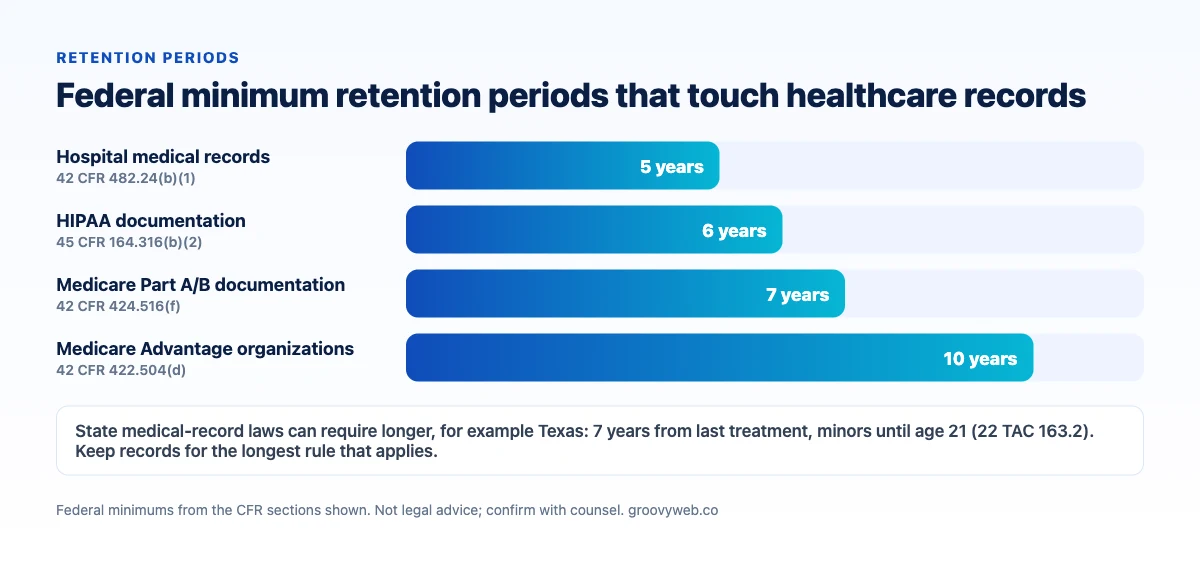
HHS says it plainly: "the HIPAA Privacy Rule does not include medical record retention requirements," and "State laws generally govern how long medical records are to be retained" (HHS HIPAA FAQ). The 6-year HIPAA rule people quote applies to something else: your HIPAA policies, procedures, risk analyses and other required documentation. Under 45 CFR 164.316(b)(2), you retain that documentation for 6 years from the date it was created or last in effect, whichever is later.
| Rule | What it covers | Minimum period |
|---|---|---|
| HIPAA, 45 CFR 164.316(b)(2) | HIPAA security policies, procedures and required documentation (not the medical record itself) | 6 years from creation or last effective date |
| Medicare, 42 CFR 424.516(f) (CMS MLN fact sheet, January 2026) | Documentation for ordered, certified, referred or prescribed Part A/B services, items or drugs | 7 years from date of service |
| Hospital Conditions of Participation, 42 CFR 482.24(b)(1) | Hospital medical records | At least 5 years, original or legally reproduced form |
| Medicare Advantage, 42 CFR 422.504(d) | Books and records of MA organizations | 10 years |
| Texas, 22 TAC 163.2 | Physician medical records | 7 years from last treatment; minors until age 21 or 7 years, whichever is longer |
| New York, Regents Rules Part 29 | Patient records of licensed professionals | 6 years; obstetrical and minor records at least 6 years and until one year after the patient turns 21 |
Minors' records often run far longer than adult records, so calculate expiry per patient, not per system. If you are a health-tech business associate, retention follows your customers' contracts and state laws, so build the rules as configuration, not code.
Do not shorten retention to save storage. When several rules apply to one chart, the longest wins. A legal hold overrides every schedule until counsel releases it.
Which HIPAA Security Rule Requirements Apply to an Archive?
All of them. An archive that holds ePHI is an information system under the Security Rule, so it needs the same risk analysis, access control, audit, integrity, transmission and disposal safeguards as your live EHR.
The technical safeguards in 45 CFR 164.312 map directly to archive features:
- Access control: unique user IDs, emergency access, automatic logoff, and encryption (currently "addressable").
- Audit controls: "record and examine activity." Log every search, view, export and deletion.
- Integrity: protect against improper alteration or destruction. Checksums and write-once storage help.
- Person or entity authentication: verify who opens the archive.
- Transmission security: protect ePHI in transit, including the bulk transfer from the legacy system.
The physical safeguards in 45 CFR 164.310(d) require a disposal policy for ePHI and its media, and removal of ePHI before media reuse. That covers the old EHR's servers, storage and export drives.
What encryption and destruction standards does HHS point to?
HHS breach guidance says PHI is "secured" if it is encrypted consistent with NIST SP 800-111 for data at rest and NIST SP 800-52 (TLS) or related VPN guidance for data in motion, or if electronic media is "cleared, purged, or destroyed consistent with NIST Special Publication 800-88" (HHS breach notification guidance). NIST published SP 800-88 Revision 2 in September 2025, which focuses on running an enterprise sanitization program. Use it for the final decommissioning of legacy hardware and for cryptographic erase of cloud storage.
Does a cloud archive vendor need a BAA?
Yes. HHS cloud guidance says a cloud provider that stores ePHI is a business associate "even if the CSP processes or stores only encrypted ePHI and lacks an encryption key" (HHS cloud computing guidance). Also check your legacy EHR vendor's BAA. Under 45 CFR 164.504(e)(2)(ii)(J), at contract termination the business associate must return or destroy the PHI if feasible, or extend the contract's protections to whatever it keeps. Get your full data export before that clause kicks in.
Watch the pending Security Rule update. HHS proposed a major Security Rule revision on January 6, 2025 that would make encryption of ePHI at rest and in transit a firm requirement rather than addressable. As of this writing it is still a proposed rule, and the current Security Rule applies. Designing archives with encryption everywhere now avoids a retrofit later.
Our healthcare security and compliance team runs this review on archives and decommissioning plans.
Can Patients Still Request Records From an Archive?
Yes. The HIPAA right of access covers PHI in a designated record set for as long as you or your business associate keep it, whether it sits in a live EHR, a read-only archive or offsite storage. Archiving data does not take it out of scope.
HHS says individuals can access PHI "regardless of the date the information was created; whether the information is maintained in paper or electronic systems onsite, remotely, or is archived" (HHS right of access guidance). You may not deny access because a business associate holds the data. Today you must act within 30 calendar days, with one 30-day extension allowed.
That clock is getting shorter. A final HIPAA Privacy Rule published November 19, 2026 cuts the response time to no more than 15 calendar days, keeps the single 30-day extension, takes effect January 19, 2027, and requires compliance by July 19, 2027. The rule says the deadline also applies to PHI "archived offsite and/or offline." An archive that needs a week of restore work will struggle.
Does information blocking apply to archived data?
It can. Under the 21st Century Cures Act rules, information blocking is a practice by a provider, certified health IT developer or health information network that is likely to interfere with access, exchange or use of EHI (HealthIT.gov). EHI is ePHI to the extent it would be in a designated record set, and the definition has covered the full scope of EHI since October 6, 2022 (HealthIT.gov EHI explainer). Moving data to an archive does not exempt it. If the archive makes legitimate requests slow or impossible, review it with counsel.
One helpful rule for migrations: certified EHRs must support a single-patient and full patient-population EHI export in a computable format, with a public link to the format documentation (45 CFR 170.315(b)(10)). If your legacy system is certified, ask the vendor for that export early.
What Should You Migrate vs Archive When Sunsetting a Legacy EHR?
Migrate what clinicians need to treat patients. Archive everything else that retention or legal rules require you to keep. Migrating every historical field adds cost and mapping errors.
A common split: active patients' problems, medications, allergies, immunizations and recent results move as discrete data into the new EHR, often through FHIR (Fast Healthcare Interoperability Resources) or HL7 interfaces. Older encounters, inactive patients, scanned documents, historical billing and legacy audit logs go to the archive. Our EMR integration guide covers the interface side.
Choose full migration into the new EHR if:
- The data is used at the point of care today
- Clinical decision support needs it as discrete fields
- The new EHR can map it without loss of meaning
Choose a read-only archive if:
- The patient is inactive or records are older
- You must keep it for state, Medicare or payer retention
- Mapping it into the new EHR would distort it
Choose keeping the legacy system live (short term only) if:
- Open claims or audits still need old workflows
- The archive is not yet validated
Step-by-step plan to sunset a legacy EHR
- Inventory the data. List every system, database, document store and backup set that holds PHI, including lab, imaging and billing.
- Build the retention matrix. For each record type, list every applicable rule (state, Medicare, hospital CoP, payer contracts, research agreements) and take the longest. Have counsel sign off.
- Check legal holds. Ask legal for open or expected litigation. Under Federal Rule of Civil Procedure 37(e), courts can impose measures, and in cases of intent to deprive, adverse inferences, when electronically stored information that should have been preserved is lost.
- Decide migrate vs archive using the criteria above, record by record type.
- Get the full export. Request the EHI export, database extracts, document files and audit logs from the vendor before the contract ends. Confirm the BAA's return-or-destroy terms.
- Map and transform. Normalize patients, encounters and documents. Use FHIR resources or C-CDA (Consolidated Clinical Document Architecture) documents where they fit, and keep originals for fidelity.
- Validate. Reconcile record counts, run checksums, and have clinicians and HIM (health information management) staff spot-check charts.
- Run in parallel. Keep the legacy system read-only for a set window while staff use the archive for real requests.
- Decommission. Shut down the legacy system, sanitize media per NIST SP 800-88, and keep certificates of destruction with your HIPAA documentation for 6 years.
What Does a Compliant Healthcare Archive Architecture Look Like?
A compliant archive has five layers: standardized storage formats, immutable encrypted storage, a search index with a clinical viewer, a retention and legal hold engine, and a full audit trail. Each layer maps to a HIPAA or retention requirement.
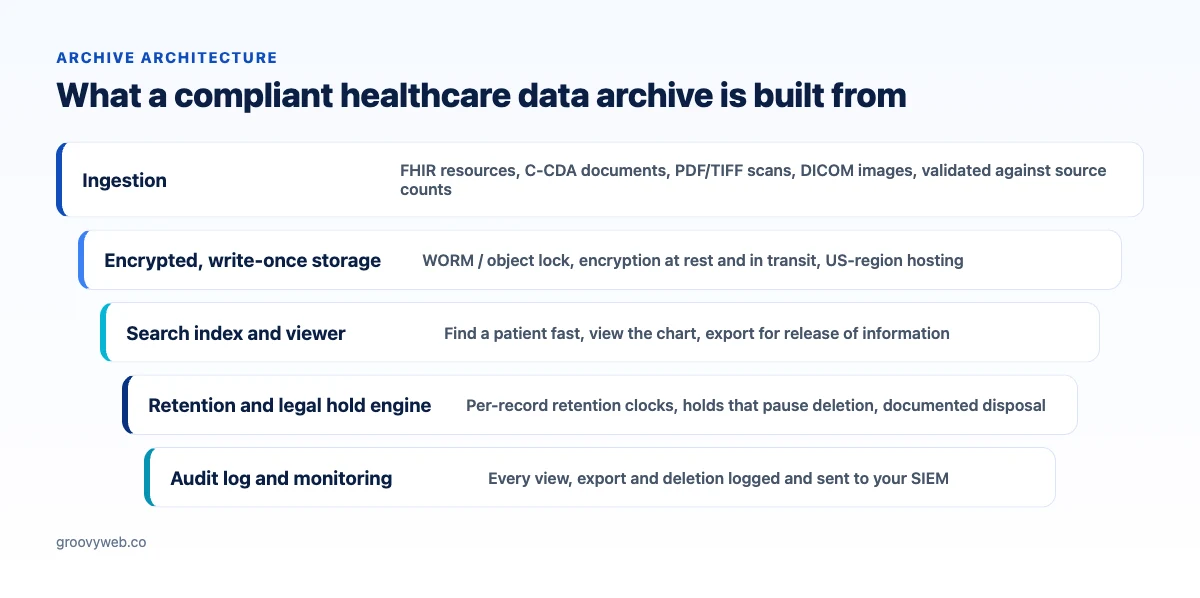
- Formats: structured data as FHIR resources or C-CDA documents, documents as PDF/A or originals, and the legacy database export as a reference copy with a data dictionary.
- Immutable, encrypted storage: write-once-read-many (WORM) storage supports the integrity standard. For example, Amazon S3 Object Lock offers retention periods, a compliance mode in which no user, including the root user, can delete a locked version during the retention period, and legal holds with no expiry date. Use customer-managed keys so cryptographic erase is possible at end of life.
- Search and viewer: lookup by patient name, date of birth, MRN (medical record number) and date range, plus a chart-style viewer so HIM staff can fulfill requests without engineering help.
- Retention and legal hold engine: calculate a destroy-after date per record, block deletion under legal hold, and route expiring records for approval.
- Audit: log every login, search, view, export, hold and deletion, and ship logs to your SIEM (security information and event management) tool.
- Interoperability: optionally launch the archive viewer from the new EHR so clinicians skip a second login. See our EHR software development work.
Normalized archives can also feed de-identified quality reporting through our healthcare data analytics work.
What drives the cost of a healthcare archive?
Archive cost depends on the data. The main drivers:
- Number of source systems and how well documented their databases are
- Volume of scanned documents and images
- How much data moves as discrete fields versus archived documents
- Vendor export fees and timelines in the legacy contract
- Storage class, retention length and egress for release-of-information requests
If the project includes connecting the archive or new system to a single EHR through FHIR or HL7, that piece typically runs $15K-$40K for a first release at Groovy Web. The final price comes after a 30-minute scoping call. Engineering time starts at $22/hr.
Healthcare Data Archiving Compliance Checklist
Governance and retention
- [ ] Retention matrix covers state law, Medicare, hospital CoP, Medicare Advantage and payer contracts per record type
- [ ] Minors' retention calculated per patient
- [ ] Legal hold process documented and tested
Security safeguards
- [ ] Archive included in the HIPAA risk analysis
- [ ] Unique user IDs, role-based access and MFA for archive users
- [ ] Encryption at rest (NIST SP 800-111) and in transit (TLS per NIST SP 800-52)
- [ ] Audit logs for search, view, export, hold and deletion
- [ ] Archive covered by backup, disaster recovery and contingency testing
- [ ] BAAs signed with the archive vendor and cloud provider
Access and interoperability
- [ ] HIM staff can find and export a patient's records without engineering help
- [ ] Release-of-information workflow meets 30 days now and 15 days by July 19, 2027
- [ ] Information blocking review completed with counsel
Migration and decommissioning
- [ ] Full EHI export received before the legacy contract ends
- [ ] Record counts and checksums reconciled
- [ ] Legacy media sanitized per NIST SP 800-88, certificates retained
- [ ] Destruction of expired records approved, logged and blocked under legal hold
Key Takeaways
- HIPAA does not set a medical record retention period. State law does, and Medicare, payer contracts and legal holds can extend it.
- The HIPAA 6-year rule applies to your compliance documentation, not the chart itself.
- An archive is not a backup. You need both, each with Security Rule safeguards.
- Patients keep their right of access to archived records. The response window drops to 15 days by July 19, 2027.
- Migrate what clinicians use, archive what the law requires, and document media sanitization.
Frequently Asked Questions
How long does HIPAA require medical records to be kept?
HIPAA does not set a retention period for medical records; HHS says state laws generally govern it. HIPAA does require you to keep your HIPAA policies, procedures and required documentation for 6 years from creation or last effective date, and to safeguard PHI for as long as you keep it.
Is a backup enough to meet healthcare data archiving requirements?
No. A backup restores a live system after failure and is usually rotated on short cycles. Retention rules require keeping records for years and producing them on request. That needs a searchable, access-controlled archive with retention rules and audit logs, alongside the backups HIPAA's contingency plan standard requires.
What is the Medicare record retention requirement?
Under 42 CFR 424.516(f), providers and suppliers furnishing ordered, certified, referred or prescribed Part A or Part B services, and the physicians who order them, must keep that documentation for 7 years from the date of service, as CMS's January 2026 MLN fact sheet confirms. State law or contracts can require longer.
Can we shut down our old EHR once data is migrated?
Yes, once you have a validated archive for everything you did not migrate, a full vendor export, confirmation that no legal hold covers data you plan to discard, and documented media sanitization. A short read-only parallel window lets staff confirm the archive handles real requests before shutdown.
Do patients have the right to records stored in an archive?
Yes. HHS guidance says the right of access applies regardless of whether information is onsite, remote or archived, and regardless of whether a business associate holds it. You currently have 30 calendar days to respond. A final rule published November 19, 2026 shortens that to 15 calendar days, with compliance required by July 19, 2027.
What format should archived EHR data be stored in?
Use open, documented formats: structured clinical data as FHIR resources or C-CDA documents, documents as PDF/A or originals, and the raw legacy database export with a data dictionary. If the legacy EHR is certified, request its EHI export, which must be computable and come with a public link to its format.
Planning to Retire a Legacy EHR?
Groovy Web has served 200+ clients since 2015, including healthcare platforms such as HIPPASHIELD, a HIPAA access-control platform. Our senior engineers work your US hours, sign BAAs, and build archives designed to support HIPAA that your HIM team can run on its own.
Next Steps
Need Help With Healthcare Data Archiving?
We review legacy systems, build the retention matrix with your counsel, and deliver a read-only archive that stays searchable and audit-ready.
Schedule a free consultation →
Related Services
- Healthcare Security and Compliance — HIPAA risk analysis, access controls and audit logging for archives
- EHR Software Development — new EHR builds and legacy data migration
- Healthcare Data Analytics — turn archived data into reporting and population insights
Published: November 2026 | Author: Groovy Web Team | Category: Healthcare
Ship Production-Grade AI with Senior Engineers
Our AI-First engineering approach delivers production-ready applications in weeks, not months.
Hire an AI-First Engineering Team