To create EHR software, run discovery on one clinic's real workflows. Then design a FHIR R4 data model, build the core charting, orders, scheduling and e-prescribing modules, wire up lab and billing interfaces, apply HIPAA Security Rule safeguards with full audit logs, migrate legacy data, and go live in phases with clinicians.
Most guides ranking for this query list generic phases and skip the standards you must implement, the rules that changed between 2024 and 2026, and the point where building stops making sense. This guide is for US health-tech founders, CTOs and clinic leaders weighing a custom EHR or EMR. For the full budget breakdown, read our EHR software development cost guide. For choosing a vendor, see how to choose an EHR development company.
Should You Build, Buy, or Extend an EHR?
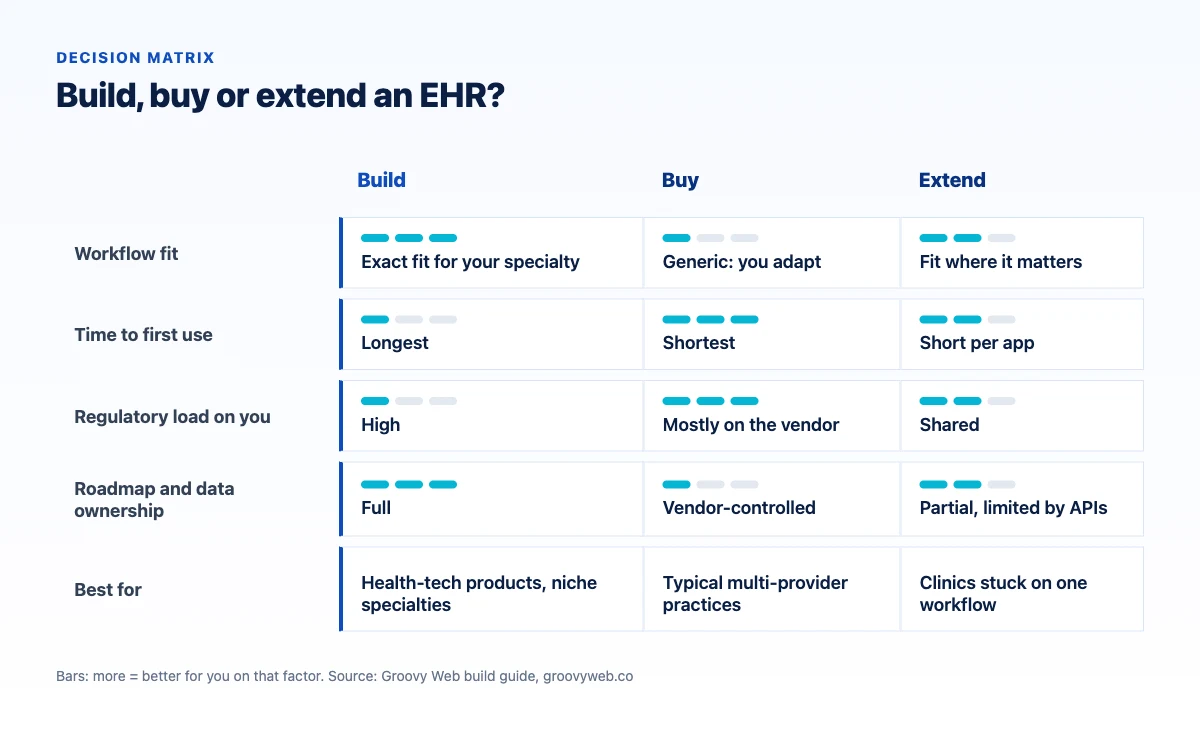
Build only when your clinical workflow is a real product advantage that off-the-shelf EHRs cannot support. Otherwise, buy a certified EHR, or extend one with custom apps on top of its APIs.
The market is not empty. ASTP/ONC's June 2026 data brief reports that 91% of office-based physicians used a certified EHR in 2024, and 95% used some EHR. So a new EHR almost always replaces something, and clinicians will compare it with the system they already know.
| Factor | Build (custom EHR) | Buy (licensed EHR) | Extend (apps on an existing EHR) |
|---|---|---|---|
| Workflow fit | Exact fit for your specialty or care model | Generic; you adapt to the vendor | Fit where it matters, vendor core elsewhere |
| Time to first use | Months (see timeline section) | Weeks to months for setup | Weeks to a few months per app |
| Regulatory load on you | High: HIPAA, EPCS audits, optional ONC certification | Mostly on the vendor | Shared; vendor holds the record of truth |
| Data ownership and roadmap | Full | Vendor-controlled | Partial; limited by vendor APIs |
| Best for | Health-tech products, niche specialties, new care models | Typical multi-provider practices | Clinics happy with core charting but stuck on one workflow |
Choose Build if:
- The EHR is your product, or a core part of it
- Your specialty workflow (behavioral health, rehab, virtual-first care) breaks generic EHRs
- You need to own the data model for analytics or AI features
- You can fund ongoing security, compliance and support after launch
Choose Buy if:
- You run a standard primary care or specialty practice
- You need CMS Promoting Interoperability credit and certified technology now
- You have no in-house product or engineering team
Choose Extend if:
- Your current EHR works for charting but one workflow is painful
- The EHR exposes FHIR APIs and supports SMART on FHIR apps
- You want results in weeks, not a multi-quarter program
Extending is often the fastest path. A focused integration with Epic, Oracle Health or athenahealth can solve a scheduling, intake or documentation gap without replacing the core record.
What Standards Does a Custom EHR Need to Support?
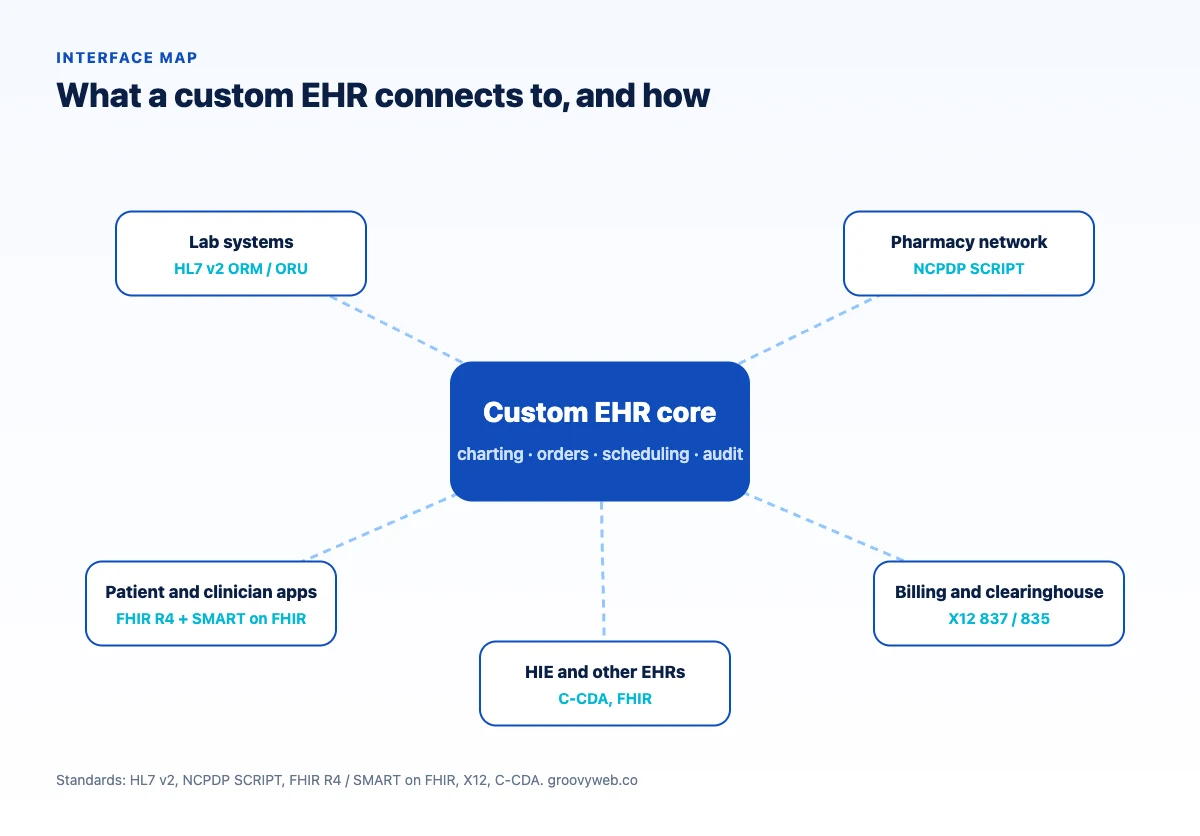
A modern US EHR needs FHIR R4 with the US Core profiles for APIs, USCDI as the minimum data set, HL7 v2 for labs and hospital feeds, SMART on FHIR for app authorization, and NCPDP SCRIPT for e-prescribing. Pick these before you design a single table.
FHIR R4 and US Core
HL7 FHIR is the API standard for health data. In the US, the US Core Implementation Guide defines which FHIR resources, fields and search parameters you must support. The current release is US Core 9.0.0, built on FHIR 4.0.1 (R4). Designing your internal model so it maps cleanly to Patient, Encounter, Condition, Observation, MedicationRequest and AllergyIntolerance saves a painful translation layer later.
USCDI
The United States Core Data for Interoperability (USCDI) is the federal list of data classes and elements every certified system must exchange. Under the HTI-1 final rule, USCDI Version 3 became the baseline for the ONC Certification Program as of January 1, 2026. Even if you never certify, treat USCDI v3 as your minimum data scope. Partners and payers will expect it.
HL7 v2
FHIR is the future, but most lab orders and results still move as HL7 v2 messages (ORM for orders, ORU for results, ADT for admissions and demographics). Budget for an interface engine and for per-lab mapping and validation. Each lab connection is its own small project.
SMART on FHIR
SMART App Launch is the OAuth 2.0-based standard that lets third-party apps launch inside your EHR or connect standalone with scoped permissions. The current SMART App Launch release is 2.2.0, and it also covers backend services for automated, no-user integrations. Supporting it turns your EHR into a platform instead of a closed box.
E-prescribing and EPCS
E-prescribing runs on the NCPDP SCRIPT standard, usually through a certified network connection. CMS has finalized that NCPDP SCRIPT version 2023011 is required beginning January 1, 2028, retiring version 2017071, so build on 2023011 now. Controlled substances add the DEA's EPCS rules: two-factor credentials for prescribers, and a third-party audit or DEA-approved certification of your application before first use. Under 21 CFR 1311.300, that audit repeats whenever controlled-substance functionality changes, or every two years, whichever comes first. Many teams embed a certified e-prescribing vendor instead of building EPCS themselves. That is usually the right call for a first release.
Our FHIR and HL7 integration team and the EMR integration guide go deeper on each interface.
How Do You Build EHR Software Step by Step?
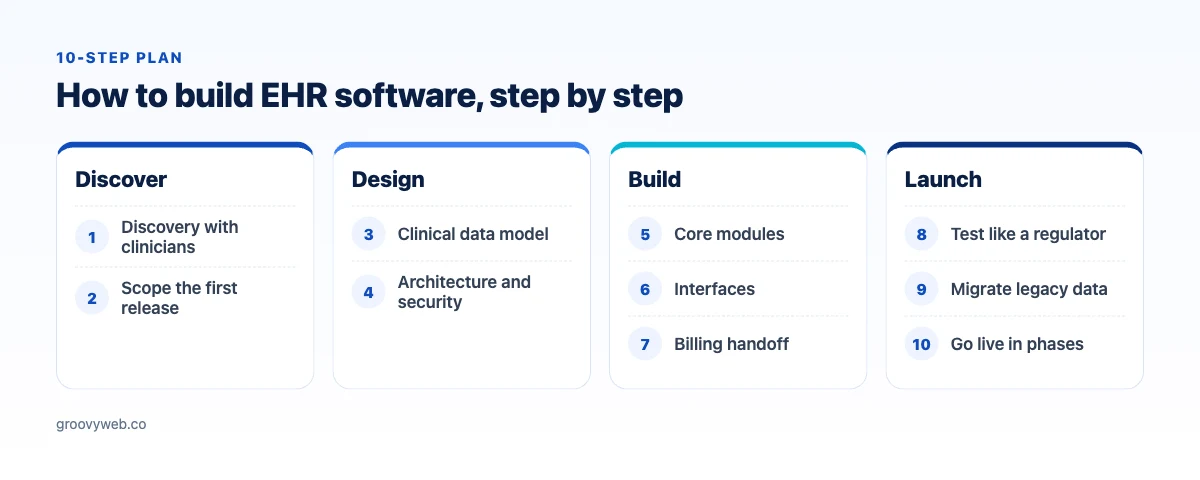
Build an EHR in ten steps, from workflow discovery to phased go-live, and ship a narrow first release for one clinic before adding specialties or locations. Each step below lists what you should have in hand before moving on.
Step 1: Discovery with real clinicians
Shadow front desk staff, nurses, providers and billers for several full clinic days. Map check-in, intake, rooming, charting, orders, prescribing, checkout and billing. The output is a ranked list of pain points that justify a custom build. If you cannot name them, revisit build vs buy.
Step 2: Scope the first release
Define one clinic, one specialty and a short list of must-have workflows. Write user stories per role and capture non-functional requirements: uptime, response times, concurrent users, data retention. Decide now what you will buy (e-prescribing, clearinghouse, identity) instead of build.
Step 3: Design the clinical data model
Model patients, encounters, problems, medications, allergies, vitals, orders, results, documents and notes. Align it with FHIR R4 resources and USCDI v3 data elements, and use standard code systems: SNOMED CT for problems, LOINC for labs, RxNorm for medications, ICD-10-CM and CPT for billing. Version every clinical record. Never hard-delete it.
Step 4: Plan architecture and security
Choose a cloud provider that will sign a Business Associate Agreement (BAA), and design for encryption at rest and in transit, role-based access, single sign-on with multi-factor authentication, and tenant isolation if you plan to serve more than one clinic. Run a HIPAA risk analysis on the design itself, not only on the finished product.
Step 5: Build the core modules
A practical first release usually includes:
- Patient registration, demographics and insurance capture
- Scheduling and calendar views per provider and room
- Clinical charting: templates, SOAP notes, problem list, medications, allergies, vitals
- Orders and results inbox with abnormal-result flags
- E-prescribing through an integrated certified vendor
- Document management and patient-facing summaries
- Role-based dashboards and task queues
A patient portal and AI documentation can follow in release two.
Step 6: Build interfaces
Connect labs over HL7 v2, the pharmacy network over NCPDP SCRIPT, and expose a FHIR R4 API with SMART on FHIR authorization. Add C-CDA or FHIR exchange with referral partners and your regional health information exchange where it matters.
Step 7: Hand off to billing
Most clinics do not want billing inside the EHR. They want clean charge capture. Generate coded encounters (CPT, ICD-10-CM, modifiers) and push them to your practice management system or clearinghouse, which sends X12 837 claims and receives 835 remittances. Our practice management software work covers this boundary.
Step 8: Test like a regulator and a clinician
Run unit, integration and end-to-end tests on every clinical workflow. Validate your FHIR API against US Core profiles, test each lab interface with real sample messages, and run penetration testing before real patient data arrives. Then run usability sessions with providers. Click count and charting time decide adoption.
Step 9: Migrate legacy data
Extract demographics, problems, medications, allergies, immunizations, notes and results. Map codes, reconcile duplicates, and run at least two full rehearsal migrations. Agree with clinicians on what moves as structured data versus archived documents, and keep read-only access to the old system for a defined period.
Step 10: Go live in phases
Train super-users first. Launch with one provider group, reduced schedules and on-site support. Track charting time, interface errors and support tickets daily, and expand only when they stabilize.
Do You Need ONC Certification for a Custom EHR?
No, ONC certification is voluntary. You need it only if your customers must use certified health IT, for example clinicians reporting to CMS Promoting Interoperability programs.
ASTP/ONC (the Assistant Secretary for Technology Policy and Office of the National Coordinator for Health IT, renamed in July 2024) describes its program as "a voluntary certification program", while noting that the CMS Promoting Interoperability programs continue to require certified health IT. Clinics building for themselves, or for cash-pay and virtual-first models, can often launch uncertified.
If you do pursue it, plan for moving targets. HTI-1 took effect on March 11, 2024, and added algorithm transparency requirements for AI and predictive decision support. ASTP/ONC's deadline table lists December 31, 2027 as the update deadline for the electronic prescribing criterion under HTI-4 and for decision support interventions under HTI-2. Certification means formal testing against every criterion you claim, so schedule it as its own workstream, not a final checkbox.
Certification also changes your legal exposure. Under the 21st Century Cures Act, developers of certified health IT are named "actors" under the information blocking rules, alongside providers and health information networks. Your clinic customers are covered as providers either way, so design data export and patient access from day one.
HIPAA is not optional, certified or not. The Security Rule's technical safeguards at 45 CFR 164.312 cover access control, audit controls, integrity, person or entity authentication, and transmission security. HHS also proposed a stricter Security Rule on January 6, 2025. It is not final as of this writing, but building MFA and encryption everywhere now avoids a retrofit later.
Audit logs deserve special attention. Log every view, create, update, export and print of patient data with user, timestamp, patient and source. Make logs tamper-evident and searchable for privacy investigations. HIPAA requires Security Rule documentation to be kept for six years from creation or last effective date, and many teams apply the same horizon to audit logs. Our healthcare security and compliance practice builds these controls into the architecture.
How Long Does It Take, Who Do You Need, and What Does It Cost?
Timelines depend on the modules, interfaces and data migration in scope, so you should get a written timeline after discovery rather than a guess up front. Groovy Web scopes that first release at $45K to $120K, depending on modules and interfaces.
Realistic timeline by phase
Durations depend on these drivers; you get a written timeline after discovery. Outside onboarding queues (labs, e-prescribing networks, clearinghouses) are the usual source of delay.
| Phase | What sets the length | Main deliverable |
|---|---|---|
| Discovery and scoping | How many workflows and specialties are in scope | Workflow maps, ranked backlog, build vs buy decisions |
| Data model, architecture, UX | Security design depth and prototype rounds | FHIR-aligned schema, security design, clickable prototype |
| Core module build | Number of modules and specialty templates | Charting, scheduling, orders, e-prescribing integration |
| Interfaces and billing handoff | Partner onboarding queues (labs, e-prescribing networks, clearinghouses) | Lab, pharmacy, FHIR API, charge export |
| Testing, migration, training | Volume and quality of legacy data to migrate | Pen test report, rehearsed migration, trained super-users |
| Phased go-live and stabilization | Number of sites and staff to train | Live clinic, support runbook, release two backlog |
Team roles
- Product owner with clinical input: owns scope; ideally paired with a practicing clinician or clinical informaticist
- Solution architect: data model, security, interoperability design
- Backend engineers (2-3): clinical services, FHIR API, interfaces
- Frontend engineer(s): charting and scheduling UI
- Integration engineer: HL7 v2, NCPDP, clearinghouse connections
- QA engineer: clinical scenario testing and regression
- DevOps and security: cloud setup, monitoring, backups, access reviews
- UX designer: early and heavy, then part-time
You can staff this in-house, through a partner, or as a mix. Groovy Web provides senior engineers in India working US hours with at least four hours of overlap with US Eastern, starting at $22/hr. You can also hire healthcare engineers to extend your own team.
Cost
| Groovy Web engagement (typical first release) | Price range |
|---|---|
| Single-clinic EHR build | $45K-$120K |
| Single-EHR integration (FHIR/HL7), if you extend instead | $15K-$40K |
| AI medical scribe pilot (release two add-on) | $40K-$90K |
Final pricing follows a 30-minute scoping call. Budgets grow with the number of specialties, locations, lab interfaces, migration volume and whether you pursue ONC certification. Plan for run costs too: hosting, e-prescribing fees, EPCS audits, security testing and support. The line-item breakdown lives in our EHR cost guide, and our EHR software development and EMR software development pages describe the delivery scope.
EHR Build Readiness Checklist
Use this checklist before you commit budget and again before go-live. Any unchecked item in the first group is a reason to pause.
Before you build
- [ ] Build vs buy vs extend decision documented with reasons
- [ ] Top five workflows mapped with real clinicians
- [ ] First-release scope limited to one clinic or specialty
- [ ] Decision on ONC certification (now, later or never)
- [ ] Buy-vs-build list for e-prescribing, identity, clearinghouse
Design and build
- [ ] Data model mapped to FHIR R4, US Core and USCDI v3
- [ ] SNOMED CT, LOINC, RxNorm, ICD-10-CM and CPT coding in place
- [ ] BAAs signed with cloud and every vendor touching PHI
- [ ] HIPAA risk analysis completed on the architecture
- [ ] MFA, role-based access and encryption at rest and in transit
- [ ] Tamper-evident audit log covering views, edits, exports and prints
Go-live
- [ ] Each lab interface tested with real sample messages
- [ ] EPCS audit or certification complete if prescribing controlled substances
- [ ] Penetration test passed and findings closed
- [ ] Two full rehearsal migrations reconciled
- [ ] Super-users trained and reduced schedules planned for launch week
- [ ] Downtime procedures and backup restore tested
Key Takeaways
- Build a custom EHR only when your workflow is a product advantage. Otherwise buy, or extend an existing EHR with FHIR and SMART apps.
- Commit early to FHIR R4 with US Core, USCDI v3, HL7 v2 for labs, SMART on FHIR and NCPDP SCRIPT 2023011.
- Integrate a certified e-prescribing vendor for release one. EPCS requires audits before first use and at least every two years.
- ONC certification is voluntary, but your buyers may need it for CMS programs. HIPAA safeguards and audit logs are never optional.
- Scope one clinic first. Groovy Web scopes a single-clinic EHR build at $45K-$120K for the first release.
Frequently Asked Questions
Can I build my own EHR from scratch?
Yes, but scope it narrowly. A small team can build a single-clinic EHR covering registration, scheduling, charting, orders and integrated e-prescribing. What makes it hard is not the screens. It is the standards (FHIR, HL7 v2, NCPDP), HIPAA security, data migration and clinician adoption. Most teams buy e-prescribing, identity and claims processing instead of building them.
What is the difference between building EHR and EMR software?
An EMR is a digital chart used inside one practice. An EHR is designed to share records across providers, labs, pharmacies and patients. Technically, the difference is interoperability: an EHR needs FHIR APIs, USCDI data coverage, and exchange with outside systems. Many US products use the terms interchangeably, but if you plan to exchange data, build to EHR standards from the start.
How long does it take to build EHR software?
It depends on the modules, specialty templates, interfaces and legacy data in scope. The longest waits are often outside your team: lab and e-prescribing network onboarding, clearinghouse enrollment and EHR vendor reviews. Multi-specialty or multi-location systems, and ONC certification, take longer. Ask for a written timeline after discovery, broken down by phase and showing which steps depend on outside parties.
Does a custom EHR need to be ONC certified?
Not legally. ONC certification is voluntary. It matters when your users must use certified health IT, such as clinicians earning credit in CMS Promoting Interoperability programs, or when enterprise buyers require it. Many startups and specialty clinics launch uncertified, design to US Core and USCDI v3 so certification stays possible, and certify later if the market demands it.
What does it cost to build EHR software?
Groovy Web scopes a single-clinic EHR build at $45K to $120K for the first release, with final pricing after a 30-minute call. Costs rise with specialties, locations, interfaces, migration volume and certification. Budget separately for hosting, e-prescribing vendor fees, EPCS audits and security testing. Our EHR cost guide breaks down each line item.
Which tech stack is best for a custom EHR?
There is no single best stack. Use a mature backend framework your team knows, a relational database with strong auditing, a cloud provider that signs a BAA, and a FHIR server or library that validates US Core profiles. Clinical software lives for a decade or more, so well-supported, maintainable technology beats novelty.
Planning a Custom EHR or EMR?
Groovy Web designs and builds HIPAA-ready clinical software, signs BAAs, and has shipped healthcare products such as HIPPASHIELD and Rehabilitation Management Software. Bring your workflows, and we will help you decide whether to build, buy or extend.
Next Steps
Need Help With Building EHR Software?
Our senior engineers work your US hours and can take a single-clinic EHR from discovery to phased go-live, or integrate with the EHR you already run.
Schedule a free consultation →
Related Services
- EHR Software Development — custom EHR builds for clinics and health-tech products
- FHIR and HL7 Integration — US Core APIs, lab interfaces and SMART on FHIR apps
- Healthcare Security and Compliance — HIPAA safeguards, audit logging and risk analysis
Published: November 2026 | Author: Groovy Web Team | Category: Healthcare
Ship Production-Grade AI with Senior Engineers
Our AI-First engineering approach delivers production-ready applications in weeks, not months.
Hire an AI-First Engineering Team