No AI coding tool is "HIPAA compliant" by itself, because HIPAA has no product certification. What matters is a signed Business Associate Agreement (BAA) for a specific plan and setup. Today Cursor Enterprise, Claude Code, OpenAI Codex and Gemini Code Assist offer BAA paths. For other tools, keep PHI out entirely.
The real question is not "which tool is compliant?" It is "will this tool ever see protected health information (PHI), and if so, does a BAA cover the exact product, plan and configuration our engineers use?" This guide covers what HIPAA requires of a coding assistant, when PHI enters coding work, what each vendor documents as of November 2026, and a policy checklist you can adopt now. Vendor terms change often, so confirm in writing before relying on any of it.
What Does "HIPAA Compliant" Mean for an AI Coding Assistant?
Very little, as a label. HIPAA compliance is something your organization achieves through policies, safeguards and contracts. A tool can only support it, mainly by signing a BAA and offering controls over how your data is stored and used.
Google states on its HIPAA compliance page that the U.S. Department of Health and Human Services (HHS) does not offer a certification program for HIPAA compliance. Microsoft's HIPAA/HITECH documentation says the same, and adds that a BAA alone does not make a customer compliant. So instead of a badge, look for:
- A BAA that names the product and plan your team uses.
- Required configuration the BAA depends on, such as a privacy mode, retention setting or sign-in method.
- The exclusions list, such as IDE extensions, cloud agents, connectors or beta features.
Covered entity, business associate, and where your dev team fits
A covered entity is a health plan, a clearinghouse, or a provider that conducts standard electronic transactions. A business associate creates, receives, maintains or transmits PHI on a covered entity's behalf. Both are defined in 45 CFR 160.103.
If you build software for a clinic and your team touches its PHI, you are a business associate. If your AI coding tool then receives that PHI, the vendor becomes your subcontractor, and you need a BAA with it. If the tool never receives PHI, no BAA is needed. That is why most healthcare teams can use AI coding tools safely: they design workflows so PHI never reaches the tool.
SOC 2 vs HIPAA vs HITRUST: what each one tells you
- HIPAA is a federal law. There is no audit you pass to "get" it. You show compliance through risk analysis, safeguards, policies and BAAs.
- SOC 2 is an independent auditor's report against the AICPA Trust Services Criteria. A Type II report tests whether controls worked over a period. It shows a disciplined security program. It says nothing about whether a vendor will sign a BAA.
- HITRUST is a certifiable control framework common in healthcare that maps HIPAA, NIST and other standards into one assessment. Some health systems require it from vendors. It is voluntary.
For a coding assistant, SOC 2 Type II is a sensible baseline. A BAA decides the matter only if PHI could reach the tool. For the wider regulatory picture, see our healthcare app compliance guide.
When Is PHI Actually Involved in Coding Work?
Less often than people fear. Writing a FHIR client, a React form or a migration involves no PHI. PHI leaks in through debugging, test data and connected tools.
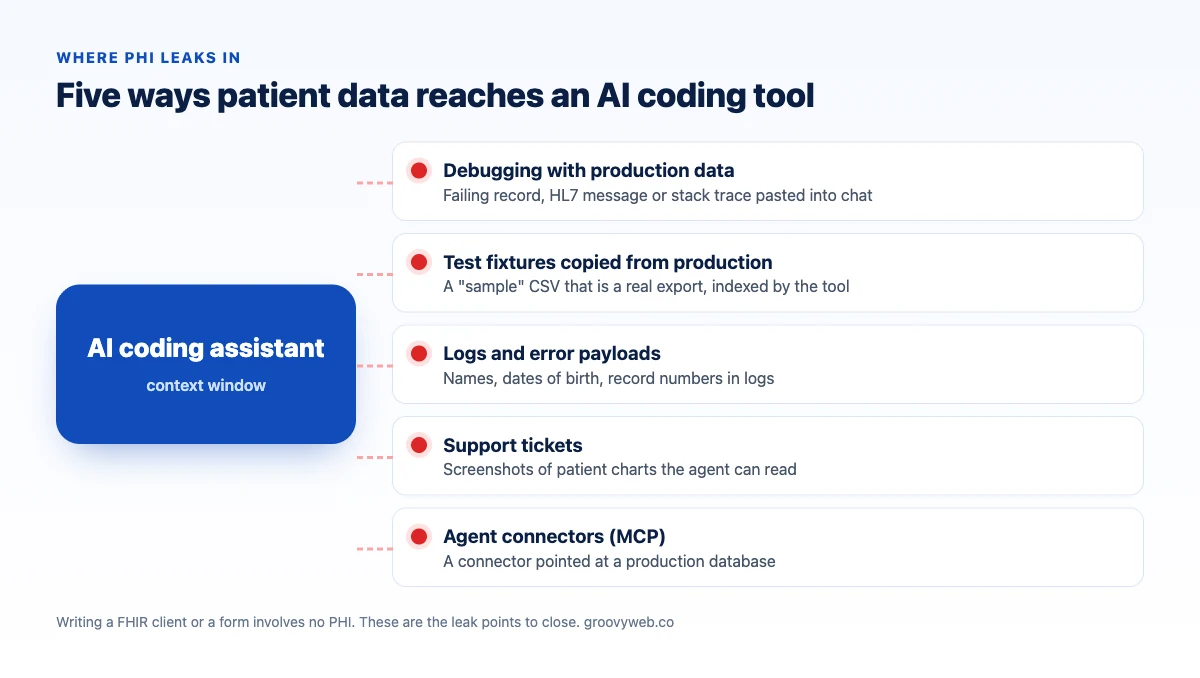
The leak points we look for when we scope healthcare projects:
- Debugging with production data. An engineer pastes a failing record, HL7 message or stack trace with a patient name into the chat panel.
- Test fixtures copied from production. A "sample" CSV in the repo is a real export, and the AI tool indexes it.
- Logs and error payloads that capture names, dates of birth or medical record numbers.
- Support tickets with screenshots of patient charts, in the tracker the AI agent reads.
- Agent connectors. Point a Model Context Protocol (MCP) server at a production database and PHI flows into the model's context. Several vendors exclude connectors and MCP traffic from their BAA.
Minimum necessary applies to engineers too
HIPAA's minimum necessary standard limits uses and disclosures of PHI to what the purpose requires (45 CFR 164.502(b) and 164.514(d)). For developers, that means no default production PHI access, debugging on de-identified or synthetic data, and logged, time-limited break-glass access that happens outside any AI tool not covered by a BAA.
Keep PHI out with synthetic data and de-identification
The cleanest approach is to leave no PHI for the tool to see.
- Synthetic data. Generate realistic fake patients, encounters and claims for dev and test. Open-source generators produce FHIR-formatted records that exercise real code paths.
- De-identified data. HHS recognizes two methods in 45 CFR 164.514(b). Safe Harbor removes 18 categories of identifiers, including names, small geographic units, dates other than year, phone numbers and medical record numbers. Expert Determination requires a qualified expert to document very small re-identification risk. See the HHS de-identification guidance.
Properly de-identified data is not PHI. Data that only masks names, while keeping service dates, ZIP codes and free-text notes, probably still is. Our healthcare data analytics team builds de-identification pipelines for this reason.
Which AI Coding Tools Offer a BAA, SOC 2 and Enterprise Data Controls?
As of November 2026, four coding assistants document a BAA path: Cursor, Claude Code, OpenAI Codex and Gemini Code Assist, each on specific plans. GitHub Copilot, Amazon Q Developer and Tabnine do not document one, but all offer strong data controls for PHI-free work.
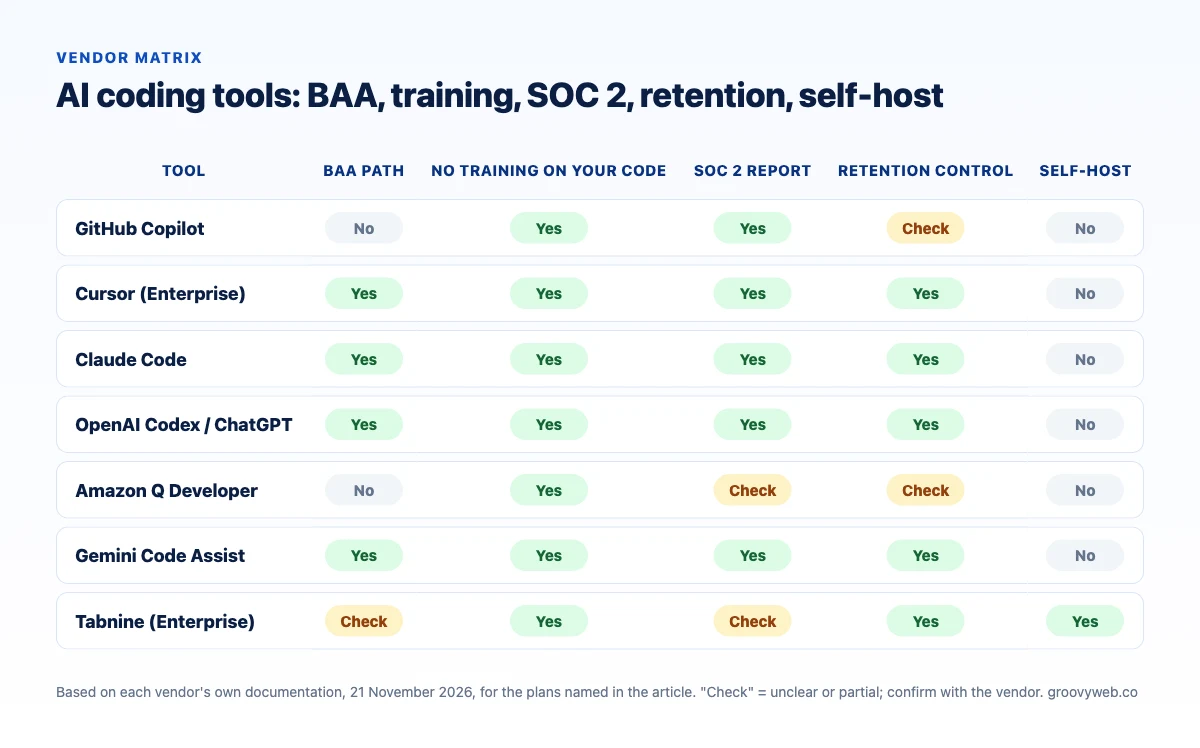
| Tool (plan) | BAA available? | Trains on your code? | SOC 2 report | Data retention | Self-host |
|---|---|---|---|---|---|
| GitHub Copilot (Business, Enterprise) | None documented. Not on Microsoft's HIPAA in-scope list. Check with GitHub. | No (GitHub) | SOC 2 Type II covers Copilot Business and Enterprise (GitHub) | Varies by surface. Check GitHub docs. | No |
| Cursor (Enterprise) | Yes, Enterprise only, Privacy Mode locked org-wide (Cursor) | No with Privacy Mode | SOC 2 Type II (Cursor) | Zero retention with providers, except own API keys and some opt-in models | No |
| Claude Code (Claude Enterprise, Claude Platform API) | Yes, HIPAA configuration on HIPAA-ready Enterprise, or ZDR API key (Anthropic) | No (Anthropic) | SOC 2 Type I and II (Anthropic) | Standard or zero retention. Some models need 30-day retention. | No |
| OpenAI Codex / ChatGPT (Enterprise, API) | Yes, on listed products. No BAA for ChatGPT Business (OpenAI) | No by default (OpenAI) | SOC 2 Type 2 for API and ChatGPT Business (OpenAI) | Admin-set retention. ZDR on eligible API endpoints. | No |
| Amazon Q Developer (Pro) | Not on AWS HIPAA Eligible Services | No for Pro (AWS) | Via AWS Artifact. Check scope. | Check with AWS | No |
| Gemini Code Assist (Standard, Enterprise) | Yes, covered under Google Cloud BAA (Google). Not the GitHub integration. | No, without permission | SOC 1, 2 and 3 (Google) | Stateless. Prompts not stored in Google Cloud. | No |
| Tabnine (Enterprise) | Not documented. Check with Tabnine. | No (Tabnine) | SOC 2 listed (Tabnine) | Context deleted after inference | Yes: VPC, on-prem, air-gapped (Tabnine) |
Is GitHub Copilot HIPAA compliant?
GitHub does not publish a BAA for Copilot that we could find, so treat Copilot as a PHI-free tool. GitHub is not on Microsoft's list of services covered by the Microsoft HIPAA BAA. GitHub's March 2026 privacy update, effective April 24, changed AI training terms only for Copilot Free, Pro and Pro+, and states that Copilot Business and Copilot Enterprise users are not affected. GitHub's SOC 2 Type II reports have covered Copilot Business and Enterprise since the April 1 to September 30, 2024 period. If you need Copilot near PHI, get written terms from GitHub.
Is Cursor HIPAA compliant?
Cursor signs BAAs on its Enterprise plan only. Its documentation says a signed BAA is required before any PHI is submitted, coverage applies only with Privacy Mode enabled and locked organization-wide, and third-party integrations are not automatically covered. Zero data retention does not apply when you bring your own API keys.
Is Claude Code HIPAA compliant?
Claude Code can be covered by Anthropic's BAA two ways. On a HIPAA-ready Claude Enterprise organization, the Primary Owner applies the HIPAA configuration, engineers sign in with Enterprise accounts, and Claude Code connects directly to Anthropic. With a Claude Console API key, coverage requires zero data retention (ZDR). Anthropic excludes the VS Code and JetBrains extensions, LLM gateways and custom base URLs, Amazon Bedrock, Google Cloud and Microsoft Foundry routes, cloud sessions, and connector or MCP data flows. The IDE extension many developers prefer is outside the BAA.
Can OpenAI Codex or ChatGPT be used with PHI?
Yes, on specific products. OpenAI lists ChatGPT for Healthcare, ChatGPT for Enterprise with Regulated Workspace, ChatGPT for Clinicians and the API with Modified Retention as HIPAA-eligible with a BAA. Codex cloud and Codex Local (CLI, IDE and desktop app) are covered when signed in with a HIPAA-eligible ChatGPT account, though the BAA does not cover running the Codex Local client on your machines. Per OpenAI's API BAA article, self-serve API enrollment requires an established usage history.
What about Amazon Q Developer, Gemini Code Assist and Tabnine?
Amazon Q Developer is absent from the AWS HIPAA Eligible Services Reference (updated November 16, 2026), while Amazon Q Business and Amazon Bedrock are listed. AWS allows non-listed services in HIPAA accounts only if they do not process or store ePHI.
Gemini Code Assist is on Google Cloud's HIPAA-covered list (updated November 11, 2026). Google notes its certifications do not apply to Gemini Code Assist on GitHub, so evaluate that integration separately.
Tabnine is the self-hosting option, with VPC, on-premises and fully air-gapped installs on Enterprise. Its trust center does not mention HIPAA, so ask directly. In an air-gapped install, code never leaves your network, which changes the BAA question.
How Should a Healthcare Team Choose an AI Coding Tool?
Start with one question: will the tool ever see PHI? If you can guarantee it will not, choose on developer experience, security reports and data controls. If you cannot, you need a BAA covering every surface engineers use, or a self-hosted deployment.
Choose a PHI-free policy with any enterprise-tier tool if:
- Dev and test environments use only synthetic or de-identified data
- Developers have no standing production PHI access
- You want your team's preferred tool, such as GitHub Copilot Business
- You enforce PHI and secret scanning on commits
Choose a BAA-covered tool if:
- Engineers sometimes debug production issues involving real records
- You build agents that read clinical data during development
- Customer contracts require BAAs for every subprocessor
- You can lock the required configuration and block uncovered surfaces
Choose self-hosted or air-gapped if:
- Security policy forbids source code leaving your network
- You have strict data residency obligations
- You have a platform team to run a Kubernetes deployment
The common trap: a BAA covers a product configuration, not a brand. Teams sign for one surface, then engineers install the IDE extension, connect an MCP server to a database, or route through a gateway. Map every surface developers actually use against the vendor's covered and excluded lists.
Apply the same standard to outside development partners. Our guide on how to choose an EHR development company lists the BAA and data-handling questions to ask.
AI Coding Tool Policy Checklist for Healthcare Engineering Teams
Use this to write or audit your internal AI coding policy, with or without a BAA.
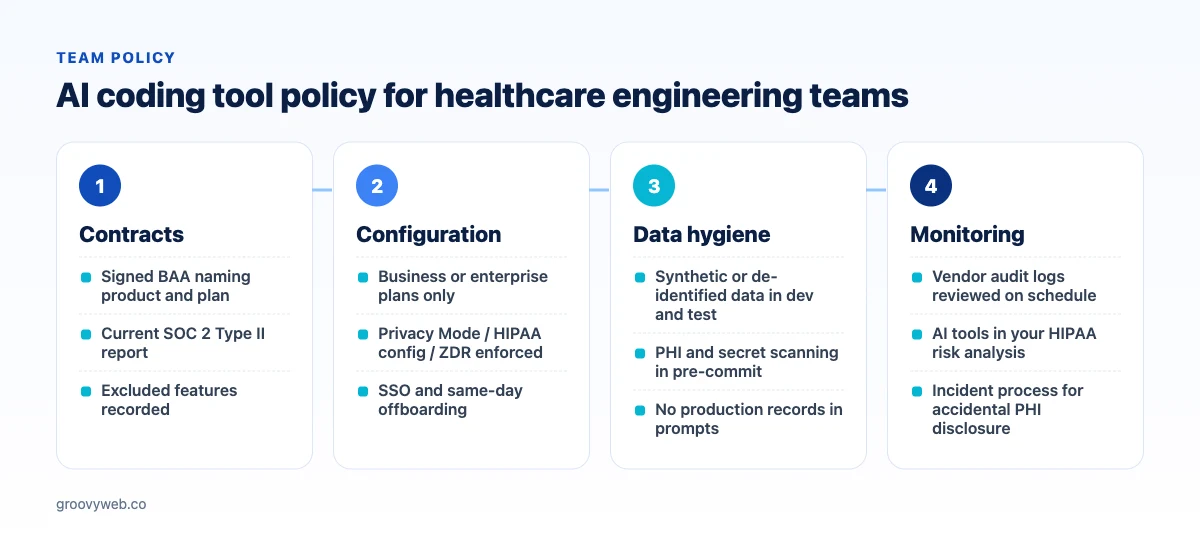
Contracts and vendor review
- [ ] Document whether each AI tool can ever receive PHI
- [ ] Get a signed BAA naming product and plan for any tool that may
- [ ] Review the vendor's current SOC 2 Type II report and exceptions
- [ ] Record the vendor's excluded features and surfaces
Configuration and access
- [ ] Business or enterprise plans only. Block personal accounts
- [ ] Enforce required settings org-wide, such as Privacy Mode, HIPAA configuration or ZDR
- [ ] Block uncovered surfaces, such as unapproved extensions, gateways and cloud agents
- [ ] Require single sign-on and same-day offboarding
- [ ] Allowlist MCP servers and connectors. None point at production PHI
Data hygiene
- [ ] Synthetic or de-identified data in all dev, test and staging environments
- [ ] PHI and secret scanning in pre-commit hooks
- [ ] Exclude data folders, exports and logs from AI indexing
- [ ] Ban pasting production records, screenshots or HL7/FHIR payloads into prompts
Monitoring and training
- [ ] Review vendor audit logs on a set schedule
- [ ] Train engineers at onboarding and yearly
- [ ] Add AI tools to your HIPAA risk analysis and re-review when terms change
- [ ] Define an incident process for accidental PHI disclosure to an AI tool
For the controls behind this list, see our healthcare security and compliance services and our guide to HIPAA-ready AI development.
How Does Groovy Web Use AI Coding Tools on Healthcare Projects?
We build healthcare software with AI Agent Teams, using a process designed to support HIPAA. The core rule: PHI never touches a developer's machine or an AI tool not covered for it.
- Synthetic data during development, so coding assistants never see real records.
- BAAs signed with our healthcare clients, and BAA coverage confirmed for production services that handle PHI.
- PHI off local machines. Production data stays in controlled cloud environments with logged, role-based access.
- US-region hosting in your cloud account, so you own the infrastructure, keys and audit trail.
- Your tool policy. If your security team mandates a tool, configuration or self-hosted assistant, we work inside it.
Our senior AI engineers work your US hours, with at least four hours of overlap with US Eastern, starting at $22/hr. Our healthcare work includes HIPPASHIELD, a HIPAA access-control and eligibility platform. To extend an existing team, see hire AI engineers for healthcare.
Key Takeaways
- No AI coding tool is HIPAA certified. Look for a BAA plus the configuration it requires.
- You need a BAA only for tools that may receive PHI. Most coding work can stay PHI-free.
- PHI leaks through debugging, test fixtures, logs, tickets and agent connectors.
- Cursor, Claude Code, OpenAI Codex and Gemini Code Assist document BAA paths on specific plans.
- GitHub Copilot, Amazon Q Developer and Tabnine do not document a BAA. Tabnine can run air-gapped.
- SOC 2 Type II shows a mature security program. It does not replace a BAA.
Frequently Asked Questions
Is there a HIPAA certification for AI coding tools?
No. HHS does not certify any product or company for HIPAA compliance, and Google and Microsoft both say so in their HIPAA documentation. A coding tool supports your compliance by signing a Business Associate Agreement and offering controls such as no-training terms, retention settings and audit logs. Your organization stays responsible for policies, risk analysis and how engineers use the tool.
Do I need a BAA if my developers never use real patient data?
No. A BAA is required when a vendor creates, receives, maintains or transmits PHI on your behalf. If dev and test environments hold only synthetic or properly de-identified data, and engineers cannot paste production records into prompts, the tool never receives PHI. Document that control in your policy and HIPAA risk analysis so auditors can see why no BAA is needed.
Is Claude Code covered by Anthropic's BAA?
It can be. Claude Code in the terminal and the Code tab of Claude Desktop is covered on a HIPAA-ready Claude Enterprise organization once the Primary Owner applies the HIPAA configuration and engineers connect directly to Anthropic. A Claude Console API key is covered only with zero data retention. IDE extensions, gateway routes, cloud sessions and MCP connectors are excluded.
Is GitHub Copilot Business safe for healthcare teams?
For PHI-free work, yes for most teams. Copilot Business and Enterprise do not use your data for AI training, and both are included in GitHub's SOC 2 Type II reports. GitHub does not publicly document a BAA for Copilot, so keep production records, logs and patient data out of prompts and repositories, and ask GitHub directly if you need written BAA terms.
Is de-identified data still PHI?
Not if it meets one of the two HHS methods. Safe Harbor removes 18 identifier categories, including names, most dates, small geographic units and record numbers, with no actual knowledge that the rest could identify someone. Expert Determination requires a qualified expert to document very small re-identification risk. Simple name masking usually leaves the data as PHI.
Is SOC 2 enough for a healthcare coding tool?
SOC 2 Type II is a good baseline because it shows a vendor's controls worked over time. It does not cover HIPAA obligations such as limits on PHI use or breach notification to you. If a tool may receive PHI, you need a BAA as well. If it never receives PHI, SOC 2 plus contractual no-training terms is usually enough.
Build Healthcare Software Without Putting PHI at Risk
Groovy Web's senior AI engineers build HIPAA-ready healthcare products with synthetic data in development, signed BAAs and US-region hosting in your own cloud account. Tell us what you are building and we will map the right tools and safeguards in a 30-minute call.
Next Steps
Need Help With HIPAA-Ready AI Development?
We help health-tech teams set up AI-assisted development that keeps PHI out of coding tools, then ship production-grade healthcare software. 200+ clients since 2015, senior engineers working your US hours.
Schedule a free consultation →
Related Services
- Healthcare Security and Compliance — HIPAA-ready architecture, access controls and audit logging
- Healthcare Data Analytics — de-identification pipelines and analytics on clinical data
- FHIR and HL7 Integration — standards-based EHR integration built on synthetic test data
Published: November 2026 | Author: Groovy Web Team | Category: Healthcare
Ship Production-Grade AI with Senior Engineers
Our AI-First engineering approach delivers production-ready applications in weeks, not months.
Hire an AI-First Engineering Team