
 Claude
Loan Origination Software: Should You Build or Buy?
Buy a configurable loan origination system if your products and rules fit a standard workflow. Build custom when your underwriting, data sources or loan products are what set you apart. Choose a hybrid when you want a vendor core and your own decision layer.
Groovy Web builds lending software for US lenders from Nadiad, Gujarat. See our lending software development work. For home loans in particular, read about custom mortgage software development, since this guide covers consumer and small-business lending.
Below: what the software must do, which rules shape the choice, and a short test for picking one of three paths.
What Does a Loan Origination System Do?
A loan origination system, or LOS, runs a loan from first application to funding. It sits before loan servicing, which handles payments and collections after the loan is made.
- Application intake and applicant communication
- Document collection and identity and income checks
- Credit and data pulls from outside sources
- Decisioning, meaning your underwriting rules and any scoring models
- Approval, decline and adverse action notices
- Closing, funding and handoff to servicing
You can buy every one of these. The real question is which ones are part of how you win.
When Does Off-the-Shelf Origination Software Work Well?
An off-the-shelf system works well when your loan products are conventional and your rules fit the vendor's configuration options. You get a working workflow sooner and shift much of the upkeep to the vendor.
It is the safer start for a small lender or a new lending line. You learn how applicants behave before you commit to code you must maintain. The cost is flexibility: you work inside the vendor's data model, release schedule and pricing.
When Does Custom Origination Software Pay Off?
Custom software pays off when a difference in your process is a business advantage a standard product cannot hold. Typical cases are unusual loan products, proprietary data sources, embedded lending inside another product, or underwriting logic you change often.
Custom also helps when you need several systems to work as one, such as origination, your bank partner and a servicing platform. The price is ownership: you carry maintenance, security and regulatory change yourself, or you pay a team to carry it with you.

Which Rules Shape the Decision?
Three sets of rules affect how flexible your software must be. None of them tells you to build or buy, but each changes what you should ask for.
| Rule | What it asks of your software | Question to ask |
|---|---|---|
| Regulation B adverse action | Statement of specific, principal reasons for a decline, sent within the required window | Can the system produce specific reasons from each decision, including model-based ones? |
| Small business lending data rule (Section 1071) | Collection and reporting of small business application data, on dates that have shifted with litigation | Can the system add data fields and reports without a rebuild? |
| Interagency third-party guidance | For banks, risk management of vendors across the relationship life cycle | Will the vendor or team support due diligence, monitoring and exit? |
Under Regulation B, section 1002.9, the statement of reasons for adverse action must be specific and indicate the principal reasons. The same section sets a 30 day window after a completed application for notifying the applicant of action taken.
The CFPB's page on Small Business Lending Under the Equal Credit Opportunity Act (Regulation B) notes that compliance dates were extended by interim final rules in June 2024 and June 2025, in light of court orders in ongoing litigation. Confirm the current date before you freeze requirements.
For banks and bank partners, OCC Bulletin 2023-17 on third-party relationships says risk management should be commensurate with the bank's risk profile and complexity, and that not every relationship carries the same risk or criticality.
Loan Origination Software: How Do Build, Buy and Hybrid Compare?
| Buy an LOS | Hybrid | Build custom | |
|---|---|---|---|
| Best for | Conventional products and standard workflows | A vendor core with your own decisioning and integrations | Differentiated products, data or underwriting |
| Speed to first loan | Fastest | Moderate | Slowest |
| You control | Configuration within the vendor's limits | Decision logic, data and integrations | Everything, including the data model |
| Main risk | Lock-in and limited change | Integration design and ownership of the seam | Maintenance and regulatory change on you |
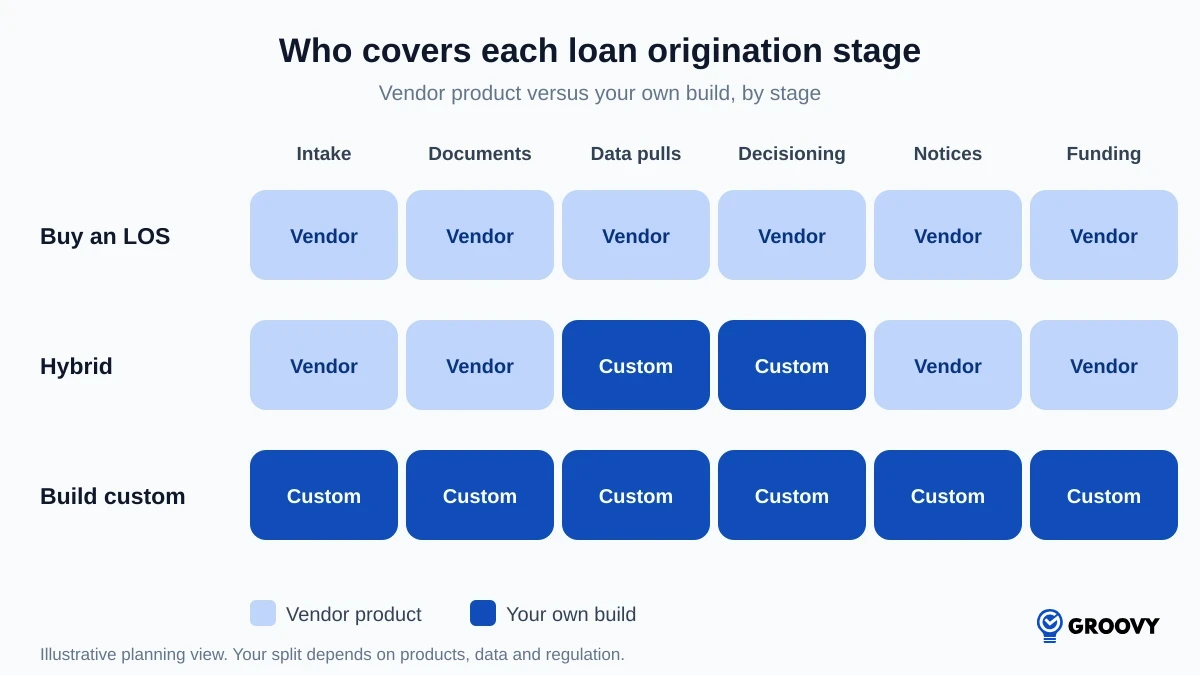
The hybrid path is where many lenders land. A vendor handles intake, documents and servicing handoff, while your team owns the decisioning layer that reflects how you underwrite.
Which Option Costs Less?
Neither one is always cheaper. Buying shifts cost to licenses, per-loan or per-seat fees and customization limits. Building shifts cost to design, build, security and upkeep. No single number fits every lender, because scope, volume and integrations decide the total.
Compare total cost over several years, not the first invoice. Ask each option to price integrations, reporting changes and regulatory updates as separate lines. Our guide to custom mortgage software shows how those lines look for home lending.
What Should You Ask a Vendor or a Development Team?
- Can the system produce specific decline reasons for every decision, including model-based ones?
- Can we change rules and fields without a code release?
- Who owns our data, and how do we export it if we leave?
- Which data sources connect today, and how are new ones added?
- What audit trail exists for each decision and each rule change?
- What happens to the price when volume, products or states change?
Groovy Web builds decision layers and integrations on top of lending platforms and as standalone systems. We ask these same questions first, because the answers decide whether to buy, hybrid or build.
Which Option Fits Your Lending Business?
Choose an off-the-shelf LOS if:
- Your loan products are conventional and your rules fit standard configuration
- You are a small lender or a new lending line and need to launch sooner
- You prefer the vendor to carry upkeep and updates
Choose a hybrid if:
- A vendor core covers intake and documents, but your decisioning is your own
- You need to connect several data sources, partners or servicing platforms
- You want to keep the option to replace the core later
Choose a custom build if:
- Your products, data or underwriting are the source of your advantage
- You embed lending inside another product and need full control of the flow
- You can fund maintenance, security and regulatory change over the long term
Bottom line: Buy what is standard, build what makes your lending different, and keep a clear line between the two. Before you sign anything, check that the system can give specific decline reasons, change rules without a rebuild and let you export your data.
FREE · 30 MINUTES · NO OBLIGATION
Tell us your loan products, volume and data sources. A senior engineer will help you choose a path and plan the build.
Frequently Asked Questions
What is a loan origination system?
A loan origination system, or LOS, runs a loan from first application to funding. It covers intake, document collection, credit pulls, decisioning, approval or decline notices, closing and handoff to servicing. It sits before servicing software, which handles payments and collections afterward.
Should a small lender build its own loan origination system?
Usually not at first. A configurable system gets you to market sooner and shows how applicants behave. Build custom decisioning or integrations later if your underwriting or data needs outgrow what the vendor allows.
What is the difference between a loan origination system and loan servicing software?
An origination system runs the loan from application to funding. Servicing software takes over after funding to handle payments, statements and collections. Many lenders use separate products for each and connect them.
Does AI underwriting change adverse action rules?
No. Regulation B still requires a statement of specific reasons that indicates the principal reasons for a decline. If a model drives the decision, the system must still be able to produce reasons an applicant can understand.
Does the Section 1071 rule apply to my lending?
It concerns small business credit data collection and reporting, and its compliance dates have moved with litigation. Whether it applies to you depends on your size and lending, so confirm with counsel and check the CFPB's current dates.
Do banks have to manage the risk of their software vendors?
Federal banking agencies expect risk management across the life cycle of third-party relationships, scaled to the bank's risk profile and the vendor's criticality. A vendor or development team should support due diligence and monitoring.
Can an India-based team build regulated lending software?
Yes, if the team works inside your compliance program and keeps the records you need. Ask for sample documentation, named engineers, data location terms and how audit trails are tested before you sign.
Want a Lending Build Scoped by Path?
Groovy Web builds lending software and can scope the work once you know whether to buy, hybrid or build. Tell us your products, volume and data sources, and we will tell you what to confirm first.
Related Services
Further Reading
Ship Production-Grade AI with Senior Engineers
Our AI-First engineering approach delivers production-ready applications in weeks, not months.
Hire an AI-First Engineering Team