
 Claude
Should You Build Your Own Payment Gateway or Use a Processor API?
Use a processor API unless moving money is your product. Build your own payment gateway only if you must handle card data or hold funds yourself, and hire a team when you need a custom layer on top of a processor.
Each step toward building your own payment gateway adds security, card network and licensing duties.
Groovy Web builds payment software for US and global clients from Nadiad, Gujarat. Check out our payment gateway software development work, or read our overview of payment gateway development first.
Below, we cover the three paths, what each one puts on your plate, and a short test for choosing.
What Does "Build a Payment Gateway" Actually Mean?
The phrase covers three very different projects. Teams often price one and mean another, so quotes for a payment gateway vary widely.
- Processor API: you collect payments through a provider's hosted fields or checkout, and the provider handles card data and settlement.
- Your own gateway or payment facilitator: you handle card data, contract with merchants and direct settlement yourself, under an acquirer's sponsorship.
- Custom layer on a processor: you hire a team to build checkout, routing, ledger, payouts and reporting on top of one or more processors.
Most products need the first or third path. The second isn't just a software project. It's a regulated business line.
When Is a Processor API Enough?
A processor API is enough when payments are a feature of your product, not the product itself.
If you sell goods, services or subscriptions and just want to accept cards and bank payments, you don't need to own card data or settlement.
Stripe's integration security guide notes that many business models do not need to handle sensitive card data. They can use a low risk integration that sends payment details straight to the provider, without passing through the merchant's servers, which reduces PCI obligations.
You still own the checkout flow, order logic and customer experience. You don't own the rails, so fees and features follow the provider's terms.
Building Your Own Payment Gateway Puts PCI Scope on Your Team
Handling card data yourself moves your team out of the lightest compliance tier. Stripe's guide warns that a business handling sensitive card data directly might need to meet more than 300 PCI DSS security controls, plus dedicated security software and hardware and outside auditors.

The PCI Security Standards Council describes the lightest tier, Self-Assessment Questionnaire A, as covering merchants whose account data functions are completely outsourced to PCI DSS validated third parties. The PCI SSC notice on updates for merchants validating to SAQ A also added an eligibility check that a merchant's site is not open to script attacks.
Build your own gateway and that outsourced position is gone. Your team, hosting and code all fall inside the assessment.
Card Data Handling by Path
| Path | Who touches card data | What you carry |
|---|---|---|
| Processor API with hosted fields | The processor | The lightest validation tier, if account data functions are fully outsourced |
| Custom layer on a processor | The processor, if the design keeps card data off your servers | Your own app security and the integration design |
| Your own gateway or payment facilitator | You | Full PCI DSS scope, card network registration and merchant risk |
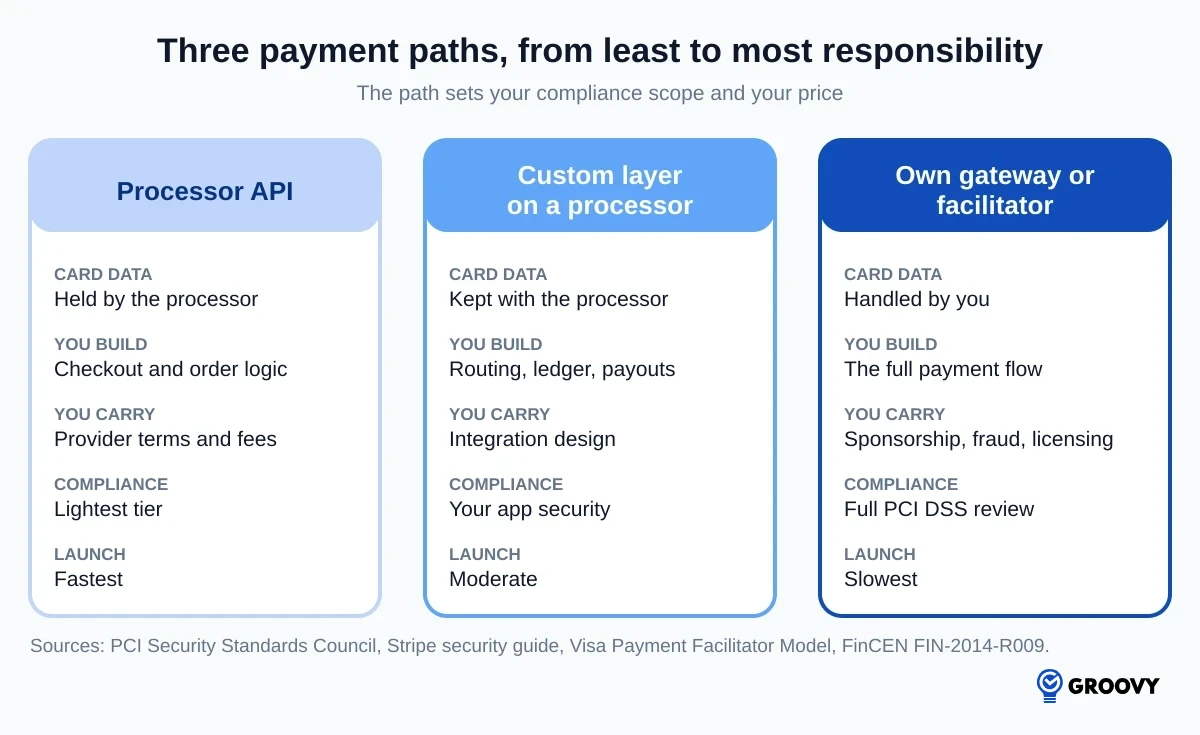
The middle row is where a hired team adds the most value. A good design keeps card data with the processor and still gives you your own checkout, ledger and reporting.
What Card Network Rules Apply if You Run a Payment Facilitator?
Visa's payment facilitator model explains that a payment facilitator contracts with an acquirer to provide Visa payment services to sponsored merchants, and receives and directs settlement of proceeds on their behalf. The acquirer must register the facilitator with Visa after a risk and financial review.
The same Visa Payment Facilitator Model says the acquirer monitors the facilitator and is responsible for the acts of both the facilitator and its sponsored merchants. It also notes that sponsored merchants may need to sign a direct merchant agreement with an acquirer, depending on annual Visa sales volume.
That sponsorship means you need an acquiring bank willing to back you. It's a business and risk decision as much as a technical one.
Money Transmitter Licenses: Not Always Required
Not always. FinCEN's ruling FIN-2014-R009 explains that a payment processor can avoid money transmitter status if it meets four conditions of the payment processor exemption.
The conditions are that the entity facilitates the purchase of goods or services or the payment of bills, operates through clearance and settlement systems that admit only BSA-regulated financial institutions, acts under a formal agreement, and has that agreement at least with the seller or creditor that receives the funds.
The ruling also says a business that disburses funds outside such a system can't claim the exemption. State rules vary, so confirm your model with counsel before you design settlement flows.
Payment Gateway Paths Side by Side
| Processor API | Custom layer on a processor | Own gateway or facilitator | |
|---|---|---|---|
| Best for | Products where payments are a feature | Marketplaces, platforms and multi-processor products | Companies whose business is payments |
| Speed to launch | Fastest | Moderate | Slowest |
| You control | Checkout and order logic | Checkout, routing, ledger, payouts, reporting | The full payment flow |
| Main risk | Provider terms and fees | Integration design and reconciliation | Compliance, sponsorship and fraud losses |
Price follows the path, not the label. No single number fits every project, so we scope each payment gateway build by path first.
When Should You Hire a Team Instead?
Hire a team when a processor API isn't enough but a full gateway is more than you need. Typical reasons are routing across several processors, a ledger that records every movement of money, split payments, payouts and reconciliation that matches your finance process.
Groovy Web builds these layers on top of established processors. Ask any team to show how the design keeps card data with the processor, how it handles retries and duplicate payments, and how reconciliation is tested before launch.
Already know you need a custom layer? Tell us how money moves in your product and we'll tell you what to confirm before you ask for prices.

Which Path Should You Choose?
Choose a processor API if:
- Payments are a feature of your product, not the product
- You want the lightest PCI burden and the fastest launch
- Standard checkout, subscriptions and refunds cover your needs
Choose a custom layer on a processor if:
- You need routing, a ledger, split payments or payouts
- You want to switch or add processors without rebuilding checkout
- You need reconciliation that matches your finance process
Choose to build your own gateway or facilitator if:
- Payments are your core business and you will onboard other merchants
- You have an acquiring bank willing to sponsor you
- You can fund compliance, fraud monitoring and legal review
Bottom line: Start with a processor API, add a custom layer when your product outgrows it, and build your own gateway only when payments are the business. Decide the path before you ask for a quote, because the path sets the compliance scope and the price.
FREE · 30 MINUTES · NO OBLIGATION
Tell us how money moves in your product. A senior engineer will help you pick a path and plan the build.
Frequently Asked Questions
Is it worth building your own payment gateway?
Only when payments are the business. It can make sense if you will onboard other merchants, have an acquiring bank willing to sponsor you, and can fund PCI scope, fraud monitoring and legal review. For most products, a processor API costs less effort and risk.
Should a startup build its own payment gateway?
Rarely. Unless payments are your product, a processor API is faster and keeps card data off your systems. Build a custom layer later if routing, a ledger or payouts become hard requirements.
What is the difference between a payment gateway and a processor?
A gateway securely passes payment details from checkout to the processor and returns the result. The processor works with the card networks and banks to authorize and settle the payment. Many providers bundle both.
Does using a processor remove my PCI duties?
No, it reduces them. PCI compliance is a shared responsibility. If account data functions are fully outsourced to validated providers, you may qualify for the lightest self-assessment, but you still attest annually and keep your own site secure.
What is a payment facilitator?
A payment facilitator contracts with an acquirer to provide card payment services to sponsored merchants and directs settlement on their behalf. The acquirer registers the facilitator with the card network and stays responsible for its conduct.
Do I need a money transmitter license?
It depends on how funds flow. A payment processor can fall outside money transmitter rules if it meets FinCEN's four exemption conditions, but state rules differ. Have counsel review your settlement design before you build.
How long does it take to build a custom payment layer?
It depends on scope, processors and reconciliation needs, so no honest single timeline fits every project. Ask for a plan that separates integration, ledger, payouts and testing, with a clear launch scope.
Want a Payment Build Scoped by Path?
Groovy Web builds payment software and can scope the work once you know your path. Tell us how money moves in your product and we will tell you what to confirm before you ask for prices.
Related Services
Further Reading
Ship Production-Grade AI with Senior Engineers
Our AI-First engineering approach delivers production-ready applications in weeks, not months.
Hire an AI-First Engineering Team