
 Claude
Medical Billing Software Development: Should You Build or Buy?
Buy when your specialty, payers and workflow match what established billing products already do. Choose medical billing software development when your rules, volume or product depend on logic those tools cannot express. Many teams buy claim transport and build the workflow around it.
Billing usually sits next to scheduling and registration, so start by mapping how it connects to your practice management software.
This guide covers the claim lifecycle, the standards your code must speak, the layers worth building, and the questions to settle before anyone writes code.
What Does Medical Billing Software Have to Do?
It moves one encounter from documented care to money in the bank. Each stage has its own data, its own failure modes and, in several cases, its own required electronic format.
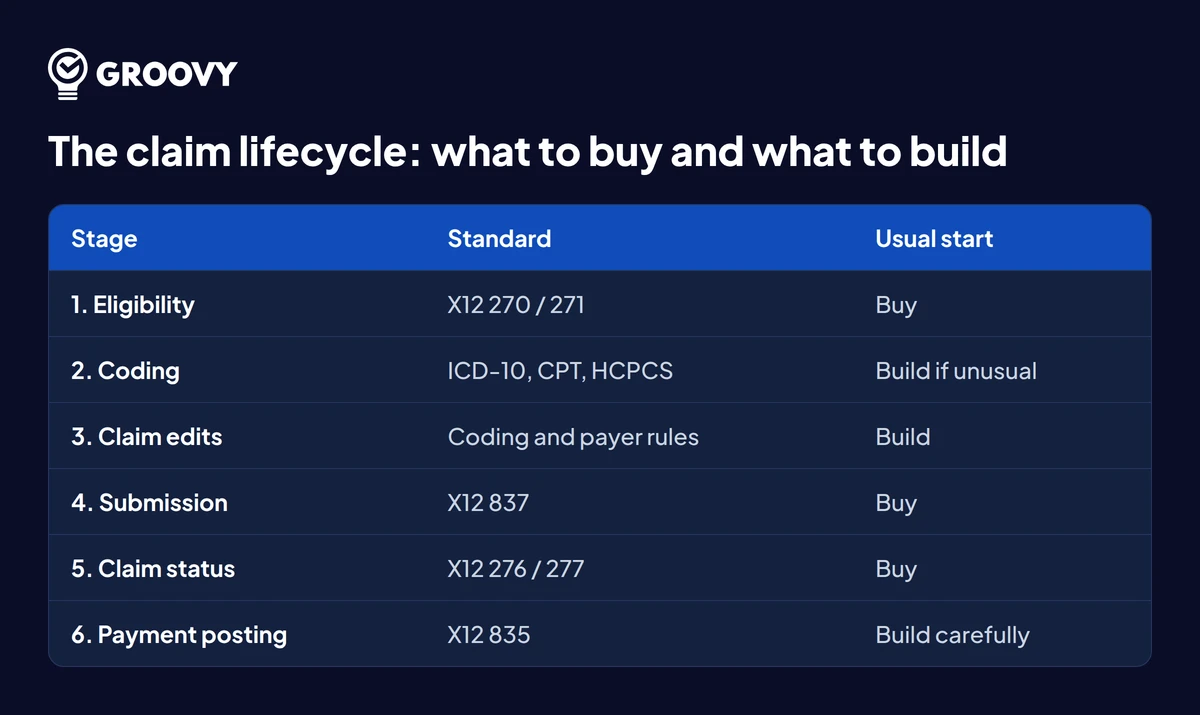
| Stage | Standard transaction or code set | What your software must keep | Usual starting point |
|---|---|---|---|
| Eligibility check | X12 270 request, 271 response | Coverage answer, date checked, payer response | Buy the connection |
| Charge capture and coding | ICD-10, CPT, HCPCS | Source note, codes, who approved them | Build if workflow is unusual |
| Pre-submission edits | Correct coding edits and payer rules | Rule fired, override, reason | Build your own rules layer |
| Claim submission | X12 837 professional or institutional | Exact file sent and its acknowledgment | Buy transport |
| Claim status | X12 276 request, 277 response | Status history by claim | Buy the connection |
| Remittance | X12 835 | Raw file, parsed lines, posting result | Build posting logic carefully |
| Denials and follow-up | Adjustment and remark codes | Owner, deadline, appeal record | Build if it is your pain point |
Abbreviations used above: ICD-10 is the International Classification of Diseases, 10th revision. CPT means Current Procedural Terminology and HCPCS is the Healthcare Common Procedure Coding System.

Which Transaction Standards Apply to Claims?
The Health Insurance Portability and Accountability Act (HIPAA) names the formats. According to CMS guidance on adopted transactions, covered entities that send claims, claim status or remittance advice electronically must use the adopted ASC X12N or pharmacy standards.
CMS is the Centers for Medicare and Medicaid Services. The versions are written into regulation, and 45 CFR 162.1102 lists the claim standards with their effective periods, including dated changes that begin in 2027. Check that section before you fix a version in your design.
HHS also adopted claims attachment and electronic signature standards in a rule effective May 26, 2026. If your payers request clinical documents, read its compliance dates and leave room for attachments in your data model.
Build vs Buy: Which Layers Are Worth Owning?
Treat billing as layers, not one product. Claim transport is regulated plumbing that clearinghouses already run. Your rules, work queues and reporting are where one organization differs from another.
| Layer | Buy when | Build when |
|---|---|---|
| Payer connectivity | A clearinghouse covers your payers | You have a direct payer link you must keep |
| Coding support | General suggestions are enough | Your specialty needs its own review rules |
| Claim edits | Standard edits catch most errors | Denials trace to rules only you know |
| Payment posting | Remittances post cleanly | Contracts or splits break the default logic |
| Work queues | Teams can adopt the vendor flow | Routing and priority are your advantage |
| Reporting | Canned aging reports answer questions | You sell or depend on custom analytics |
Procedure codes carry a licensing duty too. CPT is owned by the American Medical Association, so confirm CPT licensing terms before your product stores or displays code descriptions.
How Should the Claim Edit Engine Work?
Edits stop bad claims before a payer sees them. Medicare publishes its National Correct Coding Initiative edits, which are one public input. Your payer contracts and specialty rules are others.
Keep rules as versioned data, not code buried in screens. Each rule needs an owner, an effective date, a test claim and a clear message that tells a biller what to fix.
Diagnosis codes change on a published cycle, so load ICD-10 code releases by effective date. A claim must be validated against the set that applied on the date of service.
AI suggestions can help a coder work faster, but a person should approve what goes on the claim. See how we approach AI medical coding with a coder in the loop.
What Makes Payment Posting and Denials Hard?
The 835 remittance rarely maps one to one onto your ledger. One payment can cover many claims, adjust some lines, reverse earlier ones and move a balance to the patient.
Store every outbound 837 and every inbound acknowledgment and 835 exactly as exchanged, beside your parsed records. When a number is disputed, the raw file shows what was really sent and received.
Design these cases before the first demo:
- A payment that arrives for a claim your system cannot match
- A reversal and correction in the same remittance
- A secondary payer that needs the primary result attached
- A resubmission that must not create a duplicate claim
- A posted batch that someone needs to undo, with a record of who did it
What Does HIPAA Require From Billing Software?
Billing data is protected health information (PHI). The Security Rule's technical safeguards in 45 CFR 164.312 cover access control, audit controls, integrity, authentication and transmission security. Unique user identification is required.
Any vendor that handles PHI for you needs a business associate agreement (BAA), with terms set out in 45 CFR 164.504. That includes your clearinghouse, your cloud host and your development partner if they can see live data.
Patient card payments bring a second standard. Review the Payment Card Industry Data Security Standard and keep card numbers with a payment processor so your system never stores them. Our page on healthcare security and compliance explains how we split these duties.
What Drives the Cost of Medical Billing Software?
Scope drives cost more than screens do. Ask for an estimate broken down by these items, because a single total hides where the risk sits.
- Number of payers, clearinghouses and companion guides to test
- Professional, institutional or both claim types
- How many systems feed charges in, and how clean their data is
- Contract and fee schedule rules to model
- Historical data to migrate, including open balances
- Upkeep for code releases, standard versions and payer changes
Plan upkeep from the start. A billing system that is not updated starts producing denials, so name the person who owns code and rule updates before launch.
How Should a First Release Be Scoped?
Start with one specialty, one claim type and a small set of payers. Prove that a claim goes out, comes back and posts correctly. Then widen.
Run the new flow beside your current process on real volumes. Compare rejected claims, posting mismatches and time spent per claim. Switch over when the numbers hold, with a written way back.

What Should You Ask Before You Sign?
- Which payers and transaction types have you tested end to end?
- Where are raw transaction files stored, and for how long?
- Who updates code sets and edits, and how fast after a release?
- Will you sign a BAA, and which subcontractors can see PHI?
- Who owns the source code, the rules and the data when the contract ends?
Which Billing Route Fits Your Team?
Choose to buy a billing product if:
- Your specialty and payer mix are common
- Your team can adopt the vendor's workflow
- You want the vendor to carry standard and code updates
Choose a hybrid build if:
- Clearinghouse transport works but your workflow does not
- Denials trace to rules a product cannot express
- You want your own queues and reporting on top of bought connections
Choose to build custom if:
- Billing logic is part of the product you sell
- You serve many practices with different contracts
- You can fund ongoing code, rule and payer maintenance
Bottom line: Buy claim transport unless you have a strong reason not to. Build the rules, queues and posting logic that make your billing different, keep every raw transaction, and name an owner for updates before launch.
FREE · 30 MINUTES · NO OBLIGATION
Share your current billing tools and the step that slows you down. A senior engineer will help you decide what to buy and what to build.
Frequently Asked Questions
What is medical billing software development?
It is the design and build of software that turns documented care into claims, submits them in standard electronic formats, posts payments and denials, and tracks open balances. It usually connects to an electronic health record, a clearinghouse and a payment processor.
Do I need a clearinghouse if I build my own billing software?
Often, yes. A clearinghouse handles payer connections and transmission, so your team can focus on workflow and rules. Direct payer connections are possible, but each one needs its own testing and upkeep.
Which electronic formats does billing software use in the United States?
Common ones are the X12 837 claim, the 835 remittance, the 270 and 271 eligibility pair, and the 276 and 277 claim status pair. Confirm the versions in force under 45 CFR part 162 before you design.
Can AI handle medical coding on its own?
It can suggest codes from clinical notes, but a qualified person should review and approve them. Keep the note, the suggestion, the final code and the reviewer, so any claim can be explained later.
Who owns the data in a custom billing system?
Ownership comes from your contract. Write down who owns source code, rules and billing data, how you get a full export, and what happens to protected health information when the agreement ends.
Ready to Scope Your Billing Software?
Tell us your payers, your claim volume and where your team loses time. We will help you decide what to buy, what to build and what to confirm with your clearinghouse first.
Related Services
Further Reading
Ship Production-Grade AI with Senior Engineers
Senior engineers working with AI Agent Teams deliver production-ready applications in weeks, not months.
Hire Senior AI Engineers