
 Claude
White-Label vs Custom Telehealth Software: What Are Your Options?
White-label vs custom telehealth software comes down to what you are selling. Buy a platform to test demand, license white-label software to launch under your own brand, and build custom when your workflow, integrations or data ownership are the product.
Each route trades speed for control. The right one depends on your stage, not on which option sounds most advanced.
Groovy Web builds custom telehealth software for healthcare teams. If you are still mapping the basics, start with our telemedicine app development guide, then return here to choose a route.
Below: a side-by-side comparison, where HIPAA contracts and FDA rules change the choice, and the questions to put to any vendor before you sign.
What Does Each Telehealth Route Actually Mean?
A platform is software you subscribe to and use as it is, under the vendor's brand and rules. White-label software is built and maintained by a vendor, and you present it under your own name with limited changes.
Custom software is built for your workflow and owned or licensed on your terms. The difference that matters is who controls the roadmap, the data model and the integrations once you have patients on it.
How Does White-Label Telehealth Compare With a Custom Build?
| Platform | White-label | Custom | |
|---|---|---|---|
| Launch speed | Fastest | Fast | Slowest at the start |
| Your branding | Vendor's, with limited changes | Yours, within the vendor's template | Fully yours |
| Workflow fit | You adapt to the product | Some configuration | Built around your care model |
| EHR and system integration | What the vendor already supports | Vendor roadmap or paid add-ons | Scoped to your systems |
| Data and code control | Vendor holds both | Vendor holds the code, you need data terms | You decide, by contract |
| Cost shape | Recurring fees | Setup plus recurring fees | Build cost, then maintenance |
| Leaving later | Export what the vendor allows | Rebrand and migrate patients | You keep what the contract gives you |
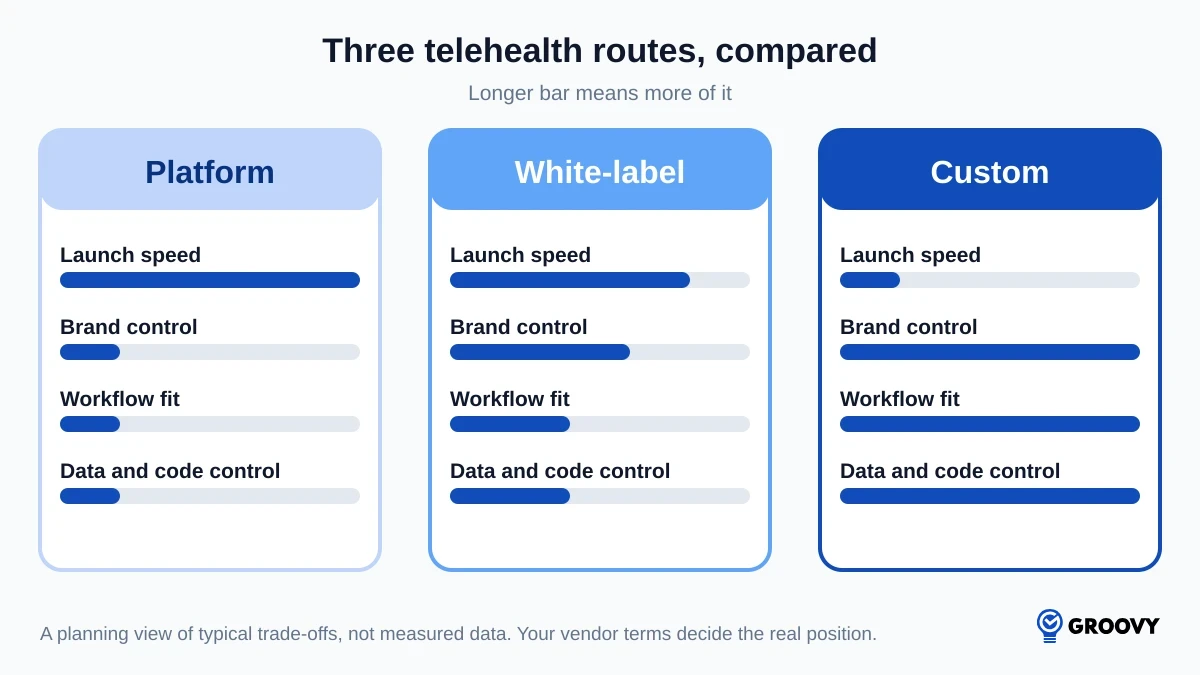
Treat the table as a map of trade-offs, not a ranking. A platform can be the right permanent answer for a small practice. Custom can be the wrong first step for a team that has not proven demand.
A quick test helps. List the five workflows your clinicians cannot work without. If a vendor's template covers all five without paid changes, white-label is probably enough. If two or more sit outside it, get a custom quote before you commit.
Do You Need a Business Associate Agreement With Each Option?
If a vendor creates, receives, maintains or transmits protected health information for you, it is a business associate under 45 CFR 160.103. That holds for a platform, a white-label vendor and a custom build team that touches patient data.

The contract must follow 45 CFR 164.504, which lists what a business associate contract has to include. Use it as the minimum when you compare vendor paper.
| Contract term | Why it matters for telehealth |
|---|---|
| Permitted uses and disclosures of PHI | Limits what the vendor may do with visit data |
| Safeguards for electronic PHI | Sets the security duty for video, chat and records |
| Reporting of unauthorized uses and breaches | Decides how fast you hear about a problem |
| Subcontractors agree to the same limits | Covers hosting, video and messaging providers behind the vendor |
| Return or destruction of PHI at the end | Decides how you leave the vendor |
A vendor that will not sign a business associate agreement is not an option for patient data. Read the subcontractor and return or destruction terms closely, because they shape your exit.
When Does Telehealth Software Become a Medical Device?
Video visits, scheduling and messaging usually have no medical purpose of their own. Features that analyse symptoms, images or readings to support diagnosis or treatment can. The FDA describes Software as a Medical Device as software intended for a medical purpose that does not need a hardware device to do it.
That rule applies to every route. Buying a platform does not hand the regulatory duty to the vendor, because you still own the product patients see. Our three question test for SaMD vs embedded software helps you classify a feature before you commit to a route.
What Does Each Route Cost Over Time?
No single number fits every telehealth product, so be wary of any quote that gives one without asking about your workflow. What differs is the shape of the cost, and that shape matters more than the first invoice.
- Platform: recurring fees that grow with seats, visits or modules
- White-label: a setup cost plus recurring fees, and paid work for changes outside the template
- Custom: a build cost, then maintenance, hosting, security reviews and a team to change it
Compare the total over the period you expect to run the product, and include the cost of integrations and of leaving. Our telehealth vs telemedicine guide explains the care models behind these costs.
How Hard Is It to Leave Each Option?
Switching is easiest when you ask about it before you sign. On a platform, you can usually export what the vendor lets you export, so confirm the formats. With white-label, you rebrand and migrate patients to a new system.
With custom software, you own what the contract says you own, so write down code, data and documentation rights. Ask every vendor for a written exit plan, and check it against the return or destruction terms of the business associate agreement.

What Should You Ask Any Telehealth Vendor Before You Sign?
- Will you sign a business associate agreement, and who are your subcontractors?
- Where is visit data stored, and how do I export it in a usable format?
- Which EHR and billing systems do you connect to today, and which are on a roadmap only?
- What changes can I make without paying for custom work?
- Who owns the code, the patient data and the integrations if we part ways?
- Which features could count as a medical device, and who carries that duty?
Get the answers in writing, because a demo shows you the best day of the product. A vendor that is vague on data export or subcontractors is showing you how leaving will go.
Which Telehealth Route Fits Your Product?
Choose a platform if:
- You are still proving that patients and clinicians will use video visits
- Your workflow is standard and you can adapt to the product
- You need to be live fast, and a vendor business associate agreement is in place
Choose white-label software if:
- Your brand and patient experience matter, but your workflow is close to standard
- You want to launch sooner than a build allows
- You have agreed data export and exit terms in writing
Choose custom software if:
- Your care model, integrations or data ownership are part of what you sell
- You need EHR, billing or device connections that vendors do not offer
- You have clinical and compliance owners ready to run the product after launch
Bottom line: Start with the lightest route that proves demand, and move to custom only when your workflow or data ownership demands it. Get the business associate agreement, the export terms and the device question settled before you pick a vendor.
FREE · 30 MINUTES · NO OBLIGATION
Tell us your care model and the systems you must connect. A senior engineer will help you pick a route and plan the build.
Frequently Asked Questions
What is the difference between white-label and custom telehealth software?
White-label software is built and maintained by a vendor, and you present it under your own brand with limited changes. Custom software is built around your workflow and integrations, and you control the roadmap and data model, by contract. The trade is launch speed against control.
Is white-label telehealth software cheaper than building custom?
It often costs less at the start, because the vendor has already built the product. Over several years, recurring fees, paid changes and migration costs can close the gap. Compare the total for the period you plan to run it.
Does a telehealth platform need a business associate agreement?
Yes, if the vendor creates, receives, maintains or transmits protected health information for you. The contract must follow 45 CFR 164.504, including safeguards, breach reporting, subcontractor limits and the return or destruction of PHI at the end.
Can I start on a platform and move to custom later?
Yes, and many teams do. Keep your patient data, call flows and requirements in formats you control, and write the export terms into the first contract. Moving is far easier when you plan it from day one.
Is telehealth software regulated by the FDA?
Not automatically. Video visits and scheduling usually have no medical purpose. Features that analyse symptoms or images to support diagnosis can be Software as a Medical Device, so confirm each feature with a regulatory expert.
What should a custom telehealth build include first?
Start with the visit flow, identity and consent, secure messaging and the one integration your clinicians need most. Add AI triage, monitoring and analytics later, once the core flow is in daily use.
Can an India-based team build custom telehealth software for US patients?
Yes, if the team works under a business associate agreement, keeps access to patient data tightly controlled and agrees US-hours support. Ask for named engineers, data location terms and sample documentation before you sign.
Not Sure Which Telehealth Route Fits?
Groovy Web builds custom telehealth software and can help you decide whether you need it. Tell us your care model and the systems you must connect, and we will tell you what to confirm before you choose.
Related Services
Further Reading
Ship Production-Grade AI with Senior Engineers
Our AI-First engineering approach delivers production-ready applications in weeks, not months.
Hire an AI-First Engineering Team